
Serious vs Non-Serious Adverse Events: When to Report in Clinical Trials
 Aug, 24 2026
Imagine you are a research coordinator on a Tuesday afternoon. A participant calls you, distressed, saying they have a headache so bad they can't see straight. Your first instinct? It sounds severe. But is it serious? If you get this wrong, you either waste the IRB's time with an unnecessary report or miss a critical safety signal that could halt a trial. This distinction is the single most common pain point in clinical safety monitoring, and getting it right is less about medical intuition and more about applying specific regulatory criteria.
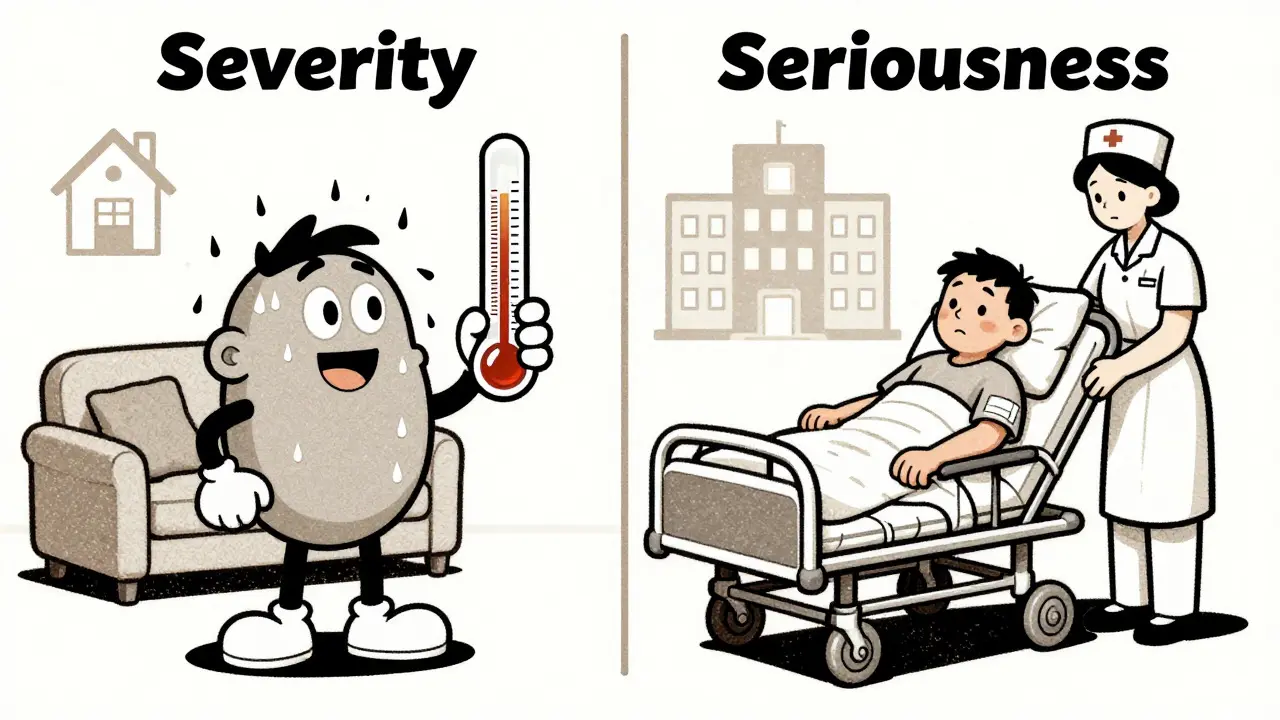
The confusion stems from language. In everyday talk, "severe" and "serious" mean the same thing. In clinical trials, they are completely different categories. One describes how intense a symptom feels; the other describes what happened to the patient as a result. Mastering this difference ensures you meet FDA and ICH requirements without drowning your team in paperwork.
Key Takeaways
- Seriousness is defined by patient outcome (death, hospitalization), not symptom intensity.
- Severity refers to the magnitude of the event (mild, moderate, severe) and does not trigger expedited reporting alone.
- Sponsors must report unexpected serious adverse reactions to the FDA within 7 days if life-threatening, or 15 days otherwise.
- Investigators must notify sponsors of any serious adverse event within 24 hours, regardless of causal relationship.
- Using the Common Terminology Criteria for Adverse Events (CTCAE) helps standardize severity grading but does not replace seriousness checks.
Defining the Core Concepts: Seriousness vs. Severity
To navigate reporting rules, you first need to untangle two terms that are often used interchangeably in casual conversation but distinct in regulatory frameworks. The International Council for Harmonisation (ICH) established these definitions in its E2A guideline, which serves as the global standard for clinical safety data management.
Adverse Event (AE) is any unfavorable medical occurrence in a patient administered a pharmaceutical product, whether or not considered related to the treatment. This broad category includes everything from a minor rash to a heart attack. Not every AE requires immediate action, but all must be recorded.
Within this broad category, we distinguish between severity and seriousness.
- Severity (Intensity): This describes how strong the symptoms are. An AE can be mild, moderate, or severe. For example, a "severe headache" means the pain is intense, but if the patient goes home and takes ibuprofen, it is still just a severe AE, not necessarily a serious one.
- Seriousness (Outcome): This describes the consequence of the event. An AE is serious if it leads to specific outcomes like death, hospitalization, or disability. A "mild fever" that results in a 3-day hospital stay for observation is technically a serious adverse event because of the outcome, even though the initial symptom was mild.
Dr. Robert Temple, former FDA Deputy Center Director, noted that confusing these two concepts remains one of the most persistent errors in safety reporting. It leads to a paradox: over-reporting non-actionable events while under-reporting truly critical ones. To avoid this, always ask: "Did something happen to the patient's status?" rather than "How bad did it feel?"
The Six Criteria That Make an Event Serious
So, when exactly does an adverse event cross the line into "serious" territory? The U.S. Food and Drug Administration (FDA) and the ICH outline six specific criteria. If an AE meets any one of these, it is classified as a Serious Adverse Event (SAE).
| Criterion | Definition | Example |
|---|---|---|
| Death | Patient dies from any cause during the study. | Cardiac arrest leading to death. |
| Life-Threatening | Risk of immediate death at the time of occurrence. | Anaphylactic shock requiring epinephrine. |
| Hospitalization | Requires inpatient admission or prolongation of existing stay. | Admitted for IV antibiotics due to infection. |
| Disability | Persistent or significant incapacity. | Stroke resulting in permanent arm weakness. |
| Congenital Anomaly | Birth defect in offspring. | Fetal malformation observed after maternal exposure. |
| Important Medical Event | May jeopardize patient and require intervention to prevent permanent damage. | Seizure requiring anti-epileptic medication adjustment. |
Note the nuance in the "Hospitalization" criterion. If a patient visits the emergency room for four hours, receives treatment, and is discharged home, it is generally not considered hospitalization unless the protocol specifically defines ER visits as serious. However, if they are admitted for overnight observation, it qualifies. This ambiguity is why clear protocol language is vital.
Reporting Timelines: Who Tells Whom and When?
Once you have identified a Serious Adverse Event, the clock starts ticking. Reporting timelines are strict and vary depending on who is doing the reporting. Getting these dates wrong can lead to regulatory findings during audits.
Investigator to Sponsor
According to 21 CFR 312.64(b), investigators must report SAEs to the sponsor "immediately." In practice, this is universally interpreted as within 24 hours of the investigator learning about the event. Crucially, this applies regardless of whether you think the drug caused the event. You do not need to determine causality before reporting; you only need to determine seriousness.
Sponsor to Regulatory Authorities (FDA)
The sponsor has a heavier burden. They must report unexpected serious adverse reactions to the FDA. The timeline depends on the nature of the event:
- Life-threatening or fatal: Must be reported within 7 calendar days.
- All other serious unexpected adverse reactions: Must be reported within 15 calendar days.
What counts as "unexpected"? It means the reaction was not listed in the Investigator's Brochure or the package insert at the time of the event. If a trial drug is known to cause nausea, and a patient gets nausea, it is expected. No expedited report is needed. But if that same patient gets liver failure, which wasn't a known risk, it is unexpected and triggers the 15-day clock.
Non-Serious Adverse Events
For non-serious AEs, there is no federal mandate for immediate reporting to the FDA or IRB. These are typically captured in Case Report Forms (CRFs) and summarized in periodic reports. Depending on the Data Safety Monitoring Board (DSMB) plan, these might be reviewed monthly or quarterly. The key here is consistency: if the protocol says "report all Grade 2+ AEs," you follow that, but you don't send an urgent fax to the FDA.
Common Pitfalls and How to Avoid Them
Even experienced researchers stumble on certain edge cases. Here are the most frequent mistakes and how to handle them.
The "Severe Anxiety" Trap
A patient experiences severe anxiety. They take a break from work but go home. Is this serious? Probably not. Unless the anxiety led to a panic attack that required ER visit or resulted in a fall causing injury, it is likely a severe (intensity) but non-serious (outcome) event. Check the CTCAE v5.0 scale for grading, but remember: high grade does not equal serious.
The Emergency Room Dilemma
Patient goes to the ER for chest pain. Troponin levels are normal. They are discharged after 6 hours. Many coordinators mark this as serious because of the ER visit. However, unless the protocol explicitly states "ER visit = SAE," this is usually non-serious. The NIH clarified in 2023 that ER treatment without hospitalization only qualifies as serious if it meets other criteria (like being life-threatening). Document the discharge clearly to support your decision.
Causality Confusion
Never delay an SAE report to figure out if the drug caused it. Causality assessment happens later, during the safety review process. If a patient on a placebo gets a stroke, it is still an SAE. Report it within 24 hours. Let the medical monitor decide if it's related to the study drug later.
Tools for Standardization: CTCAE and Decision Trees
To reduce human error, many sites use standardized tools. The Common Terminology Criteria for Adverse Events (CTCAE) version 5.0 is the industry standard for grading severity. It provides precise definitions for grades 1 through 5 (where 5 is death). Using CTCAE ensures that "moderate nausea" means the same thing at Site A in Boston as it does at Site B in London.
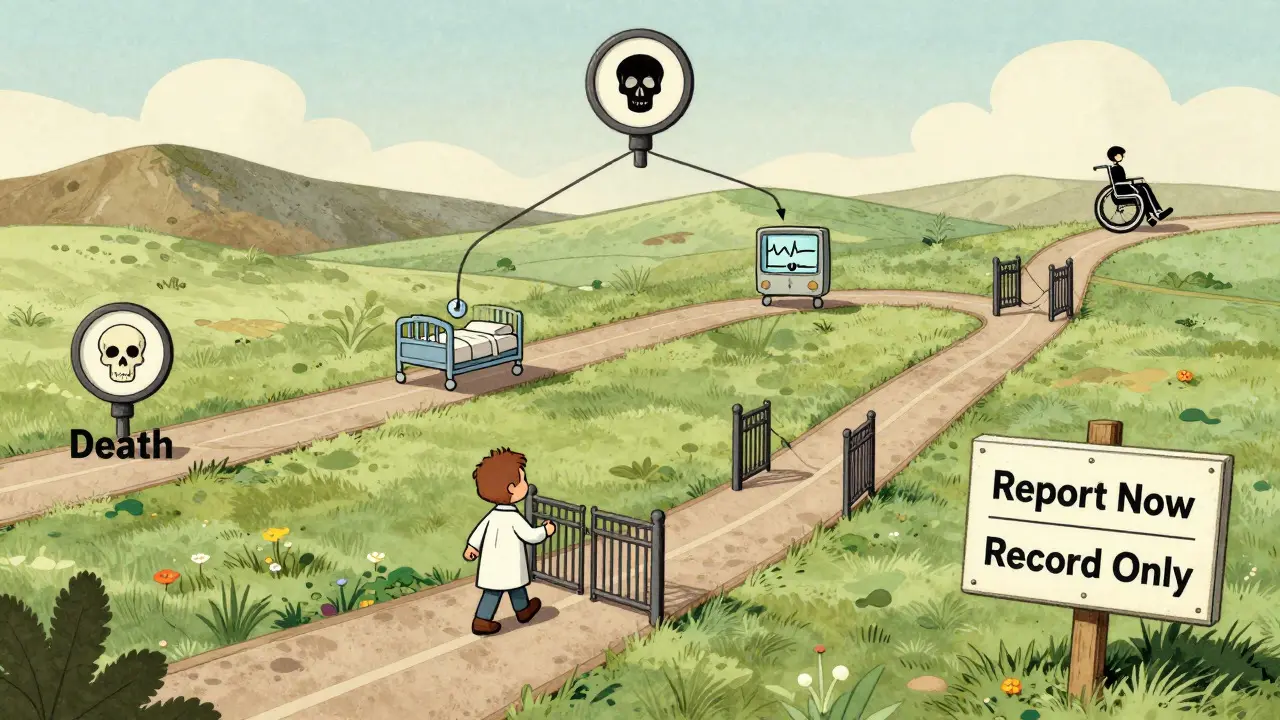
However, CTCAE only handles severity. For seriousness, many institutions use a simple decision tree based on the NIA guidelines:
- Did the patient die? (Yes = SAE)
- Was the event life-threatening? (Yes = SAE)
- Did the patient get hospitalized? (Yes = SAE)
- Did the patient suffer permanent disability? (Yes = SAE)
- Did the event require intervention to prevent permanent damage? (Yes = SAE)
If the answer is "No" to all five, it is a non-serious AE. This binary approach eliminates the gray area where opinions differ. Implementing this checklist in your site's standard operating procedures (SOPs) can drastically reduce misclassification rates. Recent data suggests that over 30% of SAE reports submitted to IRBs are actually non-serious, wasting valuable administrative resources.
Next Steps for Your Team
If you are setting up a new study or reviewing an existing one, consider these actions:
- Audit your SOPs: Do they clearly define "hospitalization"? Does it include day-case surgeries? Be explicit.
- Train your staff: Don't just read the definition. Run case studies. Give your coordinators 10 hypothetical scenarios and ask them to classify seriousness and severity. Discuss the answers.
- Use electronic capture systems: Modern Electronic Data Capture (EDC) systems can flag potential SAEs based on keywords (e.g., "admitted," "died"). Use these prompts to double-check your manual entries.
- Keep a log of decisions: When you make a borderline call (like the ER visit), document your reasoning. This protects you during audits and helps future team members understand local practices.
Getting the difference between serious and non-serious adverse events right isn't just about compliance. It's about ensuring that the people responsible for patient safety-regulators, IRBs, and sponsors-can focus their attention on the signals that truly matter. By stripping away the noise of non-serious events, you make the entire safety system more efficient and effective.
Does a severe adverse event always require expedited reporting?
No. Severity refers to intensity (mild, moderate, severe), while seriousness refers to outcome (death, hospitalization, etc.). A severe headache that resolves with rest is not a serious adverse event and does not require expedited reporting to the FDA or IRB, unless specified in the protocol.
What is the deadline for reporting an SAE to the sponsor?
The investigator must report the SAE to the sponsor within 24 hours of becoming aware of the event. This applies regardless of whether the event is suspected to be related to the investigational product.
Is an emergency room visit considered a serious adverse event?
Not automatically. An ER visit is only considered a serious adverse event if the patient is hospitalized (admitted) or if the event meets another seriousness criterion, such as being life-threatening. If the patient is treated and discharged the same day without admission, it is typically classified as non-serious unless the protocol states otherwise.
Do I need to determine if the drug caused the event before reporting?
No. Causality assessment is a separate step that occurs after the initial report. You should report the event based solely on its seriousness criteria. Delaying the report to assess causality is a common compliance error.
What is the role of the CTCAE in adverse event reporting?
The Common Terminology Criteria for Adverse Events (CTCAE) is used to standardize the grading of severity (Grade 1-5). It helps ensure consistent interpretation of symptom intensity across different sites and investigators, but it does not determine seriousness, which is based on patient outcomes.