
How to Share Your Medical History for Safe Medication Decisions
 Aug, 3 2026
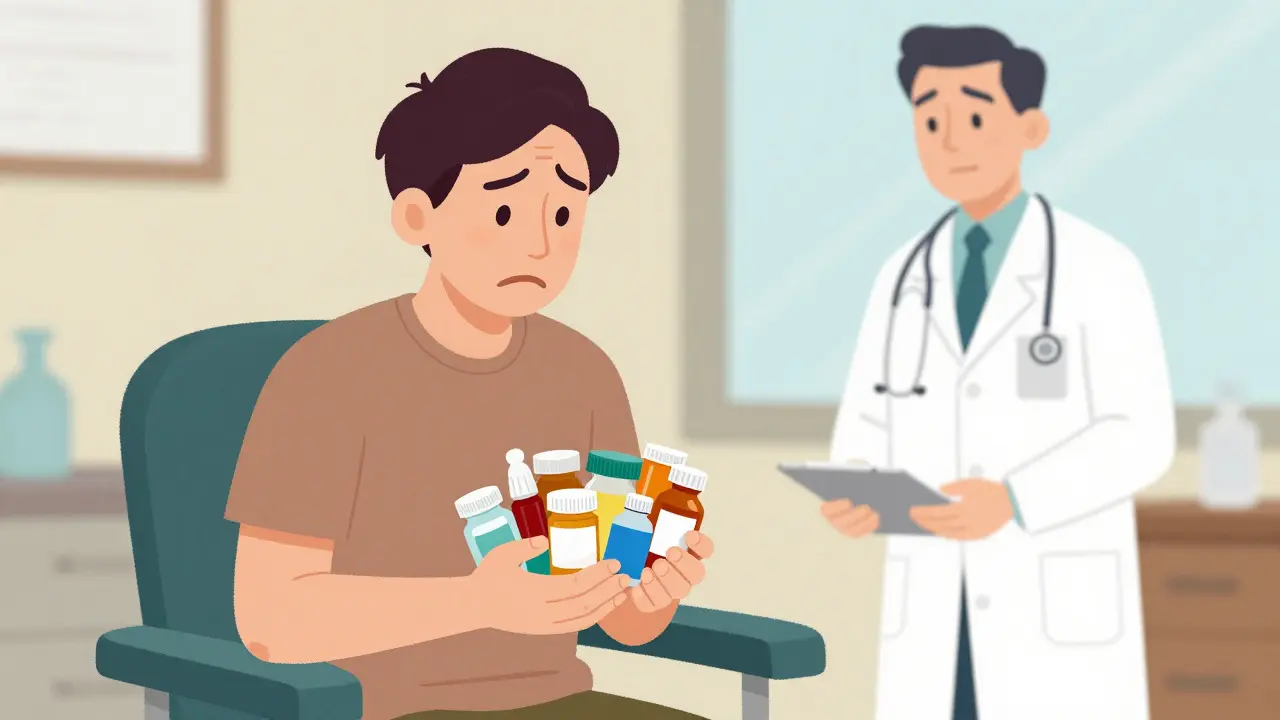
Imagine walking into a clinic feeling confident, only to realize the doctor has prescribed a new drug that clashes with something you’ve been taking for years. It’s not just an inconvenience; it’s a safety risk. Every year, thousands of preventable deaths occur because medication errors slip through the cracks during care transitions. The good news? You hold the key to preventing most of these mistakes. By actively sharing your complete medical history, you become a vital partner in your own care.
This isn’t about memorizing chemical names or acting like a pharmacist. It’s about clear, honest communication. When you and your healthcare provider align on what you’re taking-including those over-the-counter pills and herbal supplements-you drastically cut down the risk of adverse drug events (ADEs). Let’s break down exactly how to do this effectively, so every decision made about your health is safe and informed.
Why Your Complete List Matters More Than You Think
We often think of our prescription medications as the only things that matter. But your body doesn’t distinguish between a pharmacy-dispensed pill and a vitamin bought at the grocery store. Medication reconciliation is a formal process for creating the most complete and accurate list possible of a patient's current medications. This practice was established to combat the fact that medication-related errors consistently rank at the top of all medical errors. In the United States alone, these errors contribute to approximately 7,000-9,000 preventable deaths annually.
The stakes are high, especially if you take multiple drugs. Patients on five or more medications face an 88% higher risk of medication discrepancies. These aren't minor mix-ups; they can lead to hospital readmissions or severe side effects. For instance, combining certain blood thinners with common pain relievers or even specific herbs can cause dangerous bleeding. By understanding that every substance entering your body counts, you shift from being a passive recipient of care to an active participant in your safety.
- Prescription Drugs: What your doctor wrote you.
- Over-the-Counter (OTC) Meds: Painkillers, antacids, allergy meds.
- Supplements & Herbals: Vitamins, minerals, and plant-based remedies.
- Topical Treatments: Creams, patches, and eye drops.
The "Brown Bag" Method: A Simple Game-Changer
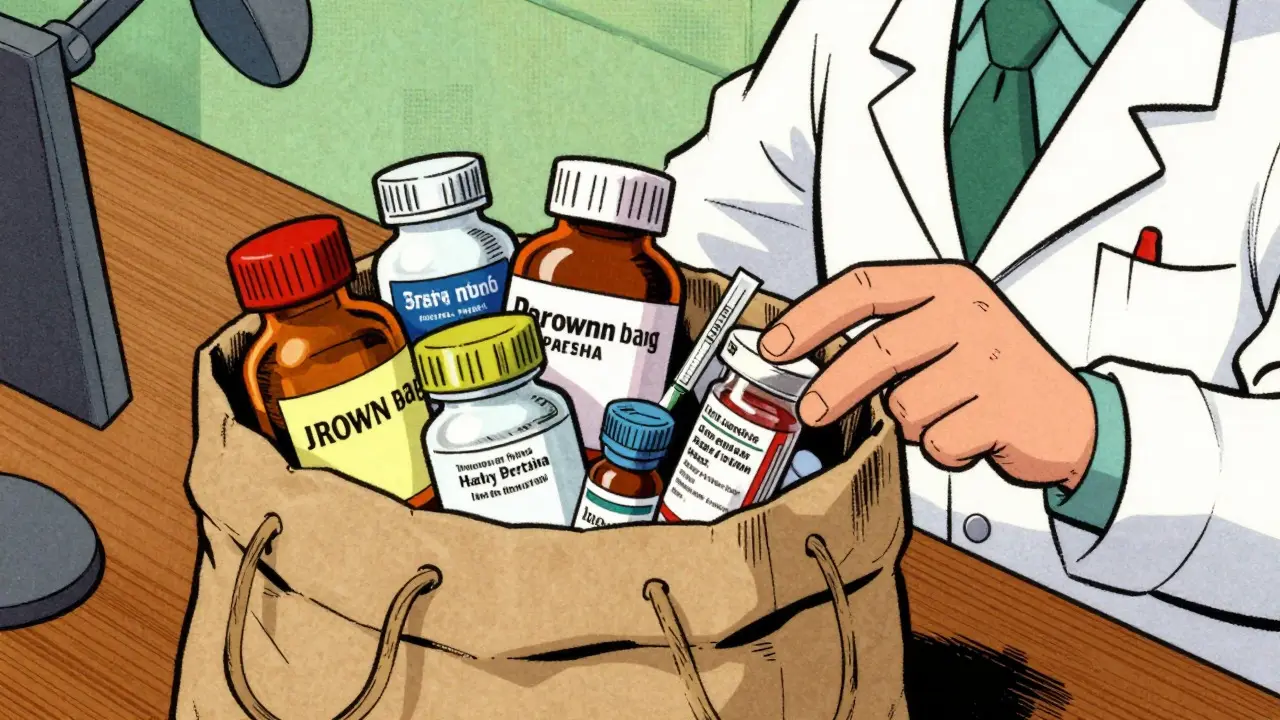
Relying on memory is risky. Studies show that 67% of patients fail to report their OTC medications accurately. Why? Because we forget. We assume the doctor knows, or we think a daily multivitamin isn't worth mentioning. Enter the "brown bag method," recommended by the American Society of Health-System Pharmacists (ASHP). It’s straightforward: bring every single bottle, box, and tube you use to your appointment in a bag.
This simple act reduces medication discrepancies by 40% compared to verbal reporting alone. It eliminates guesswork. If you have a leftover antibiotic from three months ago, bring it. If you use a strengthener shampoo with minoxidil, bring that too. Seeing the actual containers allows your provider to verify dosages, expiration dates, and exact ingredients. It’s a visual audit that catches errors before they happen.
For caregivers, this method is even more critical. Family members tracking medications for elderly relatives often struggle with complexity. Bringing the physical bottles ensures that the person administering the meds matches the record perfectly, cutting down on confusion and potential double-dosing.
Bridging the Gap Between Providers
You might wonder, "Can't my doctors just talk to each other?" Ideally, yes. Modern healthcare relies on electronic health records (EHRs) and health information exchanges (HIEs) to share data. Services like Surescripts deliver billions of medication histories annually, pulling data from pharmacies and benefit managers. However, technology isn't perfect yet.
Here’s the reality check: electronic systems currently capture only about 52% of actual medication discrepancies. Data fragmentation is a real issue. If you get prescriptions from different pharmacy chains, or if you pay cash for some meds, those records might not appear in your primary care provider’s system. Cash-pay prescriptions account for an estimated 15-20% of medications that go unrecorded in digital systems.
This is where you come in. You are the constant thread connecting your specialists, your primary care doctor, and your pharmacist. When you move between care settings-like going from the ER to a specialist follow-up-you must verbally confirm what’s changed. Ask yourself: "Did I start anything new since my last visit? Did I stop anything?" Your voice fills the gaps that algorithms miss.
| Feature | Manual Reconciliation | Electronic Reconciliation |
|---|---|---|
| Accuracy Rate | Lower (25% of home meds missed) | Higher (Only 8% missed) |
| Speed | Slow, time-consuming | Faster, automated checks |
| Cash-Pay Visibility | Dependent on patient honesty | Often invisible unless reported |
| Patient Effort | High (must remember everything) | Medium (verify pre-populated lists) |
Recognizing High-Alert Medications
Not all medications carry the same level of risk. Some are classified as "high-alert" because small errors with them can lead to significant harm. The Institute for Safe Medication Practices (ISMP) identifies drugs like insulin, anticoagulants (blood thinners), and intravenous oxytocin as particularly dangerous if mismanaged.
If you are on any of these, your communication needs to be precise. Don’t just say, "I’m on blood thinners." Say, "I take Warfarin 5mg daily, and my last INR test was two days ago." Specificity saves lives. Providers need to know your dosage frequency and any recent changes in your diet or activity levels that might affect these drugs. For example, sudden increases in leafy green vegetables can interfere with Warfarin’s effectiveness. Sharing this context helps your provider adjust your treatment plan safely.
Overcoming Communication Barriers
Health literacy is a major hurdle. Nearly 60% of Americans have difficulty understanding complex medication instructions. This doesn’t mean you’re not smart; it means medical jargon is confusing. To bridge this gap, use the "teach-back" method. After your provider explains a new medication, repeat it back in your own words. Say, "So, I take this with food once a day, right?" This confirms understanding and gives the provider a chance to correct misconceptions immediately.
Don’t be afraid to ask questions. If a term sounds vague, ask for clarification. Is this drug interacting with my allergy medicine? Will it make me drowsy? How long will I stay on it? Engaging in this dialogue empowers you to catch errors early. Remember, there is no such thing as a silly question when your health is on the line.
Keeping Your Records Updated
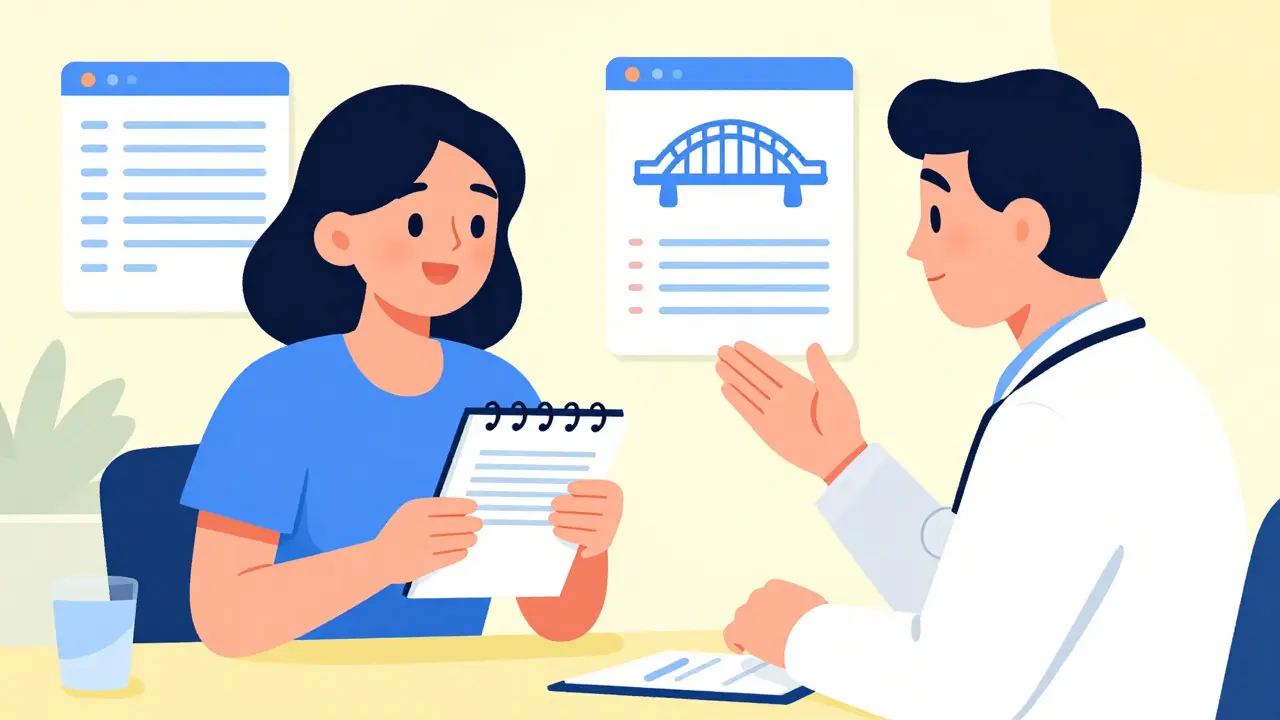
Your medication list is a living document. It shouldn’t sit in a drawer gathering dust. Update it after every healthcare visit, whether that’s a dentist, a dermatologist, or a general practitioner. Many hospitals now offer patient portals where you can view and edit your medication list. Take advantage of this. Check it regularly against what’s in your medicine cabinet.
Consider using a simple notebook or a smartphone app dedicated to health tracking. Write down the name, dose, and reason for each medication. Note when you started and stopped any drug. This habit creates a reliable reference point that you can share instantly with any new provider. It also helps you spot trends, like recurring side effects or forgotten refills.
FAQ: Common Questions About Sharing Medical History
Do I really need to tell my doctor about vitamins and herbs?
Yes, absolutely. Natural does not mean harmless. St. John’s Wort, for example, can interact with antidepressants and birth control pills, reducing their effectiveness. Garlic supplements can increase bleeding risk when taken with blood thinners. Always disclose every supplement to ensure safe medication decisions.
What should I do if I lost my medication list?
Don’t panic. Start by checking your pharmacy records online or calling your pharmacy for a refill history. Use the "brown bag method" for your next appointment by bringing all remaining bottles. Be honest with your provider that you don’t have a complete list, and work together to rebuild it accurately.
How often should I update my medication list?
Update it immediately after any change. This includes starting a new prescription, stopping a drug, changing a dosage, or adding an over-the-counter remedy. Aim to review it monthly to remove expired or unused medications, keeping your list current and relevant.
Can electronic health records replace talking to my doctor?
No. While EHRs improve data sharing, they are not infallible. They often miss cash-paid prescriptions, OTC meds, and supplements. Human verification is essential. Always verbally confirm your list with your provider to catch discrepancies that technology might overlook.
What is the "teach-back" method?
It’s a communication tool where you repeat back information in your own words to confirm understanding. For example, "Just to make sure I got it right, I take this pill twice a day with meals." This helps providers identify and correct misunderstandings about your medication regimen.
Lilith Stepanyan
August 4, 2026 AT 13:10The entire premise of this article is insulting to anyone who actually pays attention to their health. You are suggesting that the average person, drowning in bills and working two jobs, has the bandwidth to act as a pharmacist for their own care. It’s not just about 'clear communication' because the system is designed to fail you. Doctors spend four minutes with patients. They don't have time to audit your brown bag of expired ibuprofen and herbal tea. The real issue isn't patient negligence; it's a healthcare infrastructure that treats human beings like data points rather than complex biological systems. Blaming preventable deaths on patients forgetting to mention their multivitamin is a classic case of shifting liability from the provider to the vulnerable. It’s lazy journalism.
Josh Atkinson
August 5, 2026 AT 12:31Look, I get why people are grumpy about this :D but honestly? If you can’t be bothered to keep a list of what goes into your body, maybe you aren’t trying hard enough to stay alive. It’s not rocket science. I’ve been managing my dad’s meds for years and if he didn’t bring the bottles, we’d be in trouble fast. People think they’re too smart for the simple stuff until they end up in the ER. Just do the work. It takes five minutes. Don’t make excuses about being busy or tired. Your life is worth more than a little organizational effort. Stop acting like victims when the solution is literally carrying a plastic bag. Simple as that :)
Tegan Morey
August 6, 2026 AT 13:19I totally see where Lilith is coming from though! It feels overwhelming sometimes. But Josh makes a good point about the simplicity of it. I started using a little notebook just for my vitamins and prescriptions after my last scare. It really does help me feel more in control during appointments. Does anyone else find that having a physical list helps them remember things better than an app? I tried an app but kept forgetting to update it. The paper method just sticks for me!
charlie student
August 8, 2026 AT 06:01There is a deeper philosophical disconnect here between the medical industrial complex and the individual experience of illness. We are asked to participate in our own surveillance without being given the tools to understand the data. The 'brown bag' method is a ritual of trust in a system that often betrays that trust. It’s interesting how we are expected to bridge the gap between fragmented electronic records with manual labor. Perhaps the problem isn’t the lack of bags, but the lack of continuity in care itself.
Gary Browne
August 9, 2026 AT 22:40So let me get this straight. You’re telling me that instead of trusting the doctors who spent ten years in school, I should rely on my memory? That sounds risky. I mean, if I’m paying for these services, shouldn’t they know what I’m taking? It feels like they want us to do their job for free. Why can’t the pharmacy just send the info automatically? Oh wait, they said tech isn’t perfect. So whose fault is it then? Seems like everyone is passing the buck except the people holding the clipboard.
Christina Thygesen
August 10, 2026 AT 21:15i hear you gary it is frustrating. i used to feel so stupid walking in there not knowing all the names. but then i realized the doctor is just another person trying to help. when i started bringing my pills in a ziplock bag (cheaper than a brown bag lol) they were actually nicer to me. it showed i cared. it changed the whole vibe of the visit. try it once and see if it helps your anxiety too
Minal Aditi
August 12, 2026 AT 01:59Oh, please. Spare me the self-help guru nonsense. 'You hold the key'? Really? Do you also hold the key to fixing the climate crisis or ending world hunger? This is victim-blancing wrapped in a bow of toxic positivity. The fact that 7,000 people die annually because the SYSTEM fails is somehow reduced to 'did you bring your vitamin bottle?' It’s pathetic. The healthcare system is a vampire sucking the life out of its patients, both financially and emotionally, and now it wants credit for saving you if you play along nicely. Disgusting.
Diane Nash
August 12, 2026 AT 03:01While the cynicism expressed by some commenters is understandable, it is imperative to recognize the agency afforded to the patient in modern therapeutic alliances. The 'brown bag' method is not merely a logistical convenience; it is a manifestation of informed consent and active participation. To dismiss it as trivial is to ignore the statistical reality of adverse drug events. We must cultivate a mindset of rigorous self-advocacy. It is not about blaming the patient, but empowering them with the knowledge that their voice is the most critical variable in the equation of safety. Let us strive for excellence in our personal health management.
Alli Crumley
August 13, 2026 AT 16:02Diane is speaking the truth here :P The semantic drift in this thread is alarming. People confuse 'patient responsibility' with 'provider failure'. These are not mutually exclusive variables in the matrix of healthcare delivery. The pharmacokinetic implications of unreported OTC supplements are non-trivial. St. John’s Wort induces CYP3A4 metabolism which can render SSRIs ineffective. This is basic biochemistry. If you cannot grasp the importance of substrate inhibition, perhaps you should refrain from commenting on clinical protocols. Education is key :D
Marc H
August 15, 2026 AT 05:12Good grief. Is nobody reading the room? It’s a blog post about carrying your pills in a bag. Not a thesis on existential dread. Marc, chill out. Alli, stop showing off your vocabulary. And Diane, you sound like a robot written by a committee. We’re just trying to stay alive here, folks. No need for the drama. Just bring the damn bottles and go home. It’s not that deep. Though I suppose for some people, even a trip to the GP is a theatrical event. *dramatic sigh*
Chris McQuaid
August 15, 2026 AT 09:49You’re all missing the forest for the trees. The EHR fragmentation is the real killer here. The 'brown bag' is a band-aid on a bullet wound. Until we have interoperable systems that actually talk to each other across state lines and insurance networks, we are stuck in this medieval era of paper trails and verbal confirmations. It’s not about being 'proactive'; it’s about compensating for systemic incompetence. The technology exists. The will to implement it securely and universally does not. That’s the story.
sam howard
August 17, 2026 AT 05:02eh. most people dont read labels anyway. they just swallow the pill. why would they track it? its a lost cause. the system is broken. fix the system or accept the chaos. no amount of brown bags will save you from bad coding in the EHRs. i’ve seen it happen. wrong dose prescribed because of a dropdown menu error. brings the bag or not doesnt matter much then.
Samuel Hershberger
August 17, 2026 AT 11:22Hey everyone, let’s keep this constructive! Chris makes a valid point about EHR limitations, but Sam Howard is a bit too pessimistic. While the system isn’t perfect, small actions do add up. I’m a pharmacist, and I can tell you that seeing the actual bottle saves lives every single day. It catches the 'I thought I stopped taking this' moments. It’s not about blaming the patient; it’s about giving them a tool to partner with us. Please don’t let frustration stop you from protecting your health. Bring the bag! You’ve got this! 🌟