
How to Communicate Medication Goals and Expectations Clearly: A Provider's Guide
 Apr, 21 2026
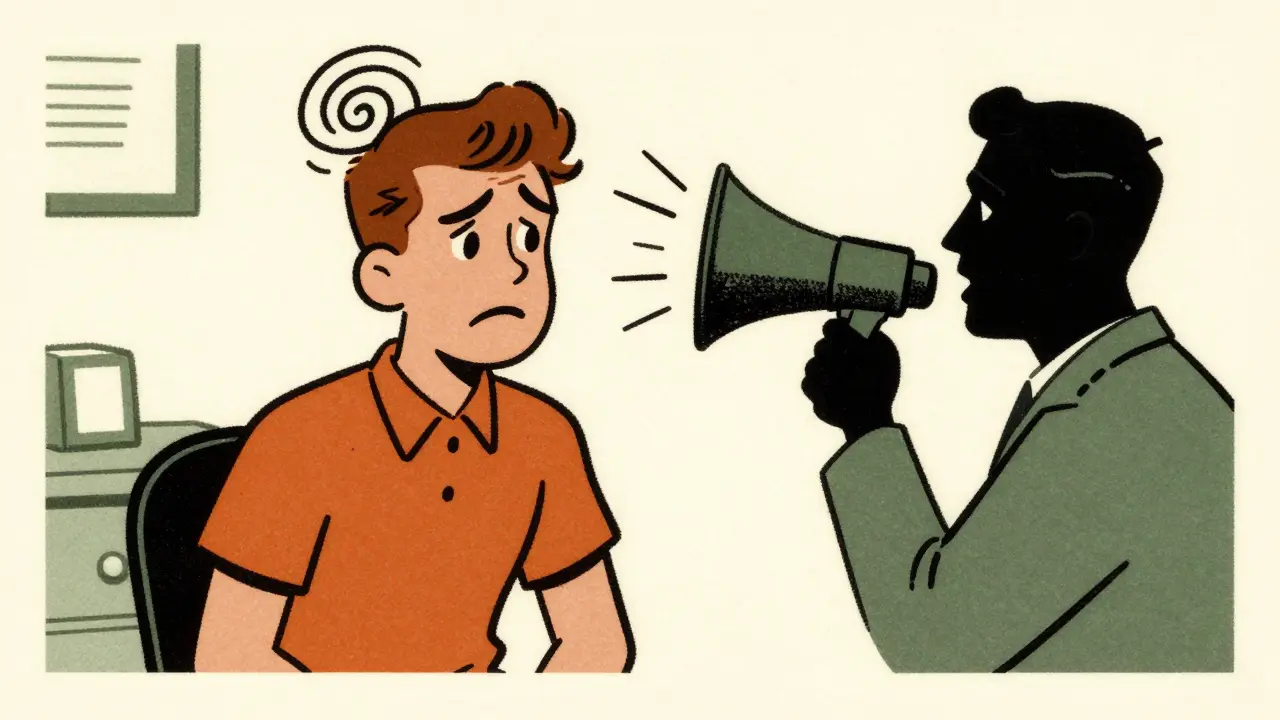
Imagine a patient leaving your office nodding along to every word, only to get home and realize they have no idea why they're taking a new pill or what happens if they miss a dose. It happens more often than we'd like to admit. In fact, research shows that nearly 50% of patients with chronic conditions don't stick to their prescribed therapies, often because they simply don't understand the goals of the treatment. When communication breaks down, the cost isn't just financial-it's measured in hospital readmissions and declining patient health.
The secret to fixing this isn't talking more; it's talking differently. To move the needle on medication communication, we need to shift from a "broadcast" model-where the provider gives instructions-to a shared model where the patient is an active partner. By setting clear, concrete expectations, you can reduce the anxiety patients feel about side effects and significantly boost their likelihood of following the plan.
The Core Principles of Shared Understanding
Before handing over a prescription, we have to establish a baseline. Most providers jump straight into the "how," but the "why" is what actually drives behavior. Patient-Centered Care is a healthcare approach where providers collaborate with patients to ensure treatment aligns with the patient's values and goals. Without this foundation, a patient might see a medication as a burden rather than a tool.
Start by asking, "What have you heard about this medication?" or "What are your main concerns with starting this treatment?" This does two things: it identifies misconceptions early and tells you exactly how much information the patient already has. If you spend five minutes explaining something they already know, you've lost their attention for the parts they actually need to hear.
Once you have the baseline, focus on these three pillars:
- The Purpose: Why is this specific drug necessary? Avoid biochemical explanations. Instead of talking about "HMG-CoA reductase inhibitors," say "This medicine helps stop your liver from making too much cholesterol."
- The Timeline: When will they feel better? Vague terms like "soon" don't work. Be specific: "Most people notice their blood pressure drop within a week, but it takes about a month to see the full effect on your labs."
- The Trade-offs: Be honest about side effects. If a drug causes dizziness in the first week, tell them. If they know it's normal, they won't panic and stop taking the medication the moment they feel a bit lightheaded.
Mastering the Teach-Back Method
The most dangerous phrase in a clinic is "Do you have any questions?" Most patients will say "no" out of politeness or embarrassment, even if they're confused. To actually verify understanding, you need to use the Teach-Back Method, which is a communication technique where the provider asks the patient to explain the treatment plan back in their own words.
The key here is to frame the request so the patient doesn't feel like they're being tested. Don't say "Repeat what I just said." Instead, try: "I want to make sure I explained this clearly. To help me out, could you tell me how and when you're going to take this medication when you get home?"
If the patient struggles, don't just repeat the same sentence louder. Rephrase it, use a visual aid, or break the information into smaller pieces. According to the Joint Commission, using this verification step can increase adherence by 23% because it catches errors before the patient leaves the building.

Reducing Cognitive Load and Improving Recall
Medical appointments are stressful, and stress kills memory. A study in JAMA Internal Medicine found that patients retain less than half of the information they're given during a visit. If you dump ten pieces of information on a patient in two minutes, most of it will vanish the moment they hit the parking lot.
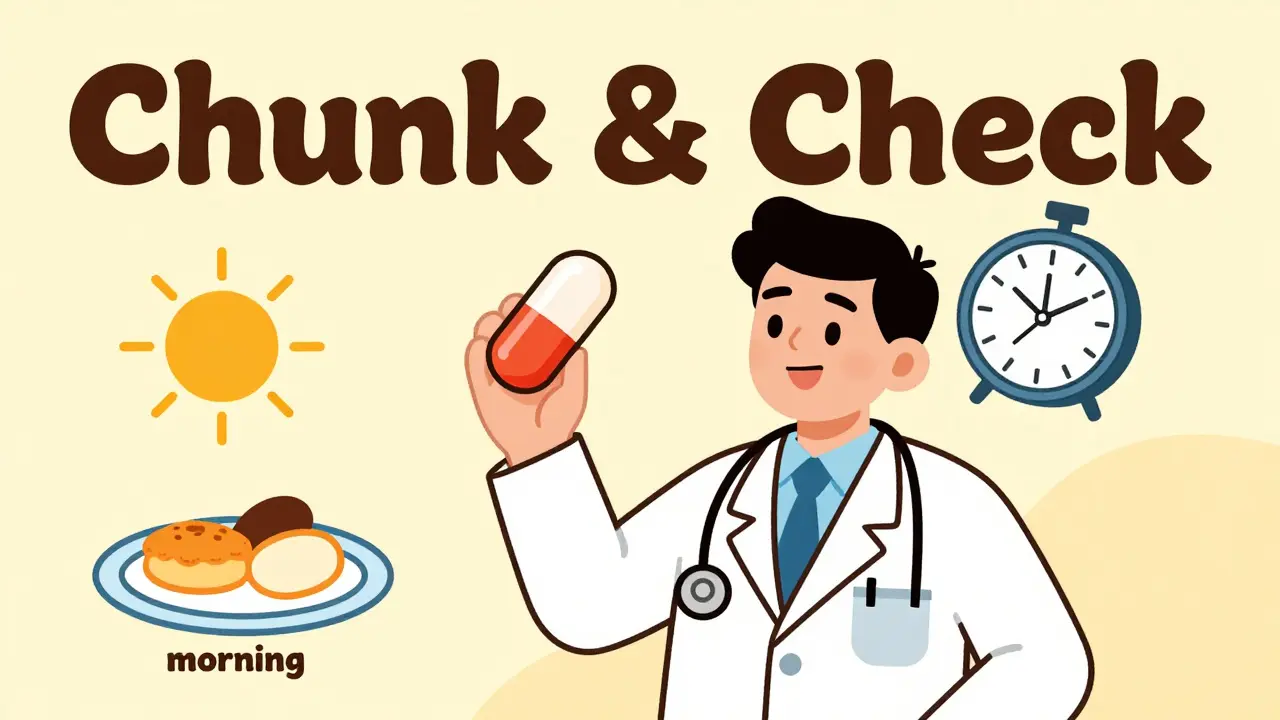
To combat this, use a technique called "Chunk and Check." Instead of a long monologue, provide a small "chunk" of information, then "check" for understanding. For example, explain the dosage, stop, and ask them to repeat it. Then move on to the side effects, stop, and check again. This keeps the patient engaged and prevents cognitive overload.
Also, watch your speed. Research from Tulane University suggests speaking at about 130-150 words per minute-roughly 20% slower than a standard conversation. It feels slow to you, but for a patient processing complex health data, it's the sweet spot for comprehension.
| Vague Approach (Avoid) | Specific Approach (Use This) | Why it Works |
|---|---|---|
| "Take as directed" | "Take one pill every morning with breakfast" | Creates a concrete habit tied to a daily event. |
| "This reduces risk by 20%" | "This moves your risk from 10% down to 8%" | Absolute risk is easier to visualize than relative risk. |
| "Take PO BID" | "Take one pill by mouth twice a day" | Eliminates medical jargon that confuses patients. |
| "You should see results soon" | "You'll likely feel a difference in 2 to 3 weeks" | Sets a realistic expectation for the timeline. |
Handling Emotions and Barriers to Adherence
Medication isn't just about chemistry; it's about psychology. If a patient is terrified of a specific side effect they read about online, no amount of "clinical evidence" will convince them to take the pill until you acknowledge that fear. Use empathy statements like, "It sounds like you're worried about how this will affect your energy levels. That's a completely valid concern."
Once the emotion is acknowledged, you can move into collaborative decision-making. Instead of saying "You must take this," try "Many patients find it helpful to take this with breakfast to avoid stomach upset. Would that work with your morning routine?" This gives the patient agency over their treatment, making them much more likely to follow through.
Don't forget the "exit strategy." For older adults, the goal isn't always adding more meds; it's often about Deprescribing, which is the planned process of reducing or stopping medications that may no longer be beneficial or may be harmful. When discussing this, be clear about why a medication is being stopped and what signs of relapse they should watch for. This prevents the patient from feeling like their care is being "cut" and instead frames it as an optimization of their health.
Practical Tools for a Busy Clinic
We know the reality: you have about 15 minutes per patient. You can't spend half an hour on a single prescription. However, you can integrate these strategies into your workflow without blowing your schedule.
- Use Visuals: Draw a simple picture of how the medication works or use a pill organizer to show exactly where each dose goes.
- Leverage the Team: If a patient is on five or more medications, bring in a pharmacist for a dedicated medication review. This specialized focus can reduce hospitalizations by 22%.
- Digital Reinforcement: Use automated reminders that reference the specific expectations you discussed. A text saying "Remember, you might feel a bit dizzy this week-this is normal" acts as a safety net for the conversation you had in the office.
- Standardized Templates: Use EHR templates that prompt you to document the patient's understanding of the purpose and schedule, rather than just checking a box that says "counseling provided."
Why is the Teach-Back method better than asking "Do you understand?"
Asking "Do you understand?" usually results in a "Yes" regardless of actual comprehension due to social pressure or a desire to please the provider. Teach-Back requires the patient to demonstrate their understanding by explaining the plan in their own words, which allows the provider to identify and correct specific misunderstandings immediately.
How do I handle a patient who is overwhelmed by too much information?
Use the "Chunk and Check" method. Break the information into small segments (about 2-3 minutes each), and verify understanding after each piece before moving forward. Limit the encounter to 2-3 key points to avoid exceeding the patient's cognitive load.
What is the best way to explain risks without scaring the patient?
Use absolute risk figures instead of relative risks. For example, instead of saying a drug "reduces risk by 20%," explain that it "reduces the risk of a heart attack from 10% to 8% over ten years." This provides a more accurate and less alarming perspective on the actual benefit.
How can I improve adherence for patients with limited health literacy?
Avoid all medical jargon (e.g., use "by mouth" instead of "PO"). Use plain language, speak slowly (130-150 words per minute), and provide visual aids like pictures or physical pill counts to supplement the verbal instructions.
When should I involve a pharmacist in the communication process?
Pharmacists are especially valuable for "polypharmacy" cases-patients taking five or more medications. A pharmacist-led review can identify drug-drug interactions and simplify complex dosing schedules, which significantly reduces the risk of medication errors.
Divyanshu Giri
April 23, 2026 AT 12:12This is some gold right here! Super helpful way to make sure patients actually get the win with their health 🚀
Ajinkya Joshi
April 24, 2026 AT 14:39Oh wow, a guide telling doctors to use plain English. Truly groundbreaking stuff. I'm sure the medical establishment is shaking in their boots now that we've discovered the 'secret' of not using jargon.
Ally Warren
April 25, 2026 AT 12:45Language is the bridge between clinical knowledge and human survival. If the bridge is built with jargon, the patient never reaches the shore of recovery.
Olayinka Ibukunoluwa Mercy
April 25, 2026 AT 18:16Such an important reminder for all of us in the healthcare space!!! 🌟 Being an inclusive mentor to our patients starts with these small but vital changes in how we speak... Truly lovely approach! ❤️✨
Mike Arrant
April 26, 2026 AT 13:42Listen, most of you are failing at this because you care more about your ego than the patient. Just shut up and let the patient talk for once. It's not rocket science, it's basic human interaction that most of you forgot in med school.
Amy Fredericks
April 28, 2026 AT 12:18I love the focus on empathy here. It really changes the dynamic from a lecture to a partnership, and that's where the real healing starts!
Dan Wizard
April 29, 2026 AT 12:28I find myself wondering if the implementation of the Teach-Back method might vary significantly across different cultural contexts, especially in regions where challenging a figure of authority-such as a physician-is socially discouraged, which could potentially lead to a false sense of understanding even when the patient is actively trying to follow the guidelines provided by the clinician.
RAJESH MARAVI
April 30, 2026 AT 03:51Who even cares about 130 words per min?? totaly ridiculuos. some peopel just want to make thins complicatd for no reson!! 🙄
Mayur Pankhi Saikia
May 1, 2026 AT 09:02The sheer audacity to suggest that a simple "chunk and check" is a panacea for systemic health literasy issues... absolutely quaint, yet utterly simplistic!!!
Caroline Duvoe
May 1, 2026 AT 09:56been seeing this everywhere 🙄 basic stuff really 💅
Dave Edwards
May 2, 2026 AT 14:41Absolutely typical that we focus on the 'how' instead of the systemic failure of the insurance companies forcing doctors into 15-minute slots! It's a moral travesty that we're treating symptoms of a broken system with communication tips! 🙄😤
Odicha ude Somtochukwu
May 3, 2026 AT 06:54I must agree that the inclusion of the pharmacist in polypharmacy cases is an exemplary strategy, as it ensures a holistic approach to patient safety... It is truly commendable to see such comprehensive guidelines provided for practitioners!!!
Mel Glick
May 3, 2026 AT 11:36Get real. Most doctors aren't going to do this because it takes too much effort. They'll just keep saying 'take as directed' and wondering why patients don't get better. It's lazy medicine, plain and simple. If you actually cared about the results, you'd stop the clock and actually talk to the human in front of you. Either you're in this to help people or you're just a pill-pusher. There is no middle ground here. Change your workflow or stop complaining that adherence is low. It's on the provider to make it happen, not the patient to guess what 'PO BID' means. Just fix it.