
How Bioequivalence Studies Are Conducted: Step-by-Step Process
 Jul, 20 2026
Have you ever wondered why your pharmacist hands you a pill that looks different from the one prescribed by your doctor? That generic medication isn't just a cheaper copy; it is the result of rigorous scientific testing designed to prove it works exactly like the brand-name original. This process is called bioequivalence, and it is the backbone of modern affordable healthcare.
Without these studies, we wouldn't have access to the vast array of low-cost medications that save billions annually. But how do regulators actually prove two drugs are equivalent if they don't look alike? It’s not about magic-it’s about math, blood samples, and strict statistical rules. Let’s walk through exactly how these studies are conducted, from the first volunteer sign-up to the final regulatory approval.
What Is Bioequivalence and Why Does It Matter?
Bioequivalence (BE) is a regulatory term used to demonstrate that a generic drug delivers the same amount of active ingredient into a patient's bloodstream at the same rate as the reference listed drug (the brand-name version). The concept was formalized in the United States by the Hatch-Waxman Act of 1984, which created the Abbreviated New Drug Application (ANDA) pathway. This law allowed companies to skip full clinical trials for safety and efficacy, provided they could prove bioequivalence.
This framework has been adopted globally. Agencies like the U.S. Food and Drug Administration (FDA), the European Medicines Agency (EMA), and Japan’s Pharmaceuticals and Medical Devices Agency (PMDA) all require this proof. The goal is simple: ensure therapeutic equivalence. When you take a generic, you expect the same effect. According to FDA data, generic drugs saved the U.S. healthcare system $1.68 trillion between 2010 and 2019. That savings exists because bioequivalence studies give us confidence without repeating expensive, multi-year clinical trials.
The Gold Standard: Crossover Study Design
Most bioequivalence studies use a specific experimental setup known as a two-period, two-sequence crossover design. This is considered the gold standard because it allows each participant to serve as their own control, minimizing variability caused by individual differences in metabolism.
| Phase | Action | Purpose |
|---|---|---|
| Screening | Health checks and baseline labs | Ensure subjects are healthy and eligible |
| Randomization | Assign Sequence A or B | Balance out order effects |
| Period 1 | Administer Test or Reference drug | Collect initial PK data |
| Washout Period | Wait 5+ half-lives | Clear drug from system completely |
| Period 2 | Administer the other drug | Collect comparative PK data |
| Analysis | Compare Cmax and AUC | Determine statistical equivalence |
In Sequence A, participants receive the test product (generic) first, then the reference product (brand). In Sequence B, the order is reversed. Typically, 24 to 32 healthy volunteers participate. For highly variable drugs-where the coefficient of variation exceeds 30%-regulators may require larger groups (50-100 subjects) using replicate designs to account for natural biological noise.
Step-by-Step: How the Study Unfolds
Conducting a bioequivalence study is a tightly controlled operation. Here is what happens on the ground:
- Subject Selection: Researchers recruit healthy adults. They screen for liver function, kidney health, and absence of chronic conditions. The goal is a homogeneous group so that any difference in drug absorption is due to the formulation, not the person.
- Randomization and Blinding: Participants are randomly assigned to sequences. Often, the pills are matched in appearance (blinded) so neither the subject nor the investigator knows which drug is being taken during each period.
- Administration: Subjects ingest the drug under fasting or fed conditions, depending on the label requirements. Fasting studies usually involve water only, while fed studies require a high-fat breakfast to simulate worst-case absorption scenarios.
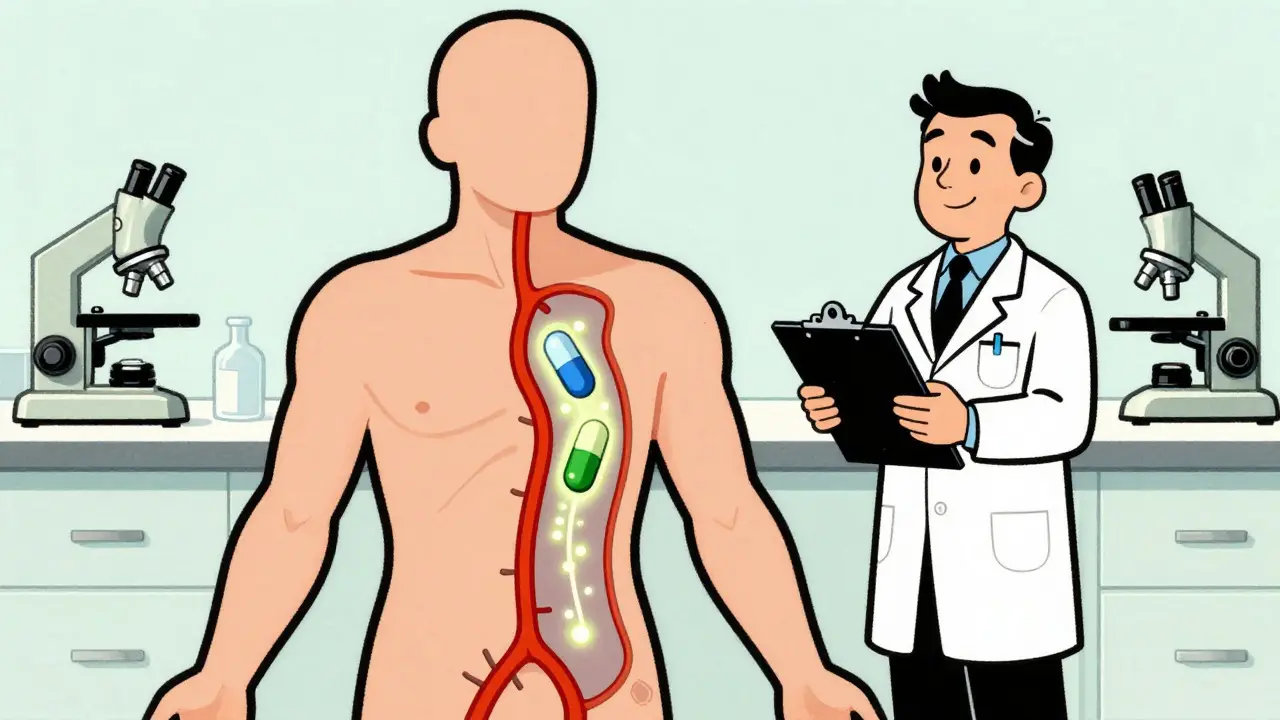
- Blood Sampling: This is the core data collection phase. Blood is drawn at multiple time points-usually at least seven. Samples are taken before dosing (zero time), around the expected peak concentration (Cmax), and during the elimination phase. Sampling continues until the area under the curve (AUC) stabilizes, typically covering three to five elimination half-lives.
- Washout: After the first period, there is a mandatory washout period. This must last at least five times the drug’s half-life to ensure no residual drug remains in the body before the second dose. Underestimating this can ruin the entire study, as seen in cases where long-half-life drugs required extended waits, costing sponsors hundreds of thousands in delays.
Analyzing the Data: Pharmacokinetics and Statistics
Once the blood samples are collected, they are analyzed using validated methods like liquid chromatography-tandem mass spectrometry (LC-MS/MS). The lab measures the concentration of the drug in plasma over time. From this data, two primary pharmacokinetic parameters are calculated:
- Cmax (Maximum Concentration): The highest level of drug reached in the bloodstream. This relates to the risk of side effects.
- AUC (Area Under the Curve): Specifically AUC(0-t) and AUC(0-∞). This represents the total exposure to the drug over time. This relates to the overall efficacy.
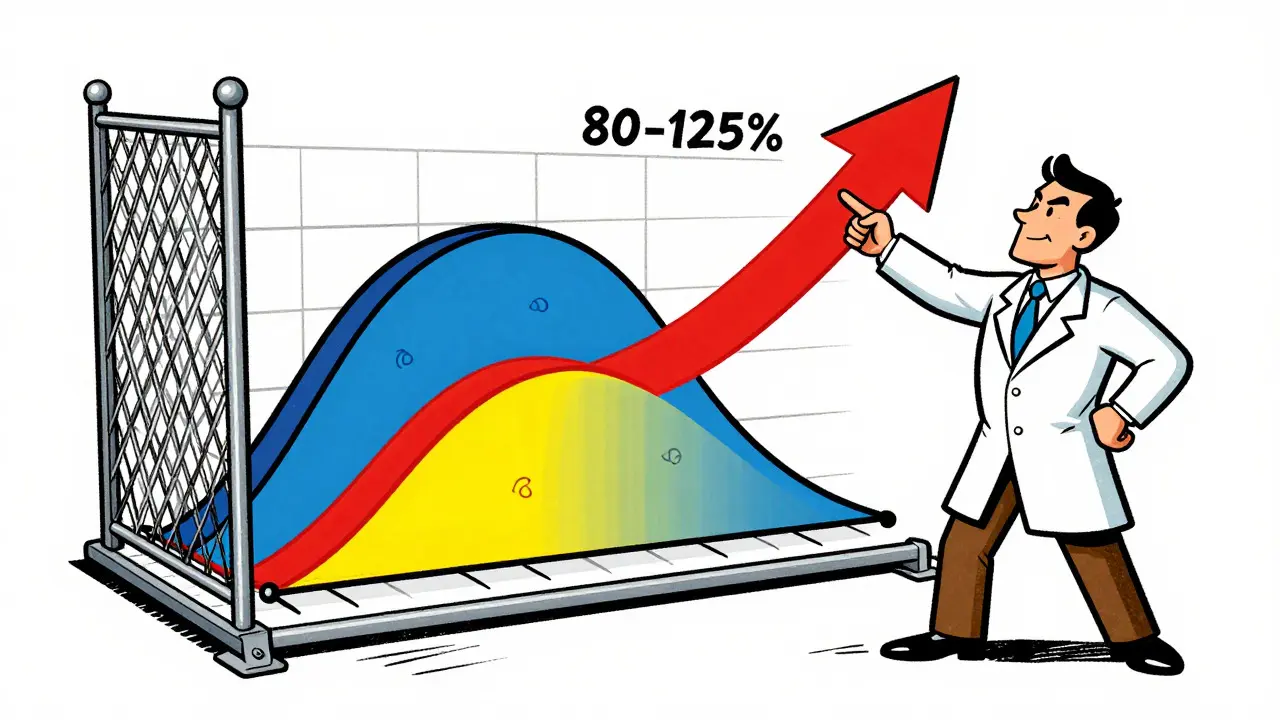
Statisticians then apply logarithmic transformation to these values and perform an Analysis of Variance (ANOVA). The key metric is the 90% confidence interval for the geometric mean ratio of the test product to the reference product. For a generic to be approved, this interval must fall entirely within 80.00% to 125.00% for both Cmax and AUC. If the range is tighter, such as 90.00% to 111.11%, it applies to narrow therapeutic index drugs (like warfarin), where small differences can cause serious harm.
Exceptions and Alternative Approaches
Not every drug fits the standard crossover model. Some require alternative strategies based on their properties:
- Parallel Studies: Used for drugs with extremely long half-lives (over two weeks). Waiting for a washout would take months, so researchers split subjects into two groups: one gets the test drug, the other gets the reference.
- Biowaivers: For drugs classified as BCS Class I (highly soluble, highly permeable), regulators may waive in vivo studies if in vitro dissolution tests show similarity. This saves time and money. The FDA accepted biowaivers for 27% of approvals in 2022.
- Pharmacodynamic/Clinical Endpoints: For locally acting drugs (like topical creams or inhalers) where systemic absorption is minimal or irrelevant, researchers measure the direct effect (e.g., skin clearance or lung function) rather than blood levels.
Common Pitfalls and Industry Realities
Even with clear guidelines, bioequivalence studies fail. Common reasons include inadequate washout periods (accounting for 45% of deficiencies), improper sampling schedules, and statistical errors. Contract Research Organizations (CROs) report dropout rates of 5-15%, often due to the inconvenience of frequent hospital stays for blood draws. Pilot studies are crucial; experts note that running a small-scale pilot reduces pivotal study failure rates from 35% to under 10%. As Dr. Jennifer Bright, former director of the FDA Office of Generic Drugs, emphasized, pilot studies are non-negotiable for complex generics.
The Future of Bioequivalence
The landscape is evolving. Regulatory agencies are increasingly accepting modeling and simulation techniques, such as Physiologically Based Pharmacokinetic (PBPK) models, to predict bioequivalence without extensive human trials. The FDA reported a 35% growth in PBPK applications since 2020. Additionally, there is a push toward expanding biowaivers and using real-world evidence to streamline approvals. Despite these changes, the core principle remains: ensuring that when you switch to a generic, you get the same therapeutic benefit as the brand-name drug.
Why are bioequivalence studies done on healthy volunteers instead of patients?
Healthy volunteers provide a consistent baseline without the confounding variables of disease states, other medications, or organ dysfunction. This makes it easier to isolate the effect of the drug formulation itself. Since the safety profile is already established by the brand-name drug, the focus is purely on absorption and exposure.
What does the 80-125% rule mean?
The 80-125% rule is the statistical acceptance criterion for bioequivalence. It means that the 90% confidence interval for the ratio of the generic drug's performance (Cmax and AUC) to the brand-name drug must fall between 80% and 125%. This range accounts for natural biological variability while ensuring therapeutic equivalence.
How long does a typical bioequivalence study last?
The actual study duration varies by drug half-life but typically involves 1 to 3 days per period for short-half-life drugs, plus a washout period of several days to weeks. The entire process, including screening and follow-up, often takes 2 to 4 weeks per subject.
Can a generic drug be less effective than the brand name?
Regulatory standards make significant differences unlikely. If a generic fails to meet the 80-125% criteria, it is not approved. While minor variations exist, they are clinically insignificant for most drugs. Narrow therapeutic index drugs have stricter limits (90-111%) to minimize any potential difference.
What is a biowaiver?
A biowaiver is an exemption from conducting in vivo bioequivalence studies. It is granted for drugs that are highly soluble and highly permeable (BCS Class I) if in vitro dissolution tests show that the generic dissolves similarly to the brand. This relies on the premise that rapid dissolution ensures complete absorption.