
Blood Thinner Overdose and Internal Bleeding: What to Do Immediately
 Feb, 20 2026
When you take a blood thinner, you're trading one risk for another. These drugs prevent deadly clots from forming in your veins or arteries, but if you take too much-or if your body reacts unexpectedly-they can cause internal bleeding, a silent, life-threatening emergency. Unlike a cut that bleeds visibly, internal bleeding doesn’t always show up right away. By the time you feel it, it might already be too late. Knowing the signs, what to do, and how fast you must act can save your life.
What Happens When a Blood Thinner Goes Too Far
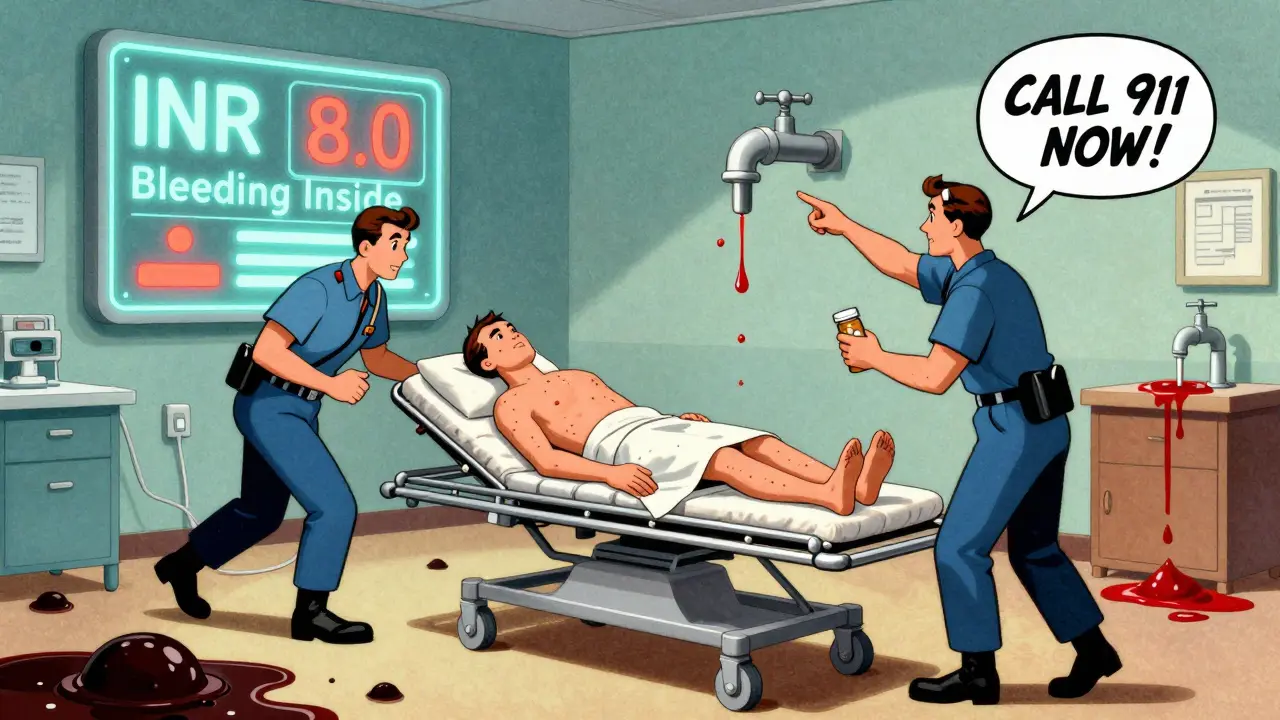
Blood thinners like warfarin, apixaban, rivaroxaban, and dabigatran work by slowing down your blood’s ability to clot. That’s good if you have atrial fibrillation, a replaced heart valve, or a history of deep vein clots. But if you accidentally take two doses, eat too much vitamin K-rich food while on warfarin, or mix it with another drug like ibuprofen, your blood can lose its ability to stop bleeding altogether.Warfarin (Coumadin) is still the most common blood thinner in use, even with newer options available. It works by blocking vitamin K, which your liver needs to make clotting proteins. When warfarin builds up in your system, your INR (International Normalized Ratio) climbs. A normal INR is around 1.0. For most people on warfarin, the target is 2.0-3.0. Once your INR hits 4.5 or higher, your risk of bleeding jumps sharply. At INR 8.0 or more, spontaneous bleeding-without any injury-is likely.
Newer drugs called DOACs (direct oral anticoagulants) like Eliquis and Xarelto don’t need regular blood tests, but they’re not safer. They act faster and leave your body faster too. That means if you overdose, the bleeding starts sooner-and ends sooner if treated right. But if you don’t get help, the clock is ticking.
Signs of Internal Bleeding You Can’t Ignore
Internal bleeding doesn’t always mean a gushing wound. Often, it’s subtle. Many people delay going to the hospital because they think their symptoms are "just a bad stomach" or "a weird bruise." Here’s what to watch for:- Black, tarry, or bloody stools (looks like tar or coffee grounds)
- Pink, red, or dark brown urine
- Coughing or vomiting blood, or material that looks like coffee grounds
- Unexplained bruising, especially large patches or bruises without injury
- Small red or purple dots under the skin (petechiae)
- Heavy or prolonged menstrual bleeding
- Severe headache, dizziness, or confusion (could mean bleeding in the brain)
- Sharp pain in the abdomen, lower back, or chest
- Extreme fatigue, weakness, or feeling faint
A 2022 survey by the National Blood Clot Alliance found that 62% of people who ended up in the ER for a blood thinner overdose had ignored early signs for over 12 hours. One Reddit user, u/WarfarinWarrior, described thinking dark stools were from eating beets-until his hemoglobin dropped to 6.2 g/dL (normal is 12-16). He needed four units of blood.
What to Do Right Now-Step by Step
If you or someone else shows signs of internal bleeding, time is everything. Don’t wait. Don’t call your doctor’s office. Don’t check online. Don’t hope it gets better.- Call emergency services immediately. Say: "I’m on a blood thinner and I think I’m bleeding inside." This gets you to the ER faster. Paramedics know what to look for.
- Do NOT take another dose. Even if you think you missed one, don’t double up. Overdose isn’t fixed by more medicine-it’s fixed by reversing it.
- Don’t take NSAIDs. No aspirin, ibuprofen, or naproxen. These make bleeding worse. Even topical creams with these ingredients can add up.
- Write down what you took. Name of drug, dose, time taken. If you have the pill bottle, bring it. This helps doctors choose the right reversal agent.
- Apply pressure to external bleeding. If you’re bleeding from a cut or nose, press firmly for at least 10 minutes. Don’t check every 2 minutes. Let it clot.
- Lie down and elevate legs. If you’re dizzy or weak, lying flat with feet raised helps keep blood flowing to your brain.
Every minute counts. A 2023 study in the Journal of Thrombosis and Haemostasis showed patients who reached the ER within 2 hours had a 97% survival rate. Those who waited over 6 hours? Only 76% made it.
How Doctors Reverse the Overdose
Emergency teams don’t guess. They act based on what drug you took and how bad your INR is.If it’s warfarin: The first thing they’ll give you is vitamin K (phytonadione) by IV. It takes hours to work, so they won’t wait. If you’re bleeding, they’ll give you 4-factor Prothrombin Complex Concentrate (PCC)-a concentrated mix of clotting factors. It starts working in minutes. FFP (fresh frozen plasma) is used if PCC isn’t available, but it’s slower and risks fluid overload.
If it’s a DOAC: There are specific antidotes:
- Idarucizumab (Praxbind) for dabigatran (Pradaxa)
- Andexanet alfa (Andexxa) for apixaban, rivaroxaban, edoxaban
These cost between $3,500 and $10,000 per dose, but they work fast. A 2022 case report showed a patient on rivaroxaban who was unconscious from a brain bleed woke up within 30 minutes after receiving andexanet alfa.
For very recent overdoses (within an hour), activated charcoal may be given to stop further absorption. But if it’s been more than 60 minutes? It’s useless. No point in wasting time.
What Not to Do
People make mistakes when they panic. Here’s what you must avoid:- Don’t take herbal supplements. Garlic, ginkgo, ginger, ginseng-all thin blood. Even "natural" doesn’t mean safe.
- Don’t drink alcohol. It messes with liver function and increases bleeding risk.
- Don’t try to "wait it out." Internal bleeding doesn’t heal on its own. It gets worse.
- Don’t drive yourself. Dizziness or weakness could cause a crash. Let emergency services handle transport.
Long-Term Prevention: Stay Safe
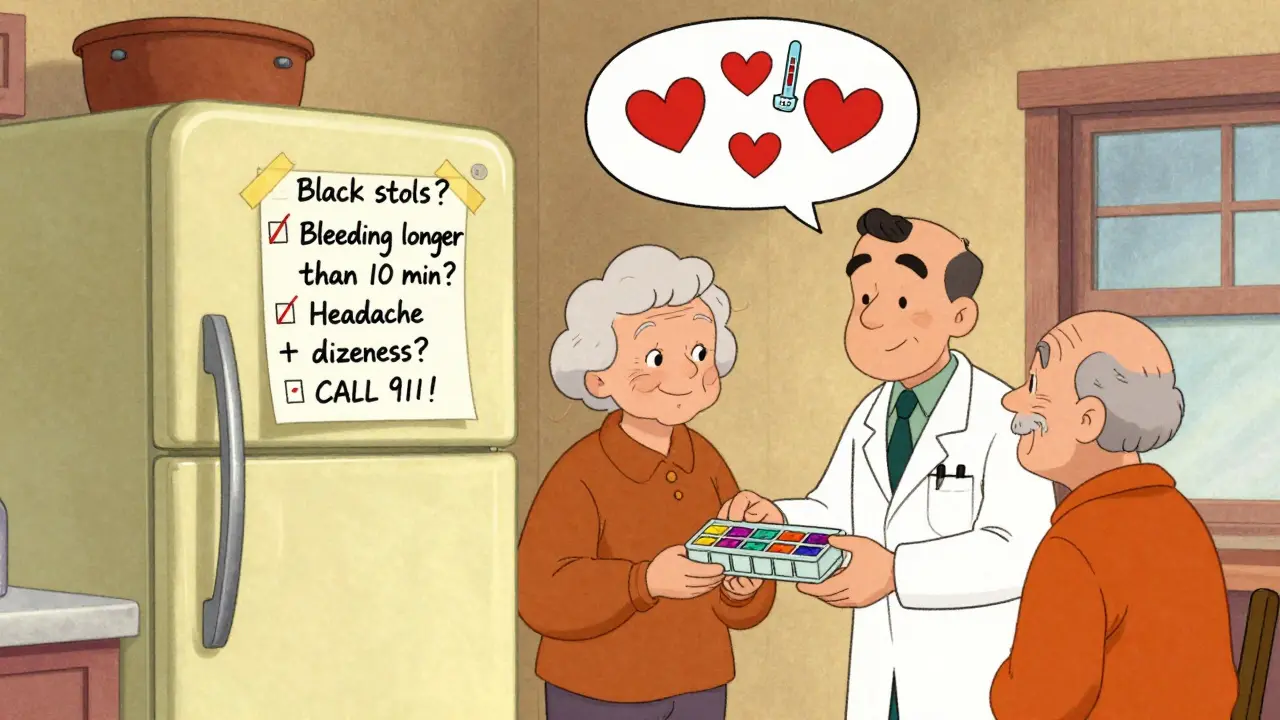
Preventing an overdose is better than treating one. Here’s how:- Use a pill organizer. Color-coded, with alarms. Many pharmacies offer free ones.
- Know your INR target. Most people: 2.0-3.0. If you have a mechanical mitral valve: 2.5-3.5. Ask your doctor to write it down.
- Get tested regularly. If you’re on warfarin, test weekly at first, then monthly. If your INR keeps swinging, ask about home testing devices-some cost under $300 and cut bleeding risk by 34%.
- Keep a bleeding checklist. Tape it to your fridge: Black stools? Bleeding longer than 10 minutes? Unexplained bruising? Headache with dizziness? Call 911.
- Review all meds with your pharmacist. Antibiotics, antifungals, even some OTC cold meds can spike your INR.
The FDA requires all blood thinner packaging to have a boxed warning about bleeding. That’s not a formality-it’s a warning. And yet, 18,452 serious adverse events from warfarin alone were reported to the FDA in 2022. Over 1,100 deaths. Most were preventable.
Frequently Asked Questions
Can I reverse a blood thinner overdose at home?
No. There are no safe, effective ways to reverse a blood thinner overdose at home. Vitamin K tablets won’t work fast enough if you’re actively bleeding. Calling 911 and going to the ER is the only reliable option. Delaying care increases your risk of death.
What if I took too much but feel fine?
Still go to the ER. Blood thinners don’t cause immediate pain. The first sign of internal bleeding is often sudden weakness or collapse. A high INR can build up silently over hours. By the time you feel symptoms, you may already be losing blood inside your body. It’s better to be safe.
Are newer blood thinners safer than warfarin?
They’re easier to use-no weekly blood tests-but not safer. DOACs like Eliquis and Xarelto have fewer food interactions and don’t need INR monitoring, but they still carry a high bleeding risk. And while reversal agents exist, they’re expensive and not always available. Warfarin has been studied longer, so doctors know how to manage it better in emergencies.
Can I take acetaminophen (Tylenol) while on a blood thinner?
Yes, acetaminophen is generally safe for pain or fever while on blood thinners. Avoid NSAIDs like ibuprofen or naproxen-they increase bleeding risk. Always check with your pharmacist before taking any new medicine, even if it’s "over-the-counter." Some cough syrups and cold pills contain hidden NSAIDs.
What if I’m on a DOAC and need emergency surgery?
Doctors will check your last dose time. If it was less than 8 hours ago, they may delay surgery to let the drug clear. If you’re bleeding, they’ll use the specific reversal agent (idarucizumab or andexanet alfa). If reversal isn’t available, they may use activated charcoal, PCC, or FFP. The key is telling them exactly which drug you took and when.
Next Steps: What to Do After an Emergency
After surviving an overdose, you’ll need follow-up care. Your doctor will likely:- Adjust your dose or switch to a different anticoagulant
- Order liver and kidney tests to check for damage
- Review all your medications for interactions
- Recommend a blood thinner safety plan with your pharmacist
Many people who survive a major bleed stop taking their medication out of fear. That’s dangerous too. Stopping your blood thinner without medical advice raises your risk of stroke or heart attack. Work with your care team to find a safer balance.
Anticoagulant overdose isn’t rare. It’s one of the top reasons adults over 65 end up in the ER because of medication errors. But with awareness, quick action, and clear plans, you can live safely on these life-saving drugs.
James Roberts
February 21, 2026 AT 05:16Let’s be real-this post is basically a lifesaver. I’ve seen too many older relatives panic over a missed dose and then double up like it’s a vitamin. The part about not driving yourself? Gold. My uncle tried to drive to the ER after vomiting blood. He crashed into a mailbox. He’s fine now, but only because the EMTs were already nearby. Don’t be a hero. Call 911. Period.
Michaela Jorstad
February 21, 2026 AT 18:29I’m a nurse, and I can’t tell you how many times I’ve seen people wait because they "didn’t want to bother anyone." You’re not bothering anyone. You’re saving your life. I had a patient last month who ignored black stools for three days. She thought it was "stress-induced IBS." Her hemoglobin was 5.8. She needed six units of blood and a two-week hospital stay. Please, if you’re on anticoagulants-listen to your body. And if you’re not sure? Err on the side of panic. It’s better than regret.
Arshdeep Singh
February 22, 2026 AT 02:24Look, I get it. People love their DOACs because they’re "convenient." But convenience isn’t safety. Warfarin’s been around since WWII. We know how to manage it. We know how to reverse it. DOACs? You’re gambling with $10k antidotes that may not be in your rural hospital. And don’t even get me started on how many patients mix them with turmeric supplements. "Natural" doesn’t mean "not lethal." You’re not a biohacker-you’re a patient. Respect the medicine.
Chris Beeley
February 22, 2026 AT 11:25Wow. This is the most comprehensive thing I’ve ever read on anticoagulant management. Honestly, it reads like a medical textbook written by someone who’s actually seen the carnage. I’m Nigerian, and here, most people don’t even know what an INR is. We think "blood thinner" means "makes blood less thick" like water. No one understands that it’s a precision instrument. This should be mandatory reading for every person over 50 with a prescription. Also, I’m printing this out and taping it to my fridge. Thank you.
Marie Crick
February 24, 2026 AT 08:01People who don’t call 911 immediately after suspecting internal bleeding should be fined. Or at least banned from owning pets. You don’t get to risk your life and then make emergency responders waste time because you "thought it might go away."
Oana Iordachescu
February 25, 2026 AT 14:26Interesting how the FDA’s boxed warning is ignored while TikTok influencers promote "natural blood thinners" like garlic and cayenne. I’ve personally seen a patient die because she replaced her warfarin with a "detox tea" she bought online. The antidote was available. She just didn’t make it to the hospital in time. The real tragedy? She wasn’t even 60. Conspiracy? No. Just ignorance. And greed. And the internet.
Davis teo
February 25, 2026 AT 18:08I’m crying. Not because I’m sad-because I’m furious. My mom took two doses of Xarelto because she thought she missed one. She had a brain bleed. They gave her Andexxa. She woke up in 42 minutes. But the cost? $9,800. Insurance didn’t cover it. We’re still paying it off. Why is this drug so expensive? Why isn’t this covered under emergency care? Why does saving your life cost more than a used car? Someone needs to answer this.
Jayanta Boruah
February 27, 2026 AT 06:19While I appreciate the thoroughness of this post, I must point out that the statistical claims lack proper citation. The 97% survival rate within two hours-what was the sample size? What were the confounding variables? Was the population stratified by age, comorbidities, or renal function? The Journal of Thrombosis and Haemostasis article referenced is legitimate, but its methodology requires scrutiny. Also, the claim that "18,452 serious adverse events" were reported to the FDA in 2022-were these all confirmed causations? Or merely temporal associations? Without this, the data becomes anecdotal propaganda. I urge the author to provide the raw dataset or at least the study DOI for peer review. This is not pedantry-it’s scientific rigor.
Ellen Spiers
February 27, 2026 AT 14:29The assertion that "activated charcoal is useless beyond 60 minutes" is misleading. While it is true that absorption kinetics diminish after one hour, in cases of massive overdose with delayed presentation, gastric lavage combined with repeated doses of charcoal may still reduce systemic absorption. The literature (e.g., Clin Toxicol 2021;59(3):211–220) suggests a window of up to four hours in certain pharmacokinetic profiles. This oversimplification could lead to inappropriate clinical decisions. Furthermore, the term "coffee grounds" as a descriptor for hematemesis is imprecise-medical professionals use "coffee-ground emesis" as a standardized term. Language matters.
Danielle Gerrish
February 27, 2026 AT 19:08I just got off the phone with my dad. He’s 72. On warfarin. His INR was 5.8 last week. He said, "I’m fine, I just feel a little tired." I screamed. I cried. I sent him this post. He’s going to the ER tomorrow. I don’t care if he thinks I’m overreacting. He’s my dad. And if this saves his life? Then every word here was worth it. Thank you. From the bottom of my heart.
madison winter
March 1, 2026 AT 02:11Interesting. I wonder how many of these "preventable deaths" are actually from patients not being properly educated by their doctors. I mean, who even tells you about petechiae? Or the difference between PCC and FFP? Most people get a pamphlet and a 3-minute chat. Then they’re left to Google "what does bloody urine mean?" And the internet says "probably nothing."
Benjamin Fox
March 2, 2026 AT 22:47Y’all are overthinking this. If you bleed inside? Go to the hospital. Stop scrolling. Stop reading. Just go. And if you’re on blood thinners? Don’t be a dumbass. Take your pill. Don’t mix it. Don’t drink. Done. End of story. 🇺🇸
Maddi Barnes
March 4, 2026 AT 13:26As someone who’s been on Eliquis for 5 years, I’ll say this: the real hero here isn’t the drug. It’s the pill organizer. Mine has alarms. It’s pink. It beeps at 8 a.m. and 8 p.m. I’ve missed exactly zero doses since I got it. Also, I keep my pill bottle taped to the fridge next to my bleeding checklist. My husband says I’m obsessive. I say I’m alive. 😊
Jeremy Williams
March 5, 2026 AT 20:03Coming from a country where access to reversal agents is rare, I want to thank you for this. In rural India, we don’t have Andexxa. We have vitamin K. We have FFP. We have time. And sometimes, we don’t have enough. This guide? It’s not just for Americans. It’s for everyone who’s ever had to beg a hospital for a vial of something they can’t afford. Please translate this. Share it. Even if it’s just to one person.