
Antibiotics in Children: Side Effects, Allergies, and When to Use
 Mar, 3 2026
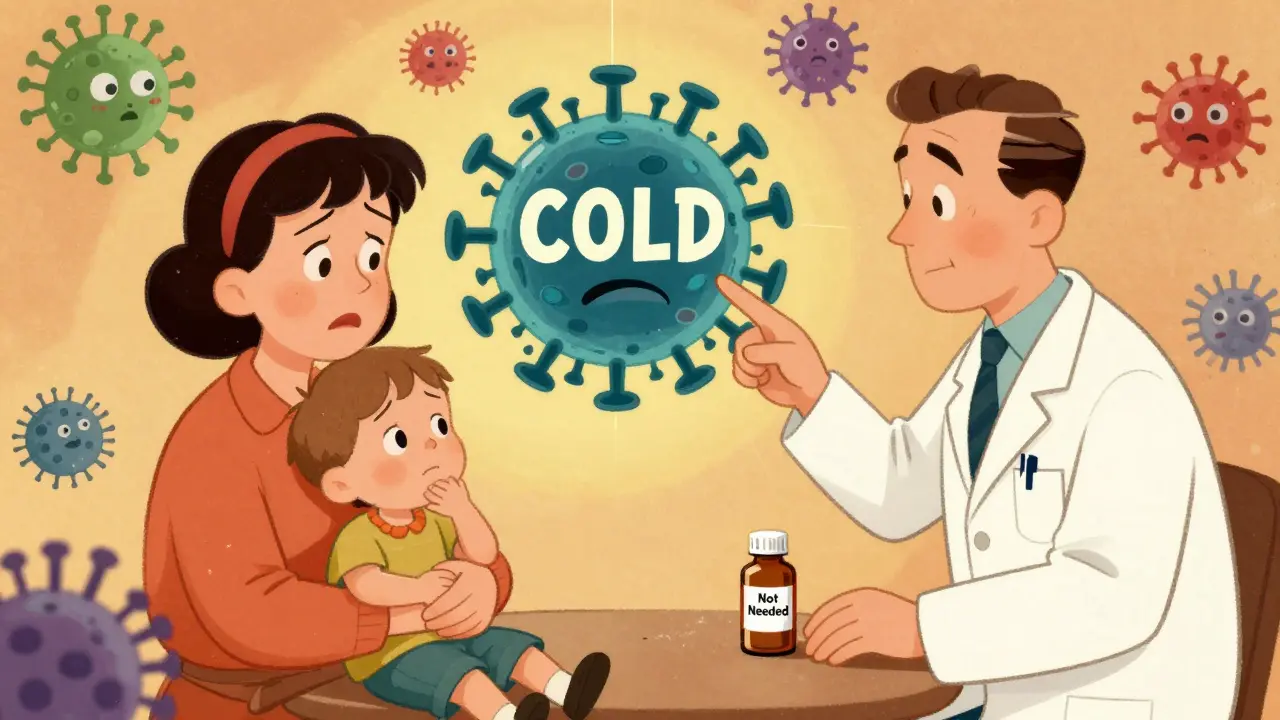
When your child is sick, it’s natural to want to fix it fast. A fever, a cough, a runny nose - it’s easy to assume antibiotics are the answer. But here’s the truth: antibiotics don’t work for most childhood illnesses. Giving them when they’re not needed doesn’t help your child get better faster. It just makes future infections harder to treat.
What Antibiotics Actually Do (and Don’t Do)
Antibiotics are powerful tools - but only against bacteria. They don’t touch viruses. And most childhood illnesses? They’re viral. A runny nose, a sore throat without fever, a cough that lasts two weeks - those are almost always viruses. In fact, 99% of vomiting and diarrhea cases in kids are viral. So are 90% of pneumonia cases. Even the green or yellow mucus you see? That’s normal during a cold. It doesn’t mean bacteria are in charge.
Only about 20% of sore throats are caused by strep bacteria. And only 10% of pneumonia cases need antibiotics. That means for every five kids with a cough or sore throat, four won’t benefit from antibiotics at all. Yet, 30% of antibiotic prescriptions for kids are unnecessary. That’s not just wasted medicine - it’s dangerous.
When Antibiotics Are Actually Needed
Doctors don’t guess. They look for clear signs. For strep throat, a rapid test or throat culture must come back positive. For ear infections, the eardrum has to be swollen, red, and painful - not just a little cloudy. For sinus infections, symptoms must last more than 10 days with thick, colored mucus and no improvement. Even then, some doctors wait 48-72 hours before prescribing, especially if the child isn’t in severe pain.
Here’s the list of infections that actually need antibiotics:
- Strep throat (confirmed by test)
- Acute otitis media (ear infection) with moderate to severe pain or fluid draining
- Bacterial sinusitis (symptoms lasting over 10 days)
- Pneumonia confirmed as bacterial (not viral)
- Whooping cough (pertussis)
- Urinary tract infections
For everything else - colds, flu, bronchiolitis, most coughs - antibiotics won’t help. And giving them anyway? It just increases the risk of side effects and resistance.
Common Side Effects in Kids
About 1 in 10 children will have a side effect from antibiotics. Most are mild, but they can be scary. The most common? Diarrhea. It happens in 5% to 25% of cases, depending on the antibiotic. Amoxicillin? Higher chance. Azithromycin? Lower. Nausea and vomiting show up in 3-10% of kids. Yeast infections (like diaper rash that won’t go away) happen in 1-5% of girls.
But the biggest issue isn’t just discomfort - it’s what antibiotics do to the good bacteria in your child’s gut. When those helpful microbes die off, bad bacteria like Clostridium difficile can take over. This causes severe diarrhea that can land kids in the hospital. In fact, 15-25% of antibiotic-related diarrhea cases in children are from this bug.
True Allergies vs. Side Effects
Parents often say, "My child is allergic to penicillin." But in 90% of cases, they’re wrong. A mild rash? That’s usually a side effect - not an allergy. True allergies involve swelling, hives, trouble breathing, or anaphylaxis. Those are rare: less than 0.1% of antibiotic courses cause them.
Here’s the key difference:
- Side effect: Rash without swelling or breathing trouble, nausea, diarrhea - happens during or right after the dose.
- True allergy: Hives, lip or tongue swelling, wheezing, passing out - happens fast, often within minutes.
And here’s the shocker: 95% of kids labeled "allergic" to penicillin because a parent or sibling was - actually aren’t. Testing can confirm this. If your child was told they’re allergic but never had a serious reaction, ask about getting tested. Avoiding penicillin unnecessarily means doctors have to use stronger, more expensive, and more risky drugs.
How Antibiotics Are Used in Kids
Not all antibiotics are the same. Each targets different bacteria. Here’s what’s commonly used:
- Amoxicillin: First choice for ear infections, sinus infections, and pneumonia. Usually given twice a day for 7-10 days. Dose is based on weight - 80-90 mg per kg per day.
- Cephalosporins (like cefdinir): Used if amoxicillin doesn’t work, or for complicated ear infections.
- Azithromycin: Given for whooping cough or milder pneumonia. Often just 3-5 days. Easy to take, but can cause more stomach upset.
Dosing matters. Too little won’t kill the bacteria. Too much raises side effect risk. Doctors calculate it by weight - not age. That’s why a 10-pound baby gets a different dose than a 60-pound child.
Why Completing the Course Matters
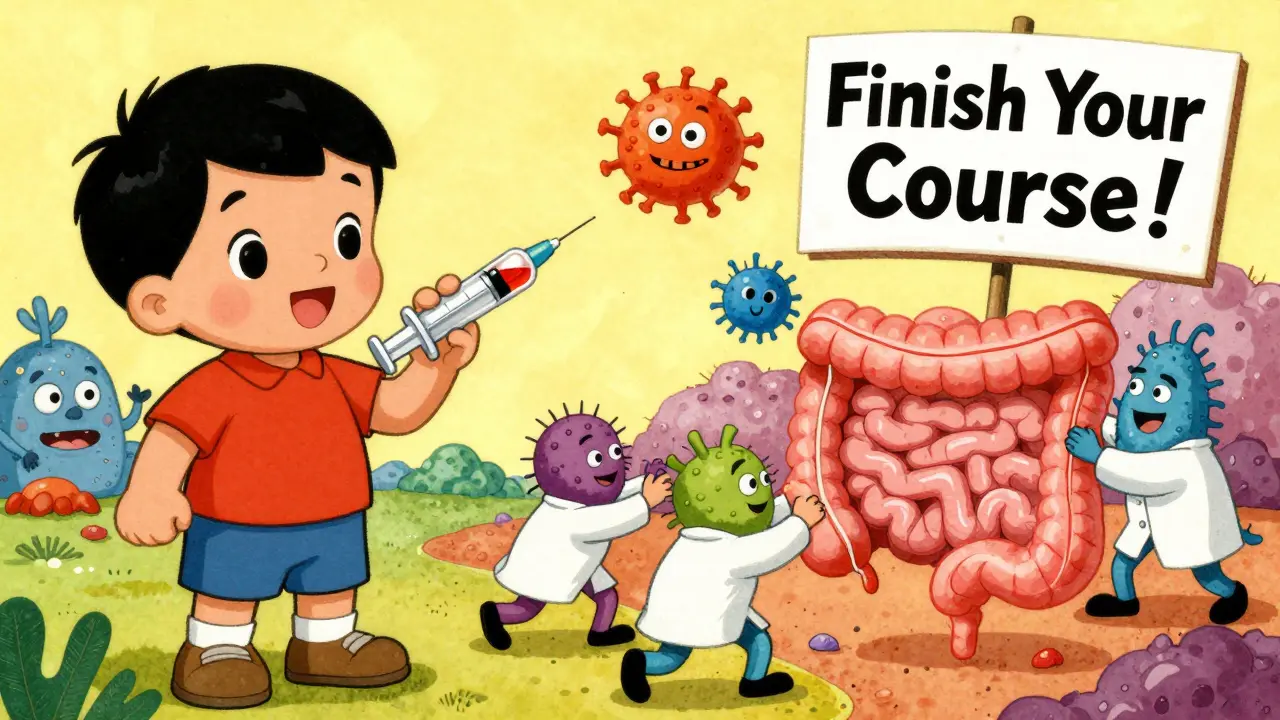
Many parents stop antibiotics early - when the fever breaks or the cough eases. But that’s a mistake. Stopping early doesn’t make your child sick again. It makes future infections harder to treat.
When you stop too soon, the toughest bacteria survive. They multiply. And now they’re resistant. That’s how we get superbugs like MRSA - methicillin-resistant Staphylococcus aureus. In kids, MRSA infections have jumped 150% since 2010. These infections don’t respond to common antibiotics. They need IV drugs, longer hospital stays, and cost far more.
Even if your child feels fine after two days, finish the full course. For amoxicillin, that’s 10 days. For azithromycin, it’s 5 days. No exceptions.
What to Do If Your Child Vomits
If your child throws up right after taking the dose:
- Within 30 minutes? Give the full dose again.
- Between 30 and 60 minutes? Give half the dose.
- After 60 minutes? Don’t repeat - wait for the next scheduled dose.
Don’t double up. That can lead to overdose. And if vomiting keeps happening, call your doctor. There may be a better option.
How to Get Kids to Take Their Medicine
Let’s be honest - most antibiotics taste awful. Nearly half of kids refuse to take them. Here’s what actually works:
- Mix with a small spoonful of chocolate syrup, applesauce, or yogurt. Not a whole cup - you don’t want them to eat the whole dose.
- Use a dosing syringe. Spray it gently inside the cheek, not down the throat. It’s less likely to trigger gagging.
- Ask your pharmacy about flavoring. Many can add strawberry, bubblegum, or grape.
- Don’t mix with juice or milk unless the label says it’s okay. Some antibiotics don’t absorb well with dairy.
And never hide the medicine in a full meal. That can mess with absorption. Small amounts - one or two spoonfuls - are best.
The Real Danger: Antibiotic Resistance
Every time we use antibiotics when they’re not needed, we make the problem worse. Bacteria evolve. They learn to survive. Now, 47% of the bacteria that cause ear infections and pneumonia in kids are resistant to penicillin. That’s up from 35% just 10 years ago.
In the U.S., antibiotic-resistant infections cause 2.8 million illnesses and 35,000 deaths every year. Kids aren’t immune. In fact, they’re often the ones who get hit hardest because their immune systems are still learning.
And it’s expensive. Unnecessary prescriptions cost $1.1 billion a year. Treating the resistant infections they cause? Another $3.5 billion.
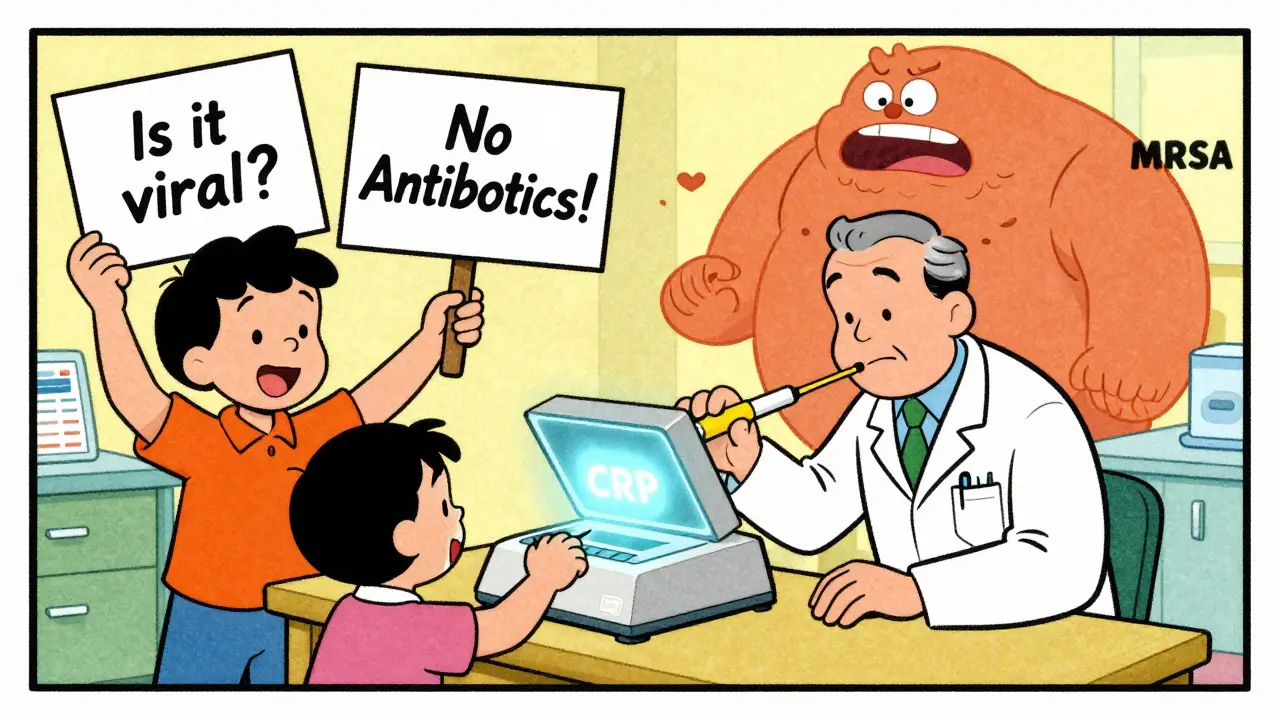
There’s hope. New tools are here. In January 2023, the FDA approved a rapid test that tells doctors in six hours which antibiotic will work - instead of waiting three days. In clinics using CRP blood tests to tell viral from bacterial infections, antibiotic use dropped by 85%.
What Parents Can Do
You’re not powerless. Here’s how you help:
- Don’t ask for antibiotics. If your child has a cold, ask: "Could this be viral?"
- Don’t use leftover antibiotics. Never give your child someone else’s medicine.
- Keep track of symptoms. If your child doesn’t improve in 48-72 hours, call back.
- Ask about testing. Can we test for strep? Can we check for bacterial infection?
- Know the signs of true allergy. If your child has swelling, trouble breathing, or hives, get help immediately.
And remember: fever doesn’t mean bacteria. Most viral illnesses last 7-10 days. That’s normal. Antibiotics won’t make it faster.
What’s Changing in 2026
Doctors are getting smarter. New guidelines from the CDC and American Academy of Pediatrics push for "watchful waiting" - especially for ear infections in kids over 6 months. If the child isn’t in severe pain and the fever is low, wait 48 hours. Most get better on their own.
Procalcitonin blood tests, which detect bacterial infection with 90% accuracy, are now being used in pediatric clinics. Studies show they cut unnecessary antibiotic use by 62% without missing a single serious case.
The message is clear: We have to stop treating every sick kid like they need antibiotics. The drugs we have now are precious. If we keep using them carelessly, we’ll run out of options. And when that happens, even simple infections could become deadly again.
Can antibiotics treat a cold or the flu?
No. Colds and flu are caused by viruses. Antibiotics only work against bacteria. Giving them for a cold doesn’t help, and it increases the risk of side effects and antibiotic resistance.
Is a rash from antibiotics always an allergy?
No. Most rashes (80-90%) are side effects, not allergies. True allergies include hives, swelling of the face or lips, wheezing, or trouble breathing. If your child only has a mild rash without other symptoms, it’s likely not an allergy - but talk to your doctor before giving the same antibiotic again.
Should I stop antibiotics if my child feels better?
No. Always finish the full course, even if symptoms disappear. Stopping early lets the toughest bacteria survive and multiply, leading to antibiotic-resistant infections that are harder to treat.
Are green or yellow snot a sign of bacterial infection?
No. Nasal mucus changes color during a viral cold - it’s normal. Green or yellow discharge doesn’t mean antibiotics are needed. Antibiotics are only considered if symptoms last more than 10 days or get worse after improving.
Can I give my child leftover antibiotics from a previous illness?
Never. Leftover antibiotics may not match the current infection, could be expired, or may have been stored improperly. Giving the wrong medicine can delay proper treatment and increase the risk of side effects or resistance.
Milad Jawabra
March 4, 2026 AT 15:56Bro, I get it - you wanna fix your kid fast. But antibiotics aren’t magic pills. I gave my 4-year-old amoxicillin for a cough that lasted 10 days, and he got diarrhea so bad we had to go to urgent care. Turns out? Viral. Now I just wait. Let their immune system do its job. 🤷♂️
Raman Kapri
March 5, 2026 AT 00:26It is imperative to note that the empirical administration of antimicrobial agents in pediatric populations without confirmatory diagnostic criteria constitutes a significant public health hazard. The data presented herein, while statistically robust, fails to account for regional variations in microbial resistance profiles, particularly in developing economies where diagnostic infrastructure is lacking.
Tildi Fletes
March 5, 2026 AT 01:14Thank you for this meticulously researched post. As a pediatric nurse with 18 years of experience, I’ve seen too many parents panic when mucus turns green. It’s not a bacterial flag - it’s the immune system doing its job. I always tell families: "Wait 72 hours. Monitor for worsening symptoms. Call if fever spikes or they stop drinking." Simple. Effective.
Divya Mallick
March 5, 2026 AT 13:21Let me tell you something - this whole "antibiotics are bad" narrative is a corporate scam pushed by Big Pharma to sell $300 rapid tests and probiotic gummies. My cousin’s son got pneumonia, and the doctor said "wait and see" - three days later, he was in the ICU. Who’s to blame? The doctor? Or the idiots who think nature will fix everything? We’re raising a generation of fragile kids because people think "natural" means "safe."
Callum Duffy
March 6, 2026 AT 21:52This is one of the clearest, most balanced summaries on pediatric antibiotic use I’ve read. I’m a GP in Scotland, and we’ve adopted watchful waiting for otitis media since 2021. The drop in unnecessary prescriptions has been dramatic. What’s more, parents are now asking better questions. Education works. Thank you for the evidence-based clarity.
Chris Beckman
March 8, 2026 AT 10:08my kid got a rash on amoxicillin and now they wont let us use it even tho the doc said it wasnt an allergy and we got tested and it was fine but now they give him cefdinir which costs 3x more and he pukes it up. why is this so hard??
Levi Viloria
March 9, 2026 AT 01:33Coming from a culture where antibiotics were given for every sniffle - I’m glad I learned this the hard way. In my village in Mexico, kids used to get IV antibiotics for fevers. Now I live in the U.S., and my daughter had a 7-day cold. I didn’t panic. I gave her honey, fluids, and rest. She’s fine. It’s not weakness to wait - it’s wisdom.
Richard Elric5111
March 10, 2026 AT 08:43One cannot help but observe the anthropological irony inherent in our contemporary medical paradigm: we have elevated pharmaceutical intervention to the status of a sacrament, even as we simultaneously deify the notion of "natural immunity." The child’s body, in its inherent capacity for self-regulation, is not an obstacle to be overcome - it is the very temple of healing. To administer antibiotics indiscriminately is not to cure - it is to perform a ritual of control over the organic, and in doing so, we risk the erosion of biological autonomy itself.
Dean Jones
March 10, 2026 AT 12:40Let’s be real - we’ve been lied to for decades. The whole "finish the course" thing? That was invented by drug companies to sell more pills. There’s zero evidence that stopping early causes resistance. In fact, the WHO says the opposite - that longer courses increase resistance risk. I read the 2022 Cochrane review. It showed no difference in outcomes between 5-day and 10-day courses for ear infections. But doctors? They’re still teaching the old dogma. Why? Because they were taught it. And because pharmaceutical reps still give them free pens. We’re not fixing a medical problem - we’re fixing a systemic lie.
Betsy Silverman
March 11, 2026 AT 02:27I love how this post breaks down the myths. My daughter had a rash on amoxicillin - we thought it was an allergy. Turns out, it was just a viral rash that coincided with the meds. We got her tested last year - she’s not allergic. Now we use penicillin for every infection. It’s cheaper, gentler, and more effective. If you’ve been told your kid is allergic - get tested. It’s a game-changer.
Helen Brown
March 12, 2026 AT 11:42What if the government is using this to control us? What if antibiotics are being withheld so they can push vaccines? I read a guy on YouTube who said the CDC is working with Big Pharma to make kids dependent on future drugs. I’m not saying it’s true… but why won’t they let us use leftover meds? Something’s off.
John Cyrus
March 12, 2026 AT 17:09Stop giving kids antibiotics for colds. It’s common sense. My kid had a cough for two weeks and I didn’t even ask for meds. He’s fine. Stop being so scared. Let them get sick. It builds immunity. Also stop using syringes - just pour it in their mouth. Kids don’t need fancy tricks. They need discipline.