
Macrolides and QT-Prolonging Drugs: Understanding the Arrhythmia Risk
 Mar, 10 2026
QT Prolongation Risk Calculator
Personal Risk Assessment
This tool helps you understand your risk of QT prolongation when taking macrolide antibiotics based on your medical profile.
Risk Assessment Results
Recommendations
When you take an antibiotic like azithromycin for a stubborn chest infection, you’re probably not thinking about your heart. But for some people, that common prescription could be setting off a silent alarm in their cardiac rhythm. Macrolide antibiotics - including azithromycin, clarithromycin, and erythromycin - are among the most prescribed antibiotics in the world. They’re used for pneumonia, sinus infections, bronchitis, and even acne. But behind their widespread use is a hidden danger: they can disrupt the heart’s electrical system and trigger a rare, life-threatening arrhythmia called Torsades de Pointes.
How Macrolides Mess With Your Heart’s Timing
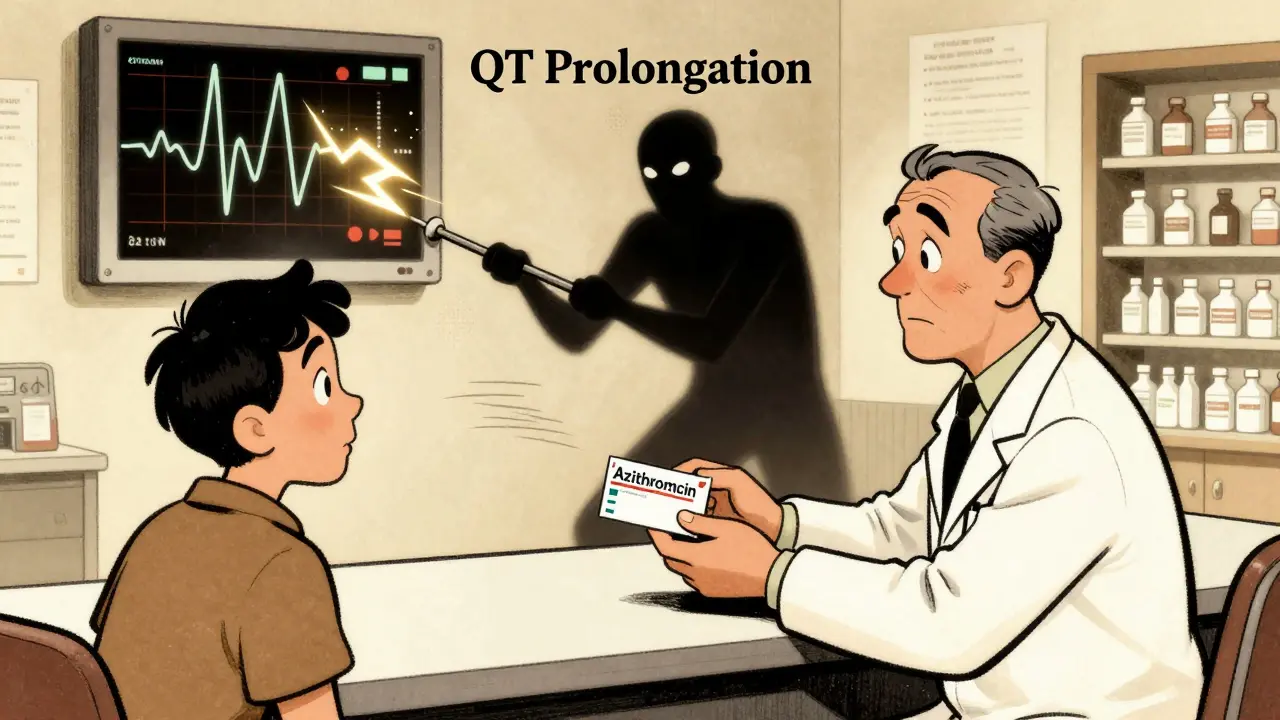
Your heart beats because of carefully timed electrical signals. Each beat starts with a spark in the sinoatrial node, then races through the chambers, making the muscle contract. The pause between beats - called the QT interval - is measured on an ECG. It represents how long the heart takes to recharge after each contraction. If that interval gets too long, the heart can fire off chaotic signals instead of a steady rhythm. That’s Torsades de Pointes: a twisting, irregular fast heartbeat that can lead to fainting, seizures, or sudden cardiac arrest.
Macrolides interfere with a key potassium channel in heart cells called IKr, encoded by the HERG gene. This channel normally helps the heart reset after beating. When it’s blocked, the heart takes longer to recharge. Think of it like a car that can’t brake properly - the electrical system just keeps running. The result? A longer QT interval on your ECG. This isn’t theoretical. Studies show clarithromycin can lengthen QT by 10-20 milliseconds, azithromycin by 5-10 ms. That might sound small, but in the wrong person, it’s enough to tip the balance into dangerous territory.
Not All Macrolides Are Created Equal
Many assume azithromycin is the safest macrolide because it’s often marketed as "less likely" to cause side effects. But that’s misleading. While it’s true that azithromycin doesn’t strongly inhibit liver enzymes (CYP3A4) like clarithromycin does - which means fewer drug interactions - it still blocks the IKr channel. The 2012 NEJM study by Wayne Ray showed azithromycin users had nearly triple the risk of cardiovascular death compared to those taking amoxicillin. Later studies tried to dismiss this, blaming "confounding by indication" - meaning sicker patients were more likely to get azithromycin anyway. But even after adjusting for 108 variables, the signal didn’t vanish completely.
Clarithromycin, on the other hand, is the clear worst actor. It’s the most potent IKr blocker among macrolides. Data from the FDA’s Adverse Event Reporting System shows clarithromycin accounted for 58% of all QT-related events, even though it’s only prescribed in about 15% of macrolide cases. It’s also more likely to cause early afterdepolarizations - tiny, abnormal electrical sparks that can trigger TdP. Erythromycin sits in the middle, but it’s rarely used today because of its nasty stomach side effects.
There’s one exception: solithromycin. This newer ketolide antibiotic was designed to avoid QT prolongation. Clinical trials showed no significant effect on the QT interval. Unfortunately, it was rejected by the FDA in 2016 due to liver toxicity - a reminder that fixing one safety issue doesn’t always solve the whole problem.
Who’s Really at Risk?
The good news? For most healthy people, the risk is tiny. Studies estimate only 3-7 cases of TdP per million macrolide courses. But risk isn’t about averages - it’s about who you are when you take the drug.
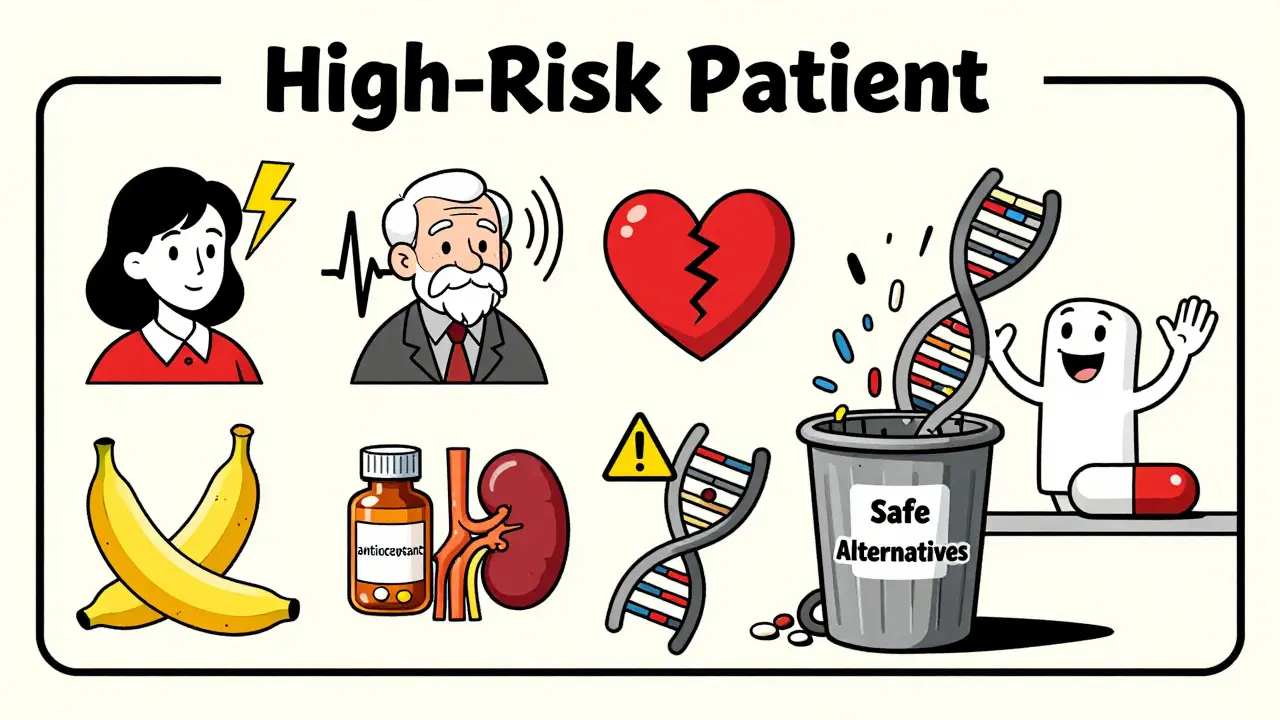
The American Heart Association lists seven major risk factors that multiply danger:
- Female sex - women are 2 to 3.5 times more likely to develop TdP
- Age over 65 - older hearts are more sensitive to electrical changes
- Structural heart disease - heart failure, past heart attack, or enlarged heart
- Low potassium or magnesium - electrolyte imbalance is a major trigger
- Concurrent QT-prolonging drugs - mixing macrolides with antidepressants, antifungals, or antiarrhythmics is like lighting a fuse
- Renal impairment - kidneys clear these drugs; if they’re slow, levels build up
- Genetic predisposition - inherited long QT syndrome can turn a routine antibiotic into a cardiac emergency
Combine just two of these - say, a 70-year-old woman with low potassium on azithromycin - and your risk jumps 24-fold. A 2022 JAMA Internal Medicine study found that 42% of macrolide prescriptions in cardiac patients involved another QT-prolonging drug. That’s not a coincidence - it’s a pattern of dangerous polypharmacy.
What Doctors Should Do - And Often Don’t
Guidelines are clear. The AHA recommends a three-step approach before prescribing:
- Screen for risk factors - check ECG for baseline QTc (over 450 ms in men, 470 ms in women), review meds, ask about heart history, check potassium levels
- Choose alternatives - for high-risk patients, use doxycycline, amoxicillin, or cefdinir instead
- Monitor - if you must use a macrolide, repeat the ECG after 3-5 days, especially if given IV
But in real clinics? Many don’t. A 2023 survey of physicians on the American College of Physicians forum showed only 62% routinely check potassium before prescribing macrolides to high-risk patients. Nearly 4 out of 10 wait for symptoms - like dizziness or palpitations - to appear. That’s too late.
Some health systems are fixing this. Kaiser Permanente added automated QT risk alerts to their electronic health record in 2017. The result? A 28% drop in high-risk macrolide prescriptions. That’s not magic - it’s smart design. When the system flags a 78-year-old on amiodarone who’s about to get azithromycin, the doctor sees it before clicking "approve."
The Bigger Picture: Why This Matters
Macrolides are still among the top 15 most prescribed drugs in the U.S. Azithromycin alone had 26.7 million prescriptions in 2022. That’s millions of hearts being exposed to a known, preventable risk. The problem isn’t the drug - it’s how we use it. We prescribe them for viral infections, for minor coughs, for patients who don’t need antibiotics at all. And when we do, we rarely pause to ask: "Is this person at risk?" The European Heart Rhythm Association puts it best: "The absolute risk remains low for most patients." But "most" doesn’t mean "all." For the 1 in 10,000 who develops TdP, it’s 100% serious. And we’ve seen the outcomes - 17 cases of cardiac arrest linked to macrolides between 2015 and 2022, 11 of them from clarithromycin. Most involved patients with undiagnosed long QT syndrome.
What You Can Do
If you’re prescribed a macrolide:
- Ask: "Is this the safest option for me?"
- Know your heart history - have you ever passed out for no reason? Had unexplained seizures? Any family member who died suddenly under 50? Tell your doctor.
- Check your meds - are you on antidepressants, antifungals, or heart meds? Bring a full list.
- Get your potassium checked if you’re over 65, have kidney disease, or take diuretics.
- If you feel dizzy, lightheaded, or have palpitations after starting the drug, stop and call your doctor. Don’t wait.
Doctors need to stop treating macrolides as "harmless." They’re not. And patients need to stop assuming antibiotics are always safe. The risk is low - but not zero. And when it hits, it hits hard.
Can azithromycin really cause sudden cardiac death?
Yes, though it’s rare. The 2012 NEJM study by Ray et al. found azithromycin was linked to a 2.88-fold increased risk of cardiovascular death compared to amoxicillin in high-risk patients. This translated to about 152 extra deaths per million 5-day courses. While later studies questioned whether this was due to underlying illness, the FDA still lists azithromycin as a "known risk" for QT prolongation. The risk is real, especially in people with heart conditions, low potassium, or on other QT-prolonging drugs.
Is clarithromycin more dangerous than azithromycin?
Yes, significantly. Clarithromycin is a stronger blocker of the IKr potassium channel, leading to greater QT prolongation (10-20 ms vs. 5-10 ms for azithromycin). It’s also more likely to cause early afterdepolarizations that trigger Torsades de Pointes. In FDA data, clarithromycin accounted for 58% of all macrolide-related QT events despite being prescribed less often. For high-risk patients, clarithromycin should be avoided entirely.
What are safer antibiotic alternatives to macrolides?
For most respiratory infections, alternatives with minimal cardiac risk include amoxicillin, doxycycline, cefdinir, or amoxicillin-clavulanate. Fluoroquinolones like levofloxacin also prolong QT and should be avoided in high-risk patients. The choice depends on the infection - but if you have heart disease, kidney issues, or are on multiple meds, ask your doctor if a non-macrolide option is possible.
Should I get an ECG before taking azithromycin?
If you’re over 65, have heart disease, take diuretics, or are on other QT-prolonging drugs, yes. A baseline ECG can reveal if your QT interval is already long. If it’s above 450 ms (men) or 470 ms (women), avoid macrolides. Even if you’re young and healthy, if you’ve ever fainted for no reason or have a family history of sudden cardiac death, get checked. Prevention is simple - a 10-minute ECG can prevent a cardiac arrest.
Can low potassium make macrolides more dangerous?
Absolutely. Low potassium (hypokalemia) is one of the strongest triggers for Torsades de Pointes. It makes the heart more electrically unstable. Macrolides already slow repolarization; low potassium makes it worse. If you’re on diuretics, have vomiting/diarrhea, or are elderly, ask your doctor to check your potassium before prescribing any macrolide. A simple blood test can prevent disaster.
Chris Bird
March 12, 2026 AT 02:45Man, I saw my uncle drop dead after a Z-pack. No history, no symptoms, just gone. Docs said it was "lucky" he got sick in the first place. Bullshit. They don’t check potassium. They don’t check ECGs. They just hand out azithromycin like candy. And we wonder why people die in their sleep.
Shourya Tanay
March 12, 2026 AT 21:20The IKr channel blockade by macrolides is a well-documented electrophysiological phenomenon, particularly concerning the hERG potassium channel’s role in phase 3 repolarization. The magnitude of QT prolongation, even if statistically modest (5–20 ms), becomes clinically significant when compounded by pharmacokinetic interactions, electrolyte derangements, or genetic variants in KCNH2. The risk stratification paradigm must evolve beyond population averages to incorporate dynamic, patient-specific risk matrices.
Mike Winter
March 13, 2026 AT 09:31It’s funny how we treat antibiotics like harmless magic pills. We’ve forgotten that medicine isn’t about curing the illness-it’s about not killing the patient in the process. I mean, if we’re okay with giving someone a drug that can trigger cardiac arrest… what’s next? Prescribing aspirin to people with hemophilia? We’re not being careful. We’re being lazy.
Randall Walker
March 14, 2026 AT 03:40Ohhh so now we’re blaming antibiotics for sudden death?? Next you’ll tell me that breathing air can cause lung cancer if you’re allergic to oxygen. I mean, sure, there’s a 1 in 10,000 chance… but hey, I got hit by lightning twice and still won the lottery. So… I guess we’re all fine?? 😅
Miranda Varn-Harper
March 14, 2026 AT 21:45While I appreciate the thoroughness of this exposition, I must respectfully challenge the implicit assumption that medical decision-making should be dictated by statistical outliers. The principle of beneficence requires that we prioritize the greatest good for the greatest number. To withhold macrolides from millions due to an exceedingly rare adverse event is not clinical wisdom-it is medical overreach masquerading as caution.
Alexander Erb
March 15, 2026 AT 08:42My grandma took azithromycin for bronchitis and was fine. But she also had her potassium checked, her meds reviewed, and her ECG done. Why? Because her doctor actually cared. It’s not the drug-it’s the system. If your doc doesn’t ask you 3 questions before prescribing, find a new one. Seriously. 💯
Donnie DeMarco
March 15, 2026 AT 23:47Clarithromycin? Bro, that stuff’s a cardiac grenade. I had a friend who took it for a sinus infection and woke up in the ER with his heart doing the cha-cha. They had to zap him twice. Azithromycin? Meh. But still… if you’re 70, on a water pill, and got a history of fainting? Don’t be a hero. Just say no. 🚫❤️
LiV Beau
March 16, 2026 AT 19:49I’m a nurse, and I’ve seen this too many times. A patient comes in with a cough, gets a Z-pack, and two days later they’re dizzy. We check the ECG-QTc is 580. They’re on fluoxetine and furosemide. No one asked about meds. No one checked labs. It’s not the antibiotic’s fault. It’s our fault. We’re not connecting dots. Let’s fix that.
Adam Kleinberg
March 17, 2026 AT 16:26They say macrolides cause arrhythmias but what they don’t tell you is Big Pharma knew this for decades. They buried the data. They funded "studies" to "disprove" it. The FDA? Bought and paid for. And now they want you to believe this is just "bad luck." Wake up. This is a manufactured crisis to keep you dependent on pills you don’t need.
Denise Jordan
March 18, 2026 AT 13:51I read all this. Boring. I just want to know if I can still get my azithromycin for my cold. I’m 30, healthy, no meds. Can I or not? Just give me a yes or no. I’m not here for a medical lecture.
Gene Forte
March 20, 2026 AT 02:41Every life matters. Even the one in 10,000. Even the one who never had a chance to ask. We don’t need more statistics-we need more courage. Courage to pause. To ask. To check. To choose the safer path-even when it’s harder. That’s not overcaution. That’s care.
Kenneth Zieden-Weber
March 21, 2026 AT 00:07So let me get this straight… you’re telling me a 68-year-old woman on lisinopril and hydrochlorothiazide, with a history of fainting and a family member who died at 42 from "unknown causes"-you’re still giving her azithromycin because "it’s just a cough"? What planet are you from? 😏
David L. Thomas
March 22, 2026 AT 07:26QT prolongation isn’t the only issue. The real tragedy is how often we miss inherited long QT syndrome. I had a patient who had two cardiac arrests on azithromycin. Turned out his dad died at 31 during a flu. Genetic testing revealed LQT2. That’s not coincidence. That’s a family time bomb. We need to screen high-risk families. Not just check labs.
Bridgette Pulliam
March 22, 2026 AT 22:26As someone who works in primary care, I’ve started requiring a quick ECG for anyone over 60 before prescribing any macrolide. It takes 5 minutes. It costs $20. It saves lives. We don’t need new drugs. We just need to stop being lazy. And maybe-just maybe-start listening to patients who say, "I’ve passed out before."