
Affirmative Consent Laws: Clarifying Patient Permission for Medical Substitution
 Mar, 17 2026
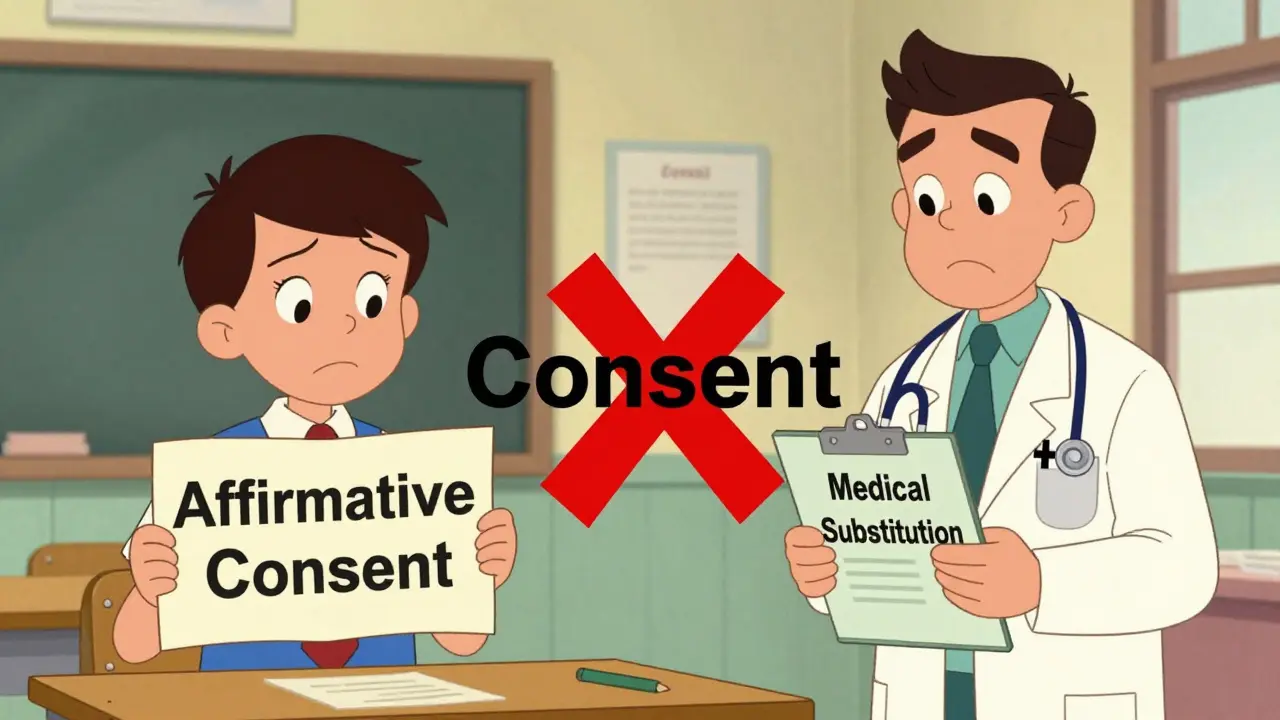
There’s a common mix-up out there: people think affirmative consent laws apply to medical decisions. They don’t. Not even close. If you’ve heard someone say, "You need affirmative consent to substitute a patient’s decision," they’re mixing two completely different legal systems. One is about sex. The other is about medicine. And confusing them can hurt real people.
What Affirmative Consent Actually Means
Affirmative consent laws were created to change how we talk about sexual activity. They started appearing in U.S. states around 2014, with California leading the way through Senate Bill 967. These laws say: no means no isn’t enough. You need a clear, ongoing, voluntary "yes." It’s not just silence. Not just lack of resistance. It’s active, conscious agreement - verbal or physical - that can be withdrawn at any time.This standard is used in college policies, campus investigations, and sexual assault cases. It’s meant to protect people in situations where power imbalances, intoxication, or fear can make "no" hard to say. It’s about communication, autonomy, and stopping harm in intimate contexts.
But none of this applies to hospitals, clinics, or doctors’ offices.
How Medical Consent Actually Works
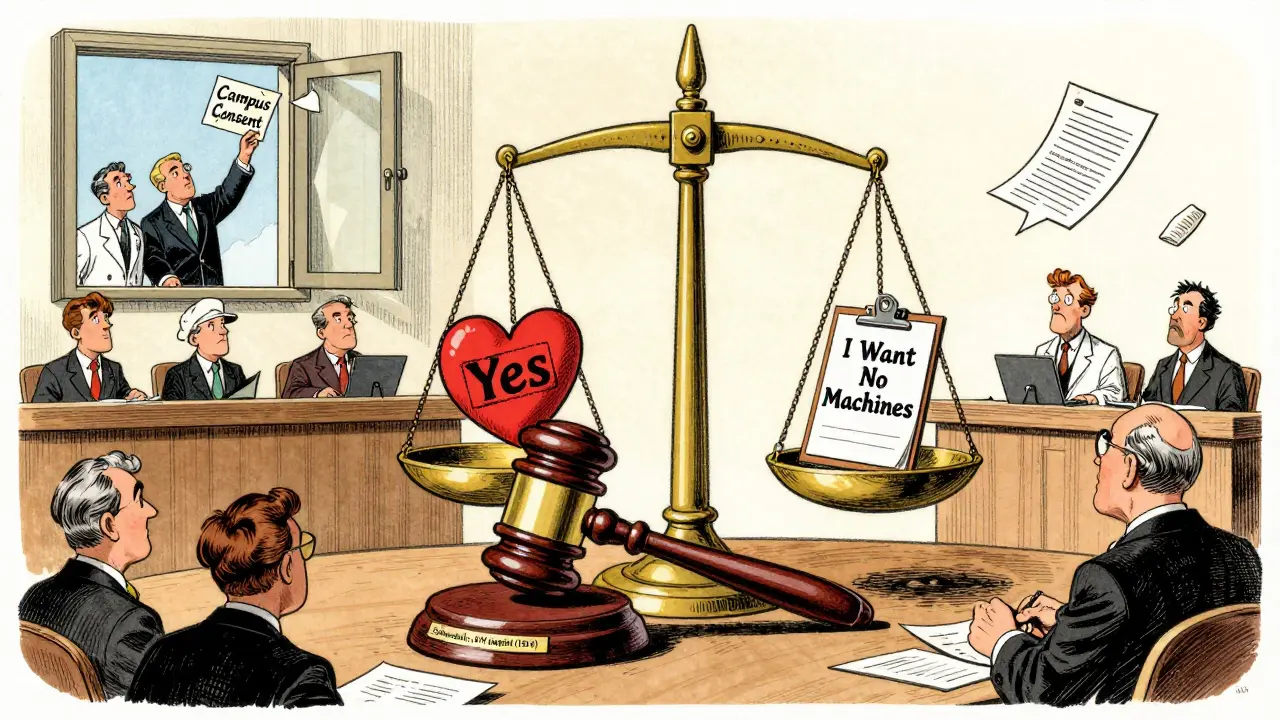
When a patient can’t make their own medical decisions - say, because they’re unconscious, severely demented, or under sedation - the law doesn’t ask for "affirmative consent." It asks: "What would this person have wanted?" That’s called substituted judgment. It’s not a guess. It’s a legal standard based on the patient’s known values, past statements, religion, or lifestyle. If a patient once said, "I never want to be kept alive on a machine," and they’re now in a coma, their family or legal representative is expected to honor that, not decide what they think is "best."If there’s no advance directive or known preference, then the decision shifts to the best interest standard. Here, providers and surrogates weigh risks, benefits, and quality of life - but still, no one asks for a "yes" in the way affirmative consent requires.
The legal foundation for this goes back over a century. In 1914, a court ruled in Schloendorff v. Society of New York Hospital that every adult has the right to decide what happens to their body. That became the bedrock of informed consent. Today, it’s written into state health codes. In California, Health and Safety Code Section 7185 spells it out clearly: substitute decision-makers must follow the patient’s wishes, not their own.
Why Mixing These Two Systems Is Dangerous
Imagine a nurse, trained on campus sexual assault policies, walks into an ICU and says, "We need affirmative consent from the family before we proceed." That’s not just wrong - it’s dangerous.Medical emergencies don’t wait for conversations. A patient in cardiac arrest needs CPR. A child with a ruptured appendix needs surgery. If staff delay care because they’re waiting for a "yes" that the law doesn’t require, lives are at risk.
And it’s not just about speed. It’s about trust. Families are already under stress. They don’t need to be told they must "actively affirm" a decision to allow a blood transfusion. They need clear information: "Here’s what’s happening. Here’s what we can do. Here’s what your loved one would have wanted."
Medical ethicists like Dr. Ezekiel Emanuel have pointed out that applying sexual consent standards to medicine creates confusion and undermines real patient autonomy. You can’t ask a grieving spouse to give "enthusiastic" consent to a ventilator wean. You can ask them: "Did your partner ever say they didn’t want to be kept alive like this?"

What the Law Actually Says About Substitution
Let’s break it down with real examples:- California: If a patient has an advance directive, that’s legally binding. If not, a spouse, adult child, or parent can decide - based on what the patient would have chosen. No "yes" required.
- New York: The Health Care Proxy Law lets you name someone ahead of time. That person doesn’t need to get verbal approval every time - they just act according to your known wishes.
- Washington: The Natural Death Act allows surrogates to make decisions if the patient lacks capacity. Again, substituted judgment is the rule.
- Minor consent: In some states, minors as young as 12 can consent to treatment for STDs, mental health, or substance abuse. That’s not affirmative consent - it’s statutory capacity.
None of these rely on the "yes means yes" model. They rely on documentation, prior statements, legal authority, and ethical duty.
Where the Confusion Comes From
You’ll hear this mix-up everywhere - especially on college campuses. Universities have trained students on affirmative consent for sexual relationships. Many students then assume the same rules apply to medical care. A 2023 survey at the University of Colorado Denver found 78% of undergraduates couldn’t tell the difference between sexual and medical consent.Even medical students get confused. A Reddit thread from January 2023 with over 1,200 upvotes had one top comment: "Affirmative consent is for sexual activity policies on campus; medical consent uses different standards based on patient capacity and disclosure requirements."
Why does this matter? Because when people believe the wrong thing, they make bad decisions. A family might refuse life-saving treatment because they think they didn’t "affirm" it properly. A doctor might hesitate to act because they’re afraid of violating a law that doesn’t exist in their field.
The Real Legal Tools for Medical Substitution
If you want to make sure your wishes are followed if you can’t speak for yourself, here’s what actually works:- Advance Healthcare Directive: A written document where you name a proxy and state your treatment preferences. This is legally binding in all 50 states.
- Do Not Resuscitate (DNR) Order: A specific instruction to medical staff not to perform CPR if your heart stops.
- Power of Attorney for Health Care: Gives someone legal authority to make decisions on your behalf.
- Conversation with family: Talk to your loved ones. Tell them what you want. Write it down. Don’t assume they’ll guess right.
None of these require anyone to say "yes" out loud. They require clarity, documentation, and respect.
What Happens If You Ignore This
In February 2023, the California Supreme Court ruled in Doe v. Smith that affirmative consent laws apply only to sexual misconduct under Title IX and education codes. They explicitly said: "This standard does not govern medical consent scenarios."The Federation of State Medical Boards issued a March 2023 advisory warning providers: "Applying sexual consent standards to medical decision-making creates unnecessary barriers to urgent care and misunderstands the legal foundations of medical consent."
The American Medical Association updated its ethics guidelines in 2023 to say the same thing: "Physicians should not apply sexual consent standards to medical decision-making processes."
These aren’t opinions. These are official positions from legal and medical authorities.
Bottom Line
Affirmative consent laws are important - but they’re for sex, not surgery. Medical substitution is about knowing what a person wanted, not getting a new "yes" every time.If you’re a patient: document your wishes. Talk to your family. Don’t assume anyone will guess right.
If you’re a caregiver: follow the law. Use substituted judgment. Don’t confuse sexual consent policies with medical ethics.
If you’re a provider: educate your team. Correct the myth. Don’t let outdated training put patients at risk.
The law is clear. The science is clear. And the stakes? They couldn’t be higher.
Nilesh Khedekar
March 18, 2026 AT 15:05Gaurav Kumar
March 20, 2026 AT 00:44David Robinson
March 21, 2026 AT 03:56Laura Gabel
March 22, 2026 AT 01:05Andrew Mamone
March 23, 2026 AT 12:37MALYN RICABLANCA
March 23, 2026 AT 18:09Sanjana Rajan
March 23, 2026 AT 21:24Kyle Young
March 24, 2026 AT 12:39Aileen Nasywa Shabira
March 25, 2026 AT 13:57Melissa Starks
March 26, 2026 AT 11:35Lauren Volpi
March 28, 2026 AT 06:30Melissa Stansbury
March 29, 2026 AT 04:40Amadi Kenneth
March 29, 2026 AT 15:19