
Which Statins Cause the Most Muscle Pain? Real Data on Risk and Relief
 Jan, 18 2026
Statin Muscle Pain Risk Calculator
Assess Your Statin Muscle Pain Risk
This tool helps determine if your muscle pain is likely statin-related based on clinical evidence. Results are based on the 2022 Lancet study and other major research.
Your Risk Assessment
Recommended action:
Your doctor may suggest continuing this statin or trying a re-challenge test to confirm if symptoms are statin-related.
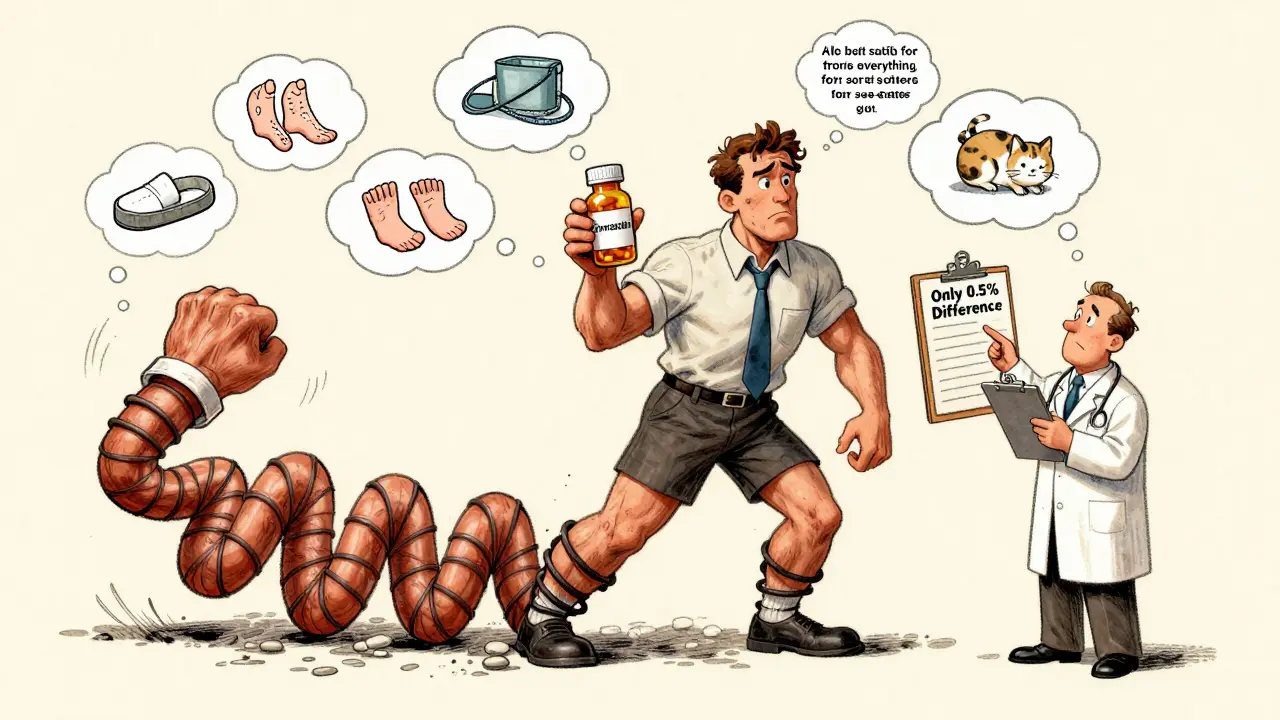
More than 30 million people in the U.S. take statins every day. They’re one of the most studied, most prescribed, and most effective drugs for preventing heart attacks and strokes. But if you’ve ever stopped taking one because of muscle pain, you’re not alone. Many people blame statins for cramps, weakness, or aching legs. The problem? Statins are rarely the real cause.
Most Muscle Pain Isn’t From Statins
A massive 2022 study in The Lancet looked at over 123,000 people across 23 clinical trials. Half took statins. Half took sugar pills. The results? 27.1% of statin users reported muscle pain. So did 26.6% of people on placebo. That’s a difference of just 0.5%. In plain terms: for every 1,000 people on statins, only about 11 extra cases of muscle pain were linked to the drug in the first year. For most, it’s coincidence, not causation. This isn’t a fluke. It’s backed by decades of research. The nocebo effect - where you feel side effects because you expect them - plays a huge role. If you’ve heard stories about statins wrecking your muscles, your brain starts looking for any ache and blames the pill. A 2023 study at the Mayo Clinic showed that when patients were given a blinded challenge (not knowing if they were on statin or placebo), nearly half had symptoms on both. The drug wasn’t the trigger. Their fear was.Not All Statins Are Created Equal
Even if you do have true statin-related muscle pain, the risk isn’t the same for every drug. Some statins are far more likely to cause issues than others. The key factors? How the body processes them and how strong they are. Here’s the real risk ranking, based on multiple studies including the 2015 SUNY analysis and 2013 Circulation meta-analysis:- Simvastatin - Highest risk. Odds of muscle pain are nearly 80% higher than pravastatin. This is especially true at doses above 40 mg. Many patients report cramping, especially in the thighs or calves.
- Atorvastatin - Moderate risk. Commonly prescribed, but still linked to more muscle complaints than some alternatives. Often blamed because it’s so widely used.
- Rosuvastatin - Slightly higher risk than pravastatin. More potent, but less lipophilic than simvastatin, so it doesn’t penetrate muscle tissue as easily.
- Pravastatin - Low risk. Water-soluble, so it stays mostly in the liver. Less likely to reach muscle cells. Often the first switch for patients with muscle complaints.
- Fluvastatin - Lowest risk. Used less often, but has the cleanest safety profile for muscles. Best choice if you’ve had issues before.
Why does this matter? Because if you’re on simvastatin and your legs hurt, switching to pravastatin or fluvastatin might solve the problem - without giving up the heart protection you need.
What Makes One Statin Riskier Than Another?
It comes down to two things: lipophilicity and metabolism. Lipophilic statins (like simvastatin and atorvastatin) dissolve in fat. That means they can slip into muscle cells more easily. Once inside, they can interfere with energy production, leading to soreness. Hydrophilic statins (like pravastatin and rosuvastatin) don’t cross into muscle tissue as readily. They stay focused on the liver, where they’re supposed to work. Metabolism matters too. Simvastatin is broken down by the CYP3A4 enzyme. If you’re on other meds that block this enzyme - like some antibiotics, antifungals, or grapefruit juice - your simvastatin levels spike. That raises your risk of muscle damage. Pravastatin and fluvastatin use different pathways, so they’re less likely to interact.
How to Tell If It’s Really the Statin
Just stopping the drug isn’t enough. Muscle pain has tons of causes: aging, dehydration, vitamin D deficiency, thyroid issues, even sitting too long. So how do you know? Doctors use a three-step check:- Stop the statin for 2-4 weeks. If pain fades, it’s a clue.
- Restart the same statin. If pain comes back quickly, it’s likely linked.
- Switch to a different statin. If the new one doesn’t cause pain, you’ve confirmed the issue was with the original drug.
This is called a statin re-challenge. It’s the gold standard. But here’s the catch: most people never do it. A 2021 survey found 78% of patients quit statins after muscle pain - without talking to their doctor. That means most are giving up life-saving medication based on guesswork.
What to Do If You Have Muscle Pain
If you’re experiencing discomfort:- Don’t quit cold turkey. Talk to your doctor first.
- Ask for a blood test. High creatine kinase (CK) levels signal muscle damage. Normal CK? Likely not statin-related.
- Consider switching. Pravastatin or fluvastatin are your safest bets. Many patients report zero issues after switching.
- Try a lower dose. Sometimes, cutting simvastatin from 40 mg to 20 mg eliminates pain while keeping cholesterol under control.
- Try every-other-day dosing. Some people tolerate statins better when spaced out.
And if switching doesn’t help? There are non-statin options. Ezetimibe lowers cholesterol by blocking absorption in the gut. PCSK9 inhibitors like evolocumab are powerful injectables, but they cost over $5,000 a year. For most, a low-risk statin is still cheaper, safer, and more effective.
Why This Matters More Than You Think
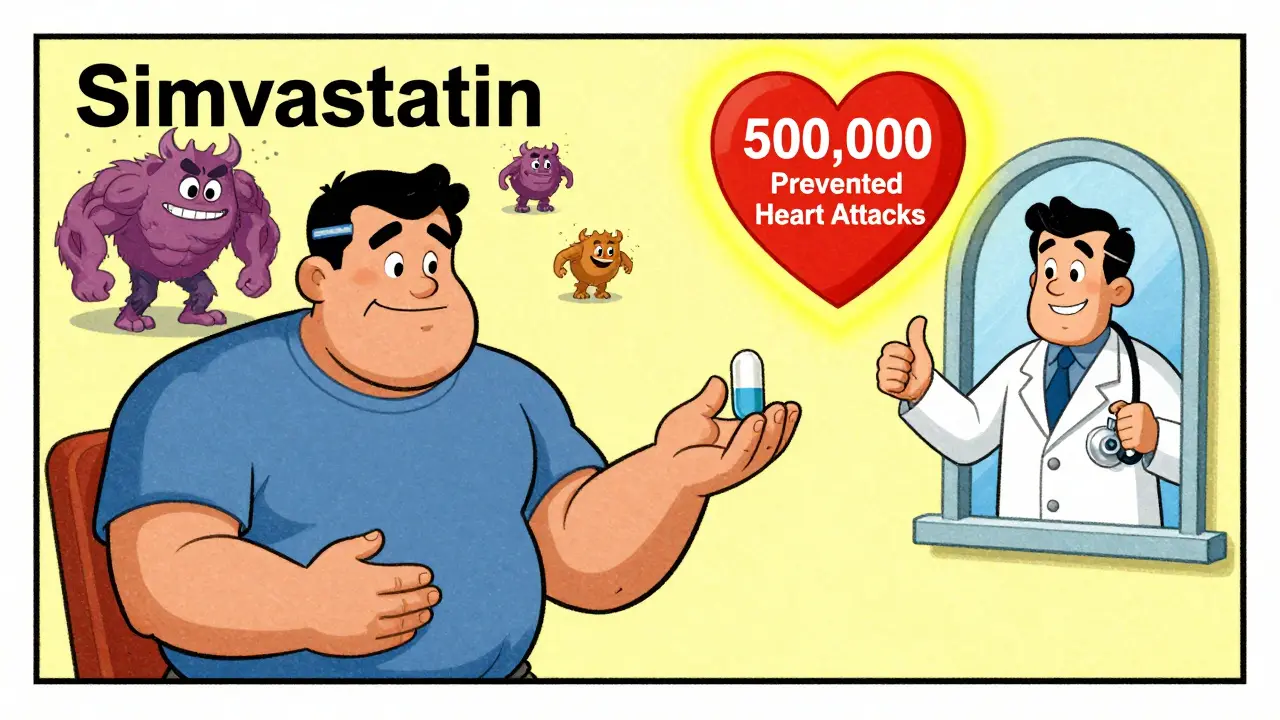
Every year, statins prevent about 500,000 heart attacks and strokes in the U.S. alone. That’s half a million people who didn’t have a cardiac event because they took their pill. But if you stop because of muscle pain you think is from the drug - and it’s not - you’re putting yourself at risk. The Oxford study found that for every 100 people who stick with statins for five years, three major cardiovascular events are prevented. That’s three heart attacks or strokes avoided. The real danger isn’t the statin. It’s the myth.Real Stories, Real Outcomes
One patient on Reddit stopped simvastatin after three months of leg cramps. He switched to pravastatin and has been pain-free for over a year. Another did a blinded challenge - didn’t know if she was on placebo or atorvastatin - and had symptoms on both. Her pain vanished when she stopped worrying about it. Patient reviews on Drugs.com show this pattern: simvastatin has the worst muscle pain ratings. Pravastatin and fluvastatin score higher. That’s not just opinion - it’s data matching science.Bottom Line
Statins are not the villain they’re made out to be. The vast majority of muscle pain isn’t caused by them. But if you do have true statin-related symptoms, the answer isn’t quitting - it’s switching. Simvastatin carries the highest risk. Pravastatin and fluvastatin carry the lowest. Talk to your doctor. Get tested. Try a re-challenge. Don’t let fear steal your heart health.Do all statins cause muscle pain?
No. Most people who report muscle pain while on statins aren’t actually experiencing a drug side effect. Studies show that over 90% of muscle complaints during the first year are unrelated to the medication. Among those who do have true statin-related pain, the risk varies greatly by drug - simvastatin is the most likely, while pravastatin and fluvastatin are the least likely.
Which statin has the least muscle pain?
Fluvastatin has the lowest risk of muscle pain based on clinical data, followed closely by pravastatin. Both are water-soluble, meaning they don’t penetrate muscle tissue as easily as lipophilic statins like simvastatin or atorvastatin. For patients who’ve had muscle issues before, switching to one of these two is often the best solution.
Can I take statins if I have muscle pain?
Yes - but only after checking if the pain is actually caused by the statin. Many causes of muscle pain exist, including aging, low vitamin D, or overexertion. If you suspect your statin is the problem, talk to your doctor. A simple re-challenge test can confirm whether the drug is truly responsible. If it is, switching to a lower-risk statin like pravastatin often resolves the issue.
Is simvastatin the worst statin for muscles?
Yes, by a significant margin. Multiple studies, including a 2015 SUNY analysis, show simvastatin has the highest odds ratio for muscle pain among commonly prescribed statins - nearly 80% higher than pravastatin. This is due to its lipophilic nature and metabolism through the CYP3A4 enzyme, which can be affected by other medications and grapefruit juice. For patients with muscle sensitivity, simvastatin should be avoided or used only at low doses.
What should I do if I stopped my statin because of muscle pain?
Don’t assume you can’t take statins again. Research shows 68% of people who stopped due to muscle pain can successfully restart therapy with the right approach. Talk to your doctor about a statin re-challenge, consider switching to pravastatin or fluvastatin, and get educated about the nocebo effect. The benefits of statins for heart health far outweigh the small chance of true muscle side effects.
Edith Brederode
January 19, 2026 AT 12:38Arlene Mathison
January 20, 2026 AT 14:43thomas wall
January 20, 2026 AT 21:47Paul Barnes
January 22, 2026 AT 05:33Andy Thompson
January 23, 2026 AT 05:05sagar sanadi
January 23, 2026 AT 13:08kumar kc
January 24, 2026 AT 02:52Thomas Varner
January 24, 2026 AT 07:59Manoj Kumar Billigunta
January 25, 2026 AT 23:00Emily Leigh
January 26, 2026 AT 16:47Jacob Cathro
January 26, 2026 AT 22:57pragya mishra
January 27, 2026 AT 20:42clifford hoang
January 29, 2026 AT 16:17Carolyn Rose Meszaros
January 29, 2026 AT 21:40Greg Robertson
January 31, 2026 AT 19:07