
Supply Chain Security: How Legitimate Drugs Are Protected from Counterfeits
 Dec, 2 2025
Every year, over 5.8 billion prescription drug packages move through the U.S. supply chain. For most people, that’s just background noise-something that happens before they pick up their medicine at the pharmacy. But behind the scenes, a complex, high-stakes system is working to make sure none of those packages are fake, tampered with, or stolen. This isn’t science fiction. It’s the pharmaceutical supply chain, and it’s the only thing standing between you and a deadly counterfeit pill.
What’s at stake when drugs go off the chain
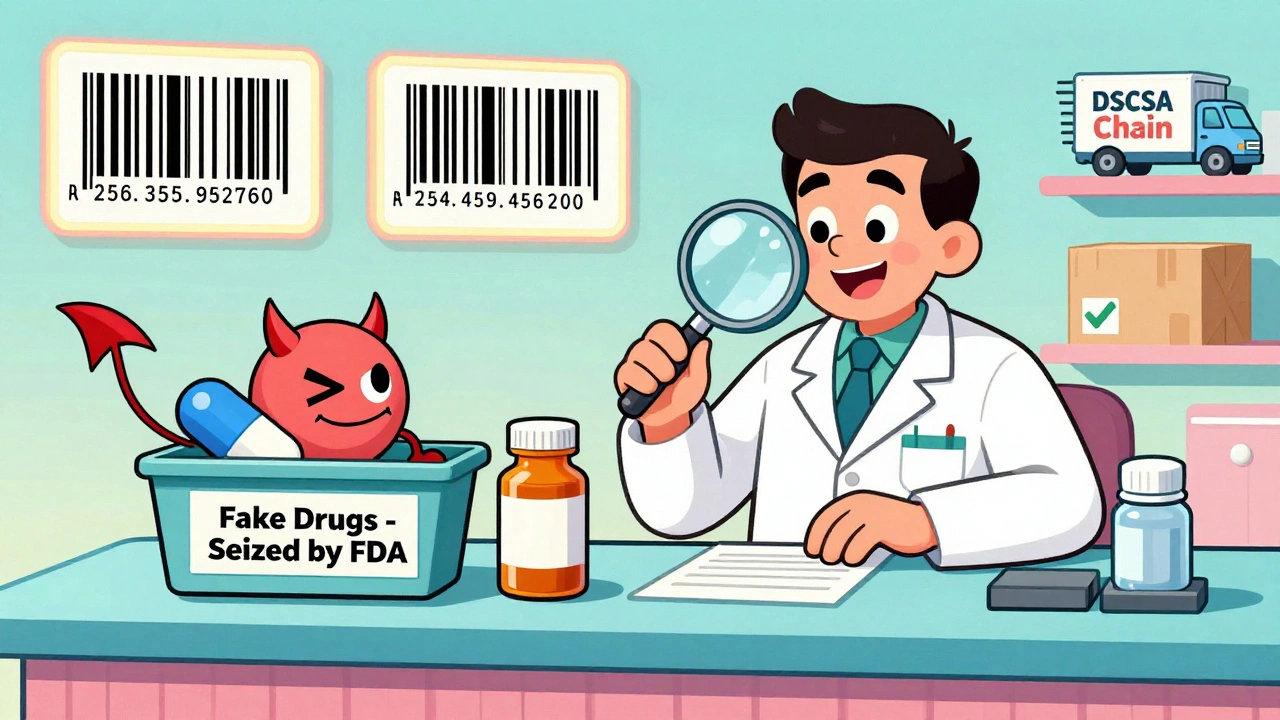
Counterfeit drugs aren’t just illegal-they’re deadly. In 2022, the FDA seized over 400 shipments of fake medications. Some contained no active ingredient. Others had the wrong dosage. A few even had toxic substances like rat poison or industrial chemicals. These aren’t rare outliers. According to the WHO, one in 10 medical products in low- and middle-income countries is counterfeit. Even in the U.S., where regulations are tighter, the threat doesn’t disappear-it just gets smarter.Counterfeiters don’t just slap on fake labels. They infiltrate the system. They pose as wholesalers. They steal legitimate products and resell them. They exploit gaps between countries with weak oversight. A single compromised shipment can end up in a hospital, a nursing home, or your local pharmacy. That’s why the system protecting legitimate drugs isn’t just about labels or barcodes-it’s about trust at every step.
The DSCSA: America’s drug safety backbone
The Drug Supply Chain Security Act (DSCSA), passed in 2013, is the foundation of how legitimate drugs are tracked and verified in the U.S. It’s not a single tool. It’s a layered system built over 14 years, with deadlines, standards, and requirements that force everyone in the chain to play by the same rules.Here’s how it works in practice:
- Every prescription drug package gets a unique serial number-like a fingerprint-printed in a 2D barcode.
- That barcode includes the National Drug Code (NDC), lot number, expiration date, and a unique serial number.
- At every handoff-manufacturer to distributor, distributor to pharmacy-the system electronically logs who sent it, who received it, and when.
- If a pharmacy receives a suspicious package, they can scan it and instantly check if the serial number matches what the manufacturer says.
That’s not theoretical. In 2022, the system blocked over 12,000 suspect product attempts from reaching patients. That’s 12,000 chances someone might have gotten a fake or dangerous drug.
How serialization turns packages into digital records
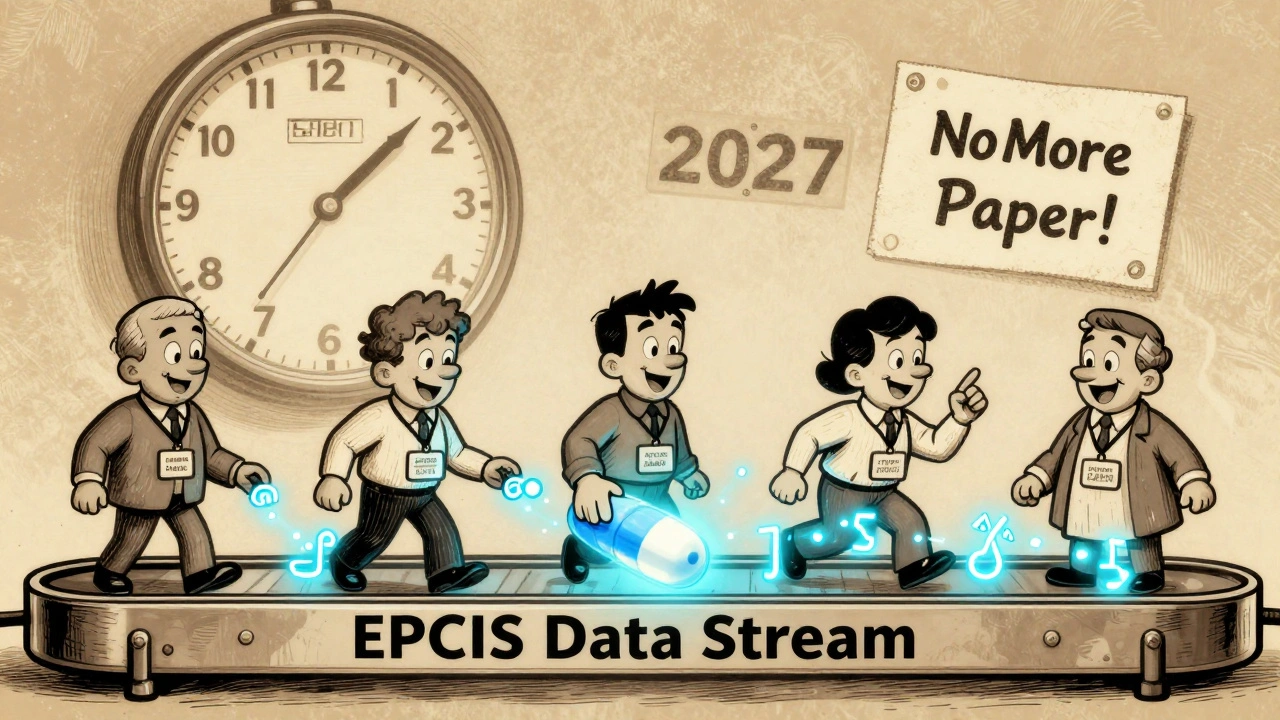
The magic isn’t in the barcode itself. It’s in the data behind it. Each package is now a digital record. When a manufacturer produces a bottle of metformin, they don’t just print a label-they assign it a unique serial number and upload it to a secure database. That number stays with the product as it moves through warehouses, trucks, and distribution centers.By 2023, every manufacturer, wholesaler, and dispenser was required to exchange this data electronically using GS1’s EPCIS standard. That means:
- Over 1.2 million unique product identifiers are generated daily.
- More than 15 million transactions are verified each day with 99.95% accuracy.
- Systems can trace a single pill back to the factory floor in seconds.
Before DSCSA, tracing a problem batch could take weeks. Now, during the 2022 infant formula crisis, the system helped remove contaminated products from shelves in 72 hours-down from 14 days. That speed saves lives.
Who’s in the chain-and how they’re verified
You can’t just walk in and start selling drugs. The DSCSA requires every trading partner to be authorized. That means:- Manufacturers must be registered with the FDA.
- Wholesalers must prove they’re licensed and have secure storage.
- Pharmacies must verify they’re buying from approved suppliers.
The FDA runs a verification service that checks each entity daily. In Q3 2023, it processed over 50,000 verification requests with a 99.8% success rate. If someone tries to sell drugs without being verified, the system blocks them automatically.
But here’s the catch: not everyone follows through. A 2022 FDA audit found only 47% of wholesale distributors consistently checked their suppliers. That’s a gap. And counterfeits thrive in gaps.
The real cost of staying safe
Protecting the drug supply isn’t free. For a mid-sized manufacturer, implementing serialization and EPCIS systems costs between $500,000 and $2 million. For a small independent pharmacy, annual compliance costs can hit $18,500-nearly 3% of their net profit.That’s why smaller pharmacies struggle. Only 76% of pharmacies met the 2023 electronic data exchange deadline. Among those with fewer than 10 employees, 63% said they couldn’t afford the software, hardware, or training. Some still use paper logs. Others rely on outdated scanners that can’t read modern 2D barcodes.
And it’s not just money. It’s complexity. Integrating new systems with old pharmacy software often takes 14 months. Staff need 200+ hours of training. And even then, 8.3% of transactions still have data errors.
How the U.S. compares to the rest of the world
The U.S. isn’t alone. The European Union runs the Falsified Medicines Directive (FMD), which also requires serialization-but with key differences:| Feature | U.S. DSCSA | EU FMD |
|---|---|---|
| Serialization format | 20-character alphanumeric | 20-digit numeric |
| Data exchange | Decentralized (EPCIS) | Centralized (EMVS) |
| Verification point | At every handoff | At pharmacy dispensing |
| Market size (2023) | $2.3 billion | $1.8 billion |
| Compliance cost impact | 22% higher for global firms | Lower for EU-only firms |
That mismatch creates headaches for global drug companies. They have to run two different systems-one for the U.S., one for Europe, and sometimes more for Brazil, China, or Japan. That’s why compliance costs are 22% higher for multinational firms than for U.S.-only companies.
What’s next? AI, blockchain, and the future of drug safety
The system isn’t static. By 2025, all data must be in JSON format instead of XML-faster, cleaner, easier to process. By 2027, paper records will be gone. Every transaction will be digital.Companies are already testing new tools:
- AI scans transaction patterns to spot anomalies-like a distributor suddenly ordering 10,000 extra pills of a drug no one else is buying.
- Blockchain pilots are being tested by 34% of top pharma firms to create tamper-proof logs.
- IoT sensors track temperature and humidity in cold-chain shipments, preventing spoilage and tampering.
McKinsey predicts that by 2030, this infrastructure will evolve into a predictive system-using data to stop counterfeits before they even enter the chain. The goal? A 95% reduction in fake drugs and $8.7 billion in annual savings from fewer recalls and less waste.
What you can do to stay safe
You don’t need to understand EPCIS or serialization to protect yourself. But you can:- Always get prescriptions filled at licensed pharmacies-avoid online sellers without a physical address or phone number.
- Check your pills. If the color, shape, or taste is different from last time, ask your pharmacist.
- Report suspicious products. The FDA has a portal for reporting counterfeit drugs.
The system works best when people speak up. A pharmacist in Ohio noticed a bottle of insulin looked off. Scanned it. Found the serial number didn’t match. Turned out to be a fake batch. That one report stopped a potential disaster.
Final thoughts: Security isn’t perfect-but it’s working
The pharmaceutical supply chain isn’t flawless. There are gaps. Costs are high. Some players cut corners. But since DSCSA rolled out, counterfeit drug incidents have dropped by 63%. The system catches thousands of bad products every year. It saved lives during the pandemic. It moved fast during the infant formula crisis.It’s not glamorous. No one sees the barcodes being scanned. No one notices the verification checks happening in the background. But that’s the point. The best security is invisible. And right now, that invisible system is keeping millions of Americans safe.
How do I know if my medication is counterfeit?
Look for changes in color, shape, size, or taste compared to previous refills. Check the packaging for misspellings, blurry barcodes, or missing lot numbers. If something feels off, take it to your pharmacist. They can scan the barcode and verify it against the manufacturer’s database. Never buy prescription drugs from unlicensed online sellers.
Is the DSCSA system foolproof?
No system is 100% foolproof. The DSCSA has reduced counterfeit drugs by 63% since 2015, but gaps remain. Some repackaged drugs lose their original serialization. International shipments still face verification challenges. And not all distributors consistently check their suppliers. But it’s the most effective system ever built for tracking prescription drugs in the U.S.
Why do some pharmacies struggle with DSCSA compliance?
Small, independent pharmacies often lack the budget for new scanners, software, and staff training. The average cost is $18,500 per year. Many still use outdated systems that can’t read 2D barcodes. Over 60% of small pharmacies with fewer than 10 employees say compliance is financially unsustainable without outside help or grants.
What happens if a fake drug gets through?
If a suspect product is identified, the pharmacy or distributor must quarantine it immediately and report it to the manufacturer and FDA within 24 hours. The manufacturer then traces the serial number back through the chain to find where it came from. The product is pulled from shelves, and if it’s confirmed as counterfeit, the FDA issues a public alert. This process, which used to take weeks, now takes hours.
Will this system work globally?
Not yet. The U.S., EU, and other regions use different standards, making international trade harder. The International Council for Harmonisation (ICH) is working on a global standard by 2026, but until then, drug companies must run multiple parallel systems. That’s why counterfeit drugs still slip through borders-especially from countries without strong tracking laws.
Colin Mitchell
December 3, 2025 AT 23:31Really appreciate this breakdown-grew up watching my grandma struggle with meds, and knowing there’s a system trying to keep her safe means a lot. Even if it’s invisible, it’s doing real work.
Stacy Natanielle
December 4, 2025 AT 15:58Let’s be clear: the DSCSA is a regulatory triumph-99.95% transactional accuracy? That’s not just impressive-it’s statistically extraordinary. 📊✨
kelly mckeown
December 5, 2025 AT 15:04i just read this and thought of my cousin who works at a small pharmacy in iowa… she’s been up until 2am scanning barcodes because the old scanner broke and they can’t afford a new one. it’s not just about tech-it’s about people.
Tom Costello
December 7, 2025 AT 13:46What’s fascinating is how this system quietly reshaped global pharma logistics. The EPCIS standard isn’t just a U.S. thing-it’s becoming the de facto baseline. Even companies outside America are adapting because it’s simply the most reliable way to track.
dylan dowsett
December 7, 2025 AT 14:20Wait… so you’re telling me we’re trusting a barcode… to keep us alive?? And that the FDA’s verification success rate is 99.8%?? What about the 0.2%?? That’s still thousands of people getting poisoned every year!!
Akash Sharma
December 9, 2025 AT 07:14I come from India, where counterfeit drugs are rampant, and seeing how the U.S. system works is both inspiring and humbling. In my country, we still rely on manual checks and community trust-sometimes a pharmacist knows your medicine better than the label. But the DSCSA model? It’s the future. We need something like this here, even if it takes decades to implement. The cost is high, yes, but the cost of inaction is measured in lives, not dollars.
Justin Hampton
December 10, 2025 AT 15:11They say this system saves lives. But who’s really benefiting? Big pharma. They pushed this law to lock out smaller competitors. Now every mom-and-pop pharmacy is drowning in compliance costs while the corporations get subsidies. This isn’t safety-it’s consolidation dressed up as regulation.
Chris Jahmil Ignacio
December 12, 2025 AT 10:00Think about it-every barcode is a government tracking chip. They know what pills you take. They know when you refill. They know your doctor. And they’re calling it 'security.' Next they'll scan your toothbrush for 'hygiene compliance.' This isn't about safety-it's about control. The FDA doesn't want to catch fakes-they want to own the data. And they're using fear to sell it.
Paul Corcoran
December 13, 2025 AT 08:43For all the talk about costs and complexity-this system stopped 12,000 fake drugs last year. That’s 12,000 people who didn’t end up in the ER because someone scanned a barcode. That’s worth every penny. Let’s not let perfect be the enemy of good. We’re making progress. Keep pushing.