
Pharmacist Responsibilities When Dispensing Generics: Legal Obligations Explained
 Jan, 14 2026
When a pharmacist hands a patient a bottle of generic medication, it might look like a simple swap. But behind that exchange is a complex web of federal rules, state laws, and professional duties that can make or break patient safety. In 2023, generic drugs made up 90.5% of all prescriptions filled in the U.S., saving the system over $313 billion. But that savings only works if pharmacists get the legal details right. Get one thing wrong-skip a consent form, miss a state restriction, or substitute a drug that shouldn’t be swapped-and you’re not just risking a fine. You’re risking a patient’s health.
What the Law Actually Says: Federal vs. State Rules
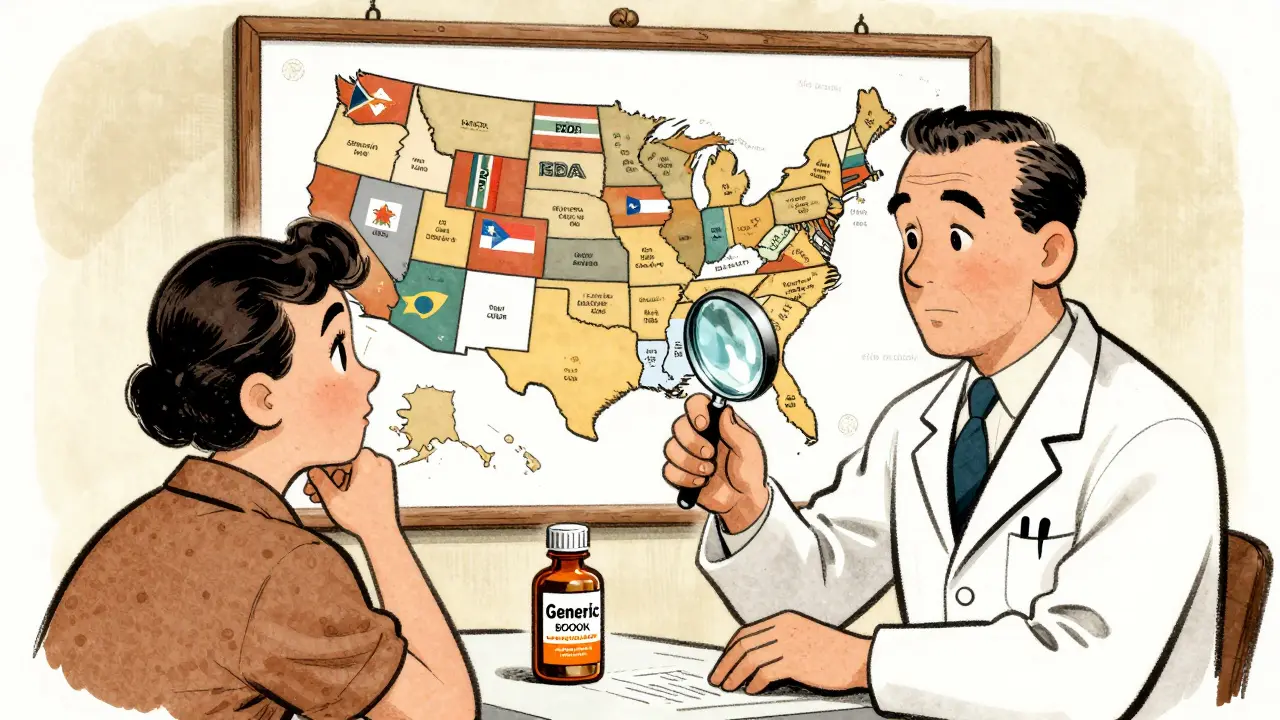
The foundation for generic substitution starts with the FDA. Under the Hatch-Waxman Act of 1984, the FDA created a system to approve generic drugs that are therapeutically equivalent to brand-name drugs. That means they have the same active ingredient, strength, dosage form, and route of administration. They must also prove bioequivalence-meaning they work the same way in the body. The FDA publishes this information in the Orange Book, updated every month, which lists every approved generic and its therapeutic equivalence rating. Only A-rated drugs can be substituted without a prescriber’s permission. But here’s the catch: the FDA sets the scientific standard. The law on whether you can actually substitute a drug? That’s up to each state. There are 51 jurisdictions-50 states plus D.C.-and each has its own rules. Some require you to substitute. Some let you decide. Some demand the patient’s signature. Some ban substitution for certain drugs entirely. You can’t rely on one rule. You have to know 51.Mandatory vs. Permissive Substitution: Do You Have to Swap?
Twenty-four states have mandatory substitution laws. That means if a prescriber writes a brand-name drug and no restrictions are noted, you must dispense the generic unless the patient refuses. States like New York and California fall into this category. In these places, pharmacists are expected to be cost-savers by default. In contrast, 26 states use permissive substitution. Here, you can substitute-but you don’t have to. This gives you more professional discretion. For example, if a patient has had a bad reaction to a particular generic manufacturer in the past, you can choose to stick with the brand. But you still need to follow your state’s consent rules. The difference isn’t just legal-it’s practical. Mandatory substitution states see generic use rates around 92.7%. Permissive states hover at 87.3%. That gap shows how much the law shapes behavior.Consent Rules: Do You Need the Patient’s OK?
Even if your state allows substitution, you might still need the patient’s permission. Eighteen states operate on presumed consent: if the patient doesn’t say no, you can swap. Thirty-two states require explicit consent. That means you must inform the patient and get a clear yes before switching. In explicit consent states, you can’t just say, “We have a cheaper version.” You have to explain what substitution means. You have to confirm they understand. You have to document it. Some states require a signed form. Others allow verbal consent recorded in the pharmacy system. Skip this step, and you’re in violation-even if the drug is A-rated and legally substitutable. Real-world example: A patient in Texas gets a new prescription for sertraline. The brand is Zoloft. The generic is fine. But the patient has never taken a generic before. The pharmacist assumes consent because Texas is an explicit consent state. No explanation. No confirmation. The patient later reports anxiety spikes. Turns out, they thought the pill looked different because it was “a new medicine,” not a generic. That’s a counseling failure-and a legal one.Drugs You Can’t Substitute-Even If They’re A-Rated
Not all A-rated drugs are fair game. Some medications have a narrow therapeutic index (NTI), meaning the difference between a safe dose and a dangerous one is tiny. A small change in absorption can lead to toxicity or treatment failure. The FDA says generics are bioequivalent. But real-world data tells a different story. Tennessee bans substitution for antiepileptic drugs used in epilepsy or seizure disorders-even if the generic is A-rated. Hawaii does the same, but only if the prescriber and patient haven’t both consented in writing. Florida excludes anticoagulants, anticonvulsants, anti-asthmatics (especially extended-release), insulin, and cardiac glycosides from automatic substitution. In California, levothyroxine (thyroid medication) is protected under state law, even though it’s A-rated. Why? A 2019 JAMA Internal Medicine study found a 12.7% higher rate of adverse events when switching cardiac glycosides like digoxin between generics and brands. Patients don’t always notice subtle changes-until they end up in the ER. Pharmacists must know these exceptions cold. If you substitute a drug your state explicitly forbids, you’re not just breaking policy-you’re breaking the law. State boards of pharmacy don’t look kindly on that.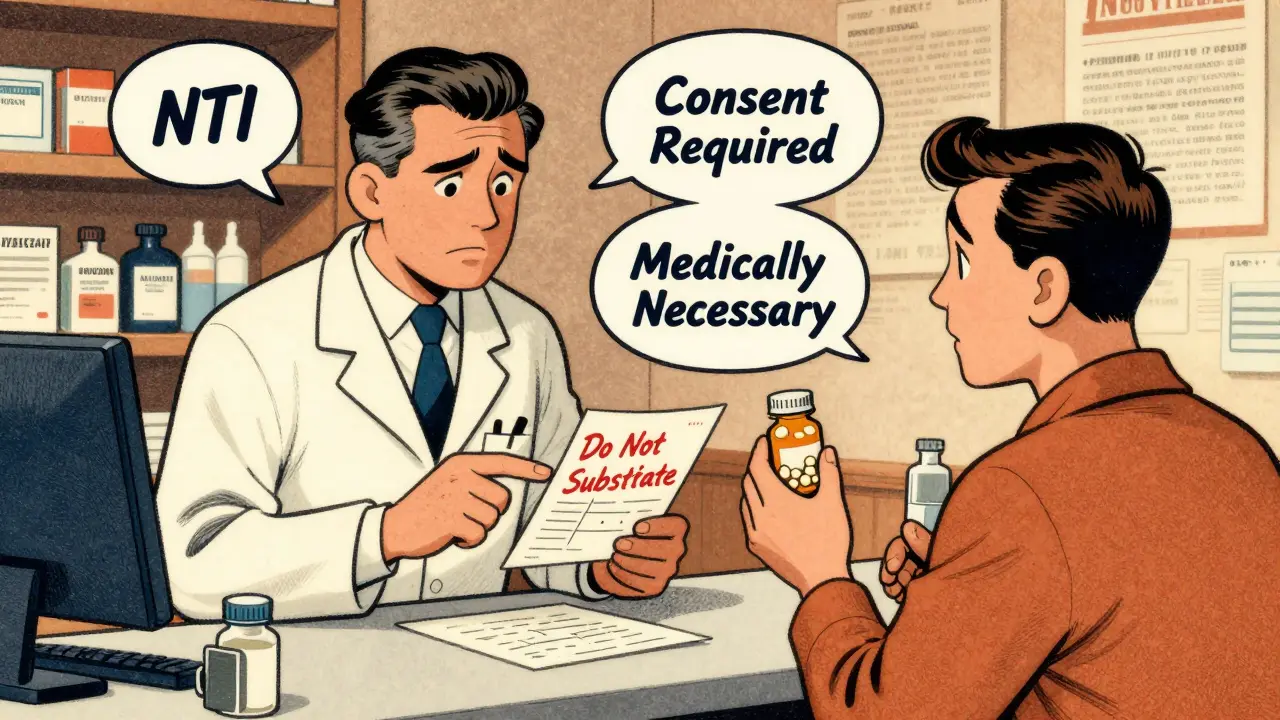
The ‘Medically Necessary’ Clause: How Prescribers Block Substitution
Prescribers can stop substitution by writing “Dispense as Written” or “Medically Necessary” on the prescription. But how they do it varies wildly. In Florida, the prescriber must write “MEDICALLY NECESSARY” in their own handwriting on a paper script. For electronic prescriptions, they must perform an “overt act”-like checking a box labeled “Do Not Substitute.” If they don’t, you can substitute. In New York, “DAW 1” on the script means no substitution. In California, it’s “Do Not Substitute” or “Brand Necessary.” The problem? Many prescribers don’t know the rules. A 2022 survey found that 38% of physicians didn’t know how to properly block substitution in their state. That puts the burden squarely on the pharmacist to spot the error. If the script says “Zoloft” with no notation, but the prescriber meant to block substitution, you’re legally allowed to swap. But if the patient has a history of instability on generics, you have a professional obligation to call the prescriber.Documentation: The #1 Reason Pharmacists Get in Trouble
The National Association of State Boards of Pharmacy (NASPA) found that 68% of disciplinary actions against pharmacists in 2022 were due to documentation errors-not drug errors. That’s right. You didn’t give the wrong pill. You just didn’t write down that you asked the patient for consent. Or you didn’t log that you checked the Orange Book. Or you didn’t record the prescriber’s “Medically Necessary” note. Electronic health record systems help, but they’re not foolproof. If your pharmacy’s software doesn’t auto-populate consent fields based on state rules, you’re manually responsible. You must log:- Whether substitution occurred
- Which drug was dispensed (generic or brand)
- Whether consent was obtained and how
- Any prescriber restrictions noted
- The source used to verify therapeutic equivalence (e.g., FDA Orange Book)
What You Need to Stay Compliant
Keeping up with 51 sets of rules sounds impossible. But it’s doable with a system:- Use the FDA Orange Book daily. It’s free, updated monthly, and the only official source for therapeutic equivalence ratings.
- Know your state’s law cold. Bookmark your state board of pharmacy’s website. Subscribe to their alerts.
- Train your staff. Make sure every pharmacist and tech knows the consent rules and NTI exceptions.
- Update your pharmacy’s formulary. If your state requires one (like Florida), make sure it’s current and includes all excluded drugs.
- Use technology wisely. Pick pharmacy software that auto-blocks substitutions based on state and drug class.
- Document everything. If you didn’t write it down, it didn’t happen.
What Happens If You Get It Wrong?
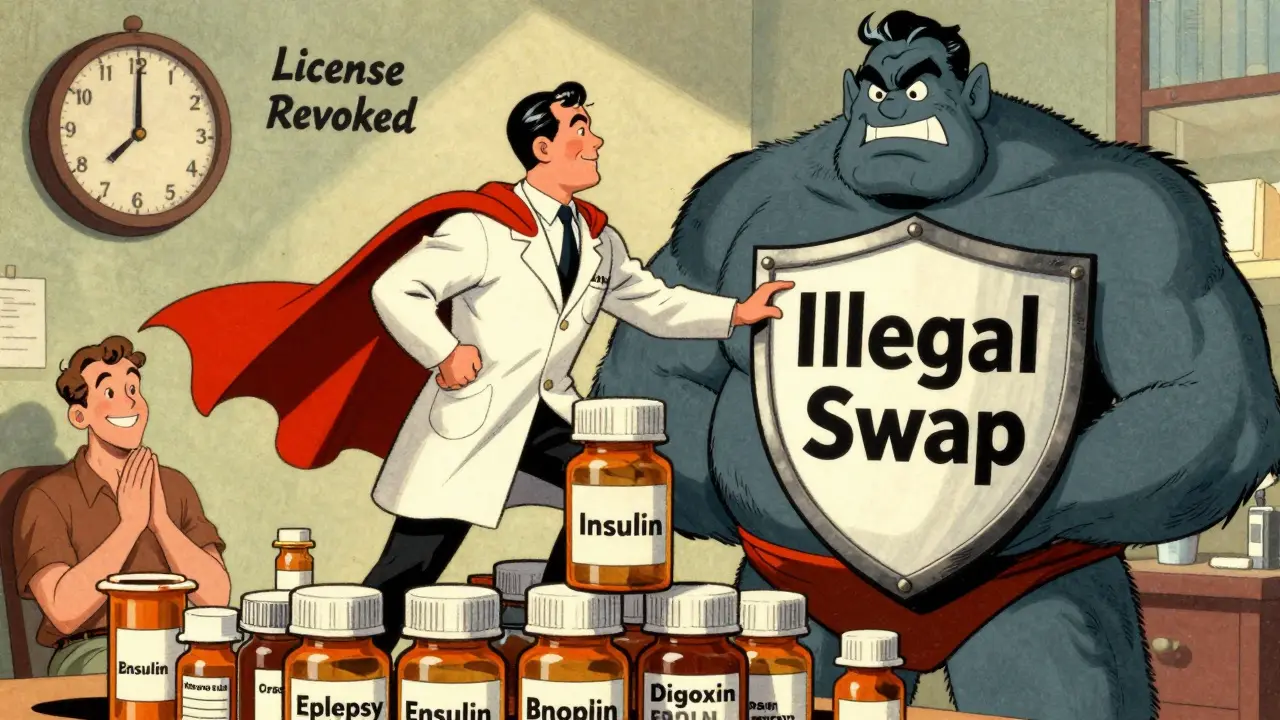
The consequences aren’t theoretical. In 2021, a Tennessee pharmacist substituted an antiepileptic drug for a patient with epilepsy. The patient had a seizure. The state board revoked the pharmacist’s license. In another case, a pharmacist in Florida substituted a generic insulin without checking the formulary exclusion list. The patient’s blood sugar spiked. The case went to court. The pharmacy paid $1.2 million in damages. Beyond legal liability, there’s reputation. Patients trust pharmacists to protect them. If they learn you substituted a drug they shouldn’t have gotten, they won’t come back. And they’ll tell others.Bottom Line: You’re the Last Line of Defense
Generic drugs save money. They’re safe. They’re effective. But they’re not automatic. As a pharmacist, you’re not just a dispenser-you’re a legal gatekeeper. You’re the one who checks the Orange Book. You’re the one who asks for consent. You’re the one who spots the “Medically Necessary” note. You’re the one who says no when the law says no. The system works because pharmacists know the rules. Don’t assume. Don’t guess. Don’t rely on what you heard five years ago. Stay current. Document everything. Protect your license. Protect your patient.Can I substitute a generic drug if the prescription says ‘Dispense as Written’?
No. If the prescriber writes ‘Dispense as Written,’ ‘Brand Necessary,’ or ‘Do Not Substitute’ on the prescription, you are legally required to dispense the brand-name drug-even if a generic is available and A-rated. This instruction overrides all substitution laws in every state. Failing to follow it is a violation of pharmacy practice law and can lead to disciplinary action.
Are all generic drugs approved by the FDA safe to substitute?
The FDA approves all generics as therapeutically equivalent to their brand-name counterparts, but state laws may restrict substitution for certain drugs regardless of FDA approval. For example, antiepileptic drugs, insulin, and some cardiac medications are often excluded from substitution even if they’re A-rated. Always check your state’s formulary exclusions and NTI (narrow therapeutic index) drug lists before substituting.
Do I need to get patient consent every time I substitute a generic?
It depends on your state. Thirty-two states require explicit consent-meaning you must inform the patient and get their agreement before substituting. Eighteen states allow presumed consent, where substitution is allowed unless the patient objects. Always know your state’s rule. Even in presumed consent states, best practice is to inform patients to avoid confusion or complaints.
What is the FDA Orange Book, and why does it matter?
The FDA Orange Book is the official government publication that lists all approved drug products with therapeutic equivalence evaluations. It’s the only authoritative source for determining whether a generic drug is rated ‘A’ (substitutable) or ‘B’ (not substitutable). Pharmacists must consult it before making any substitution to ensure compliance with federal and state laws. It’s updated monthly and available for free online.
Can I substitute a generic for a controlled substance like Adderall?
Yes, if the generic is FDA-approved as therapeutically equivalent (A-rated) and your state allows substitution. However, controlled substances often have additional state-level restrictions. Some states require prescriber authorization even for generics, and others prohibit substitution for stimulants entirely. Always check both state substitution laws and controlled substance regulations before dispensing.
How often do generic substitution laws change?
They change frequently. In 2022, 17 states amended their generic substitution laws. New legislation often targets biosimilar drugs, narrow therapeutic index medications, or consent requirements. Pharmacists should subscribe to alerts from their state board of pharmacy and complete at least 40-60 hours of continuing education annually to stay compliant.
Susie Deer
January 15, 2026 AT 17:40State laws? Who even keeps track of 51 sets of rules? It's chaos. And you wonder why people don't trust pharmacists.
Alvin Bregman
January 17, 2026 AT 16:09if the generic is approved by the fda and looks the same why do i need a 10 page consent form
also why do some states ban thyroid meds but not blood pressure stuff makes no sense
Robert Way
January 18, 2026 AT 18:40Sarah Triphahn
January 19, 2026 AT 03:34And don't get me started on the 'Medically Necessary' clause. Most doctors don't even know what they're writing. You're the expert. Use your judgment.
Allison Deming
January 19, 2026 AT 07:49Continuing education is not optional-it is the moral foundation of our profession. To neglect it is to betray the trust placed in us by patients who rely on our expertise, not our convenience.
TooAfraid ToSay
January 20, 2026 AT 23:14Dylan Livingston
January 22, 2026 AT 06:12And yes, I’ve seen the same generic cause anxiety spikes. Guess what? It’s not the drug. It’s the patient’s mind. You didn’t explain it. You just handed it over like a vending machine. That’s not compliance. That’s emotional neglect dressed up as law.
Andrew Freeman
January 23, 2026 AT 23:00Also why do we even have state laws? If the fda says its safe why are we playing 51 different versions of monopoly? Just make one national rule and stop wasting our lives.