
OTC Drug Facts Labels: What to Look For and How to Use Them
 Feb, 2 2026
Drug Facts Active Ingredient Checker
Check for overlapping active ingredients in your OTC medications to avoid accidental overdoses. This tool helps you identify potential dangerous combinations based on the Drug Facts label requirements.
Your Medications
Symptoms or Conditions
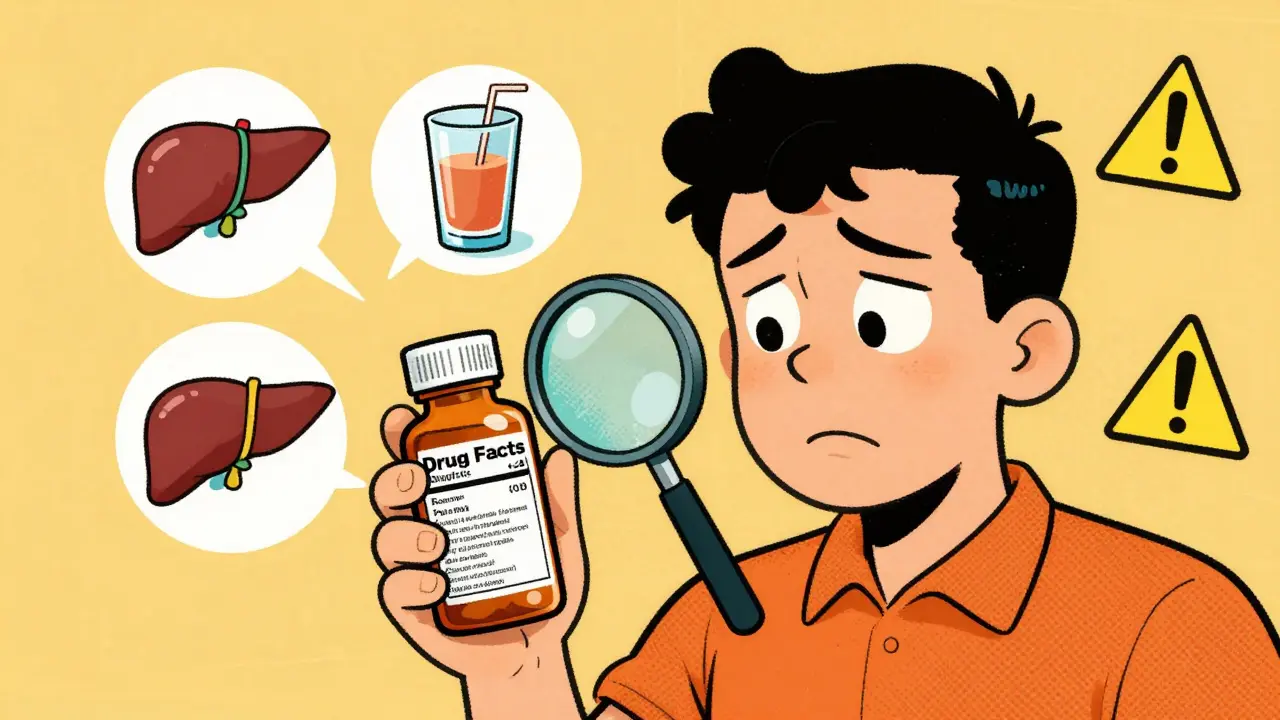
Every time you pick up a bottle of pain reliever, cold medicine, or even hand sanitizer, there’s a small but powerful piece of information staring back at you: the Drug Facts label. It’s not just a sticker or a printed paragraph-it’s a standardized, government-mandated guide designed to keep you safe. And yet, most people glance at it for less than five seconds before tossing the box into the cabinet. That’s a problem. In 2022, U.S. poison control centers handled over 1.2 million cases related to misuse of over-the-counter (OTC) drugs. Many of those cases could have been avoided with just a little more attention to the label.
What Exactly Is a Drug Facts Label?
The Drug Facts label is the FDA’s answer to decades of confusing, inconsistent packaging. Before 1999, every OTC product had its own format. One bottle might list ingredients at the bottom, another buried them in tiny print, and some didn’t even say how much to take. The FDA stepped in with a rule (21 CFR § 201.66) that forced all OTC drugs-whether it’s aspirin, antacid, or sunscreen-to follow the same layout. It’s not optional. If it’s sold without a prescription in the U.S., it must have this label.The goal? Make it easy to find critical info, no matter what brand you’re holding. That means if you’ve read the label on one product, you know exactly where to look on the next. No guessing. No flipping through说明书. Just clear, consistent, science-backed information.
The 8 Sections You Must Read (in Order)
The Drug Facts label has eight sections, always in this exact order. Skipping one could mean missing a life-saving warning or accidentally doubling your dose. Here’s what each one means-and why it matters.1. Active Ingredient(s)
This is the meat of the label. These are the chemicals that actually treat your symptoms. They’re listed by their generic name (like acetaminophen, not Tylenol), followed by the amount per dose. For example: Acetaminophen 325 mg.Why this matters: Many OTC products contain the same active ingredient. If you’re taking a cold medicine with acetaminophen and also taking a painkiller with acetaminophen, you could hit the toxic limit-5,000 mg in 24 hours-without realizing it. That’s one of the top causes of accidental liver damage in the U.S. Always check this section before combining meds.
2. Purpose(s)
This tells you what category the ingredient belongs to. For example:- Analgesic (pain reliever)
- Antihistamine (allergy relief)
- Decongestant (stuffy nose)
- Antacid (heartburn)
This helps you understand how the drug works. If you’re unsure why you’re taking something, this section gives you the basic function. It also helps you avoid taking two drugs with the same purpose-like two decongestants-which can overstimulate your system.
3. Use(s)
This is where the label tells you exactly what the product is approved to treat. It might say: Temporarily relieves minor aches and pains due to headache, toothache, muscle strain, and menstrual cramps.Don’t assume it works for anything else. Just because a painkiller helps your headache doesn’t mean it’s safe for your child’s earache. Always match your symptoms to what’s listed. If your issue isn’t listed, talk to a pharmacist. Using a drug for an unapproved purpose is risky-and sometimes illegal.
4. Warning(s)
This is the most critical section. It’s not a suggestion. It’s a red flag. Warnings include:- When to stop using the product (e.g., “Stop use and ask a doctor if pain worsens or lasts more than 10 days”)
- When to ask a doctor before use (e.g., “If you have liver disease”)
- Drug interactions (e.g., “Do not take with alcohol”)
- Special risks (e.g., “May cause drowsiness” or “Keep out of reach of children”)
Some warnings are in a red box. That’s not decoration-it’s the FDA’s way of saying, “This could kill you if ignored.” For example, liver warnings for acetaminophen are required to be in red. If you have a history of liver issues, alcohol use, or take multiple medications, this section could save your life.
5. Directions
This tells you how much, how often, and when to take it. It’s not “take as needed.” It’s “Take 1 tablet every 4 to 6 hours. Do not exceed 6 tablets in 24 hours.”Pay attention to:
- Age-based dosing (children’s doses are not scaled-down adult doses)
- Measurement units (teaspoon vs. milliliter-use the provided measuring cup, not a kitchen spoon)
- Timing (e.g., “Take with food” or “Take on an empty stomach”)
Overdosing on OTC meds is shockingly common. In 2022, 32% of medication errors involved taking too much. Always use the measuring device that comes with the product. A regular spoon can be off by 50%.
6. Other Information
This section usually includes storage instructions (e.g., “Store at room temperature”) and, for oral products, the sodium content per dose. That’s right-some painkillers and antacids contain a lot of sodium. If you’re on a low-sodium diet for high blood pressure or heart disease, this matters. A single tablet might have 200 mg of sodium. That’s 10% of your daily limit.7. Inactive Ingredients
These are the fillers, dyes, flavors, and preservatives. They don’t treat your symptoms-but they can cause reactions. If you’re allergic to corn, soy, dyes, or gluten, this is your checklist. For example, some acetaminophen tablets contain corn starch. Some cough syrups have alcohol or artificial colors. If you’ve ever had a rash, swelling, or stomach upset after taking a med you’ve used before, check this section. It might be the inactive ingredient, not the active one, causing the problem.8. National Drug Code (NDC)
This is a unique 10- or 11-digit number printed on the label. It’s not for consumers to memorize-but it’s essential if you need to report a problem, look up the product online, or talk to your pharmacist about a recall. Always keep the box or label if you’re taking a new medication. You might need the NDC later.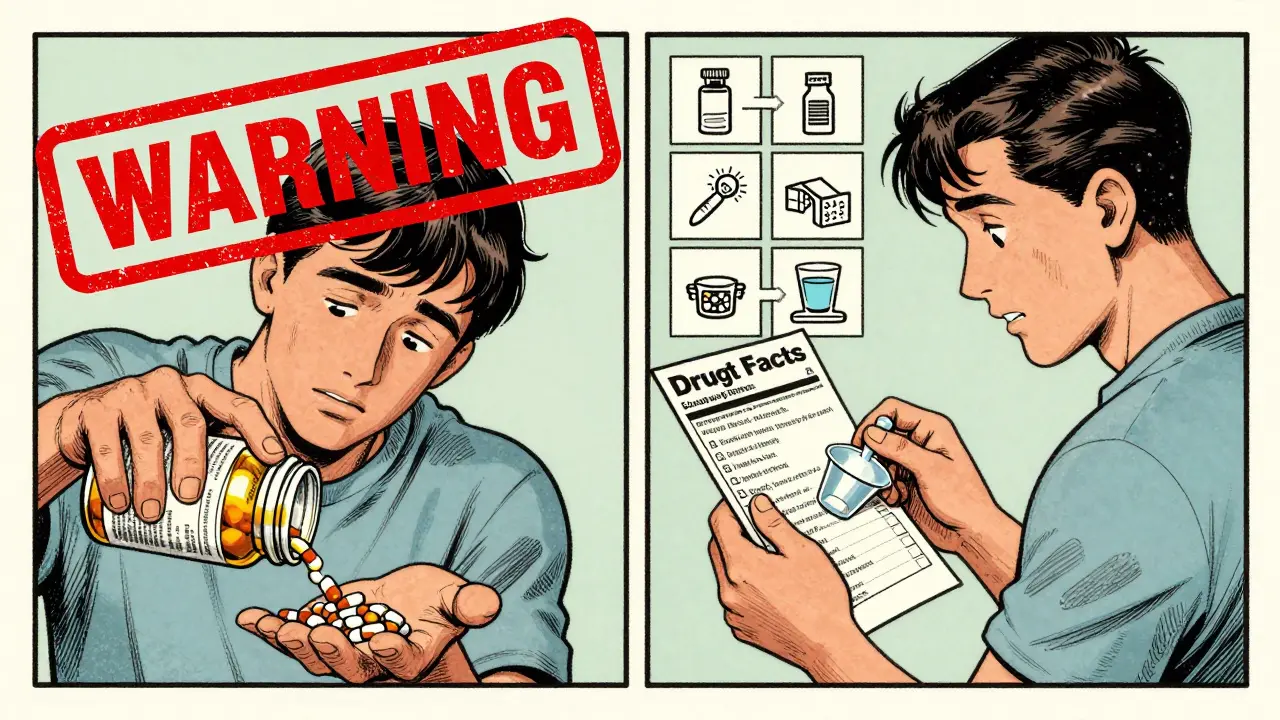
Why This System Works (And Why People Still Get It Wrong)
Since the FDA rolled out the Drug Facts format in 2003, medication errors dropped by 27%. That’s over 300,000 fewer accidental overdoses and reactions each year. The reason? Consistency. When you know where to look, you find answers faster.But here’s the catch: 34% of people still struggle to find info on crowded packaging. 28% don’t know whether to “stop” or “ask a doctor.” And 22% mix up teaspoons and milliliters.
Here’s what most people do wrong:
- They assume “natural” means safe. Herbal OTC products still need Drug Facts labels-and can interact with prescription drugs.
- They use expired meds. The label says “Expires MM/YY.” If it’s past that date, toss it. Effectiveness drops, and chemicals can break down into harmful substances.
- They ignore warnings about alcohol. Many painkillers, antihistamines, and sleep aids warn against mixing with alcohol. That’s not a suggestion-it’s a warning.
- They share meds. Just because it worked for your sister doesn’t mean it’s safe for you. Different weights, allergies, and health conditions change everything.
How to Use the Label Like a Pro
Follow this simple 4-step routine every time you take a new OTC medicine:- Check the active ingredient. Are you already taking something with the same one? If yes, don’t double up.
- Read the warnings. Do any of them apply to you? Liver disease? Pregnancy? High blood pressure? If unsure, ask a pharmacist.
- Match your symptoms to the Uses. Is this product actually approved for what you have?
- Measure exactly. Use the tool provided. No guessing. No eyeballing.
That’s it. Five minutes. One label. Could prevent a hospital visit.
What’s Changing? Digital Labels and the Future
The FDA is testing QR codes on OTC packaging that link to more detailed info online-like video instructions or multilingual translations. That’s helpful for people with low vision or limited English. But the physical label won’t disappear. The core Drug Facts format stays. Why? Because when your phone dies, the bottle doesn’t.Right now, the FDA is also looking at how to make labels clearer for older adults and non-native English speakers. The goal isn’t to overhaul the system-it’s to make the existing one even more accessible.
Final Thought: Your Safety Is on That Label
OTC drugs are convenient. They’re cheap. And they’re everywhere. But they’re still drugs. They have side effects. They interact. They can harm you if used carelessly.The Drug Facts label isn’t bureaucracy. It’s your last line of defense. It’s the reason you didn’t overdose on acetaminophen last winter. It’s the reason your child didn’t get drowsy from an allergy med meant for adults.
Next time you reach for a bottle, pause. Read the label. Not once. Twice. The difference between feeling better and ending up in the ER might be just a few seconds of your time.
Do all over-the-counter products have a Drug Facts label?
Yes, if it’s regulated by the FDA as an OTC drug. That includes pain relievers, cold medicines, antacids, antihistamines, sleep aids, and even hand sanitizers, sunscreens, and anti-cavity toothpaste. Products like vitamins, herbal supplements, or cosmetics without drug claims don’t need the label-but if it claims to treat or prevent a disease, it must have one.
Can I trust generic brands over name brands?
Absolutely. Generic OTC drugs contain the same active ingredients, in the same strength, and follow the same FDA guidelines as name brands. The only differences are in inactive ingredients (like dyes or fillers) and price. If the Drug Facts label matches, the generic is just as safe and effective. Save your money.
What should I do if I can’t read the label?
Don’t guess. Ask your pharmacist. Many pharmacies offer large-print labels or audio instructions. You can also call the manufacturer’s customer service number (usually on the box) and ask them to read it to you. Some companies now offer QR codes that link to audio versions. Never take a medicine you can’t understand.
Is it safe to take OTC meds during pregnancy?
Some are, some aren’t. Always check the Warning section for pregnancy-related cautions. For example, ibuprofen is not recommended after 20 weeks of pregnancy. Acetaminophen is generally considered safe but should still be used at the lowest effective dose. Never assume a medication is safe just because it’s available without a prescription. Talk to your doctor or pharmacist first.
Why do some labels say “Do not use if seal is broken”?
That’s a tamper-evident warning. If the seal is broken, the product may have been opened, contaminated, or altered. Even if it looks fine, don’t risk it. The FDA requires this warning on most OTC products to prevent accidental poisoning or infection. Throw it out and get a new one.
Can I use an expired OTC medicine?
It’s not recommended. While most expired OTC drugs don’t become toxic, they lose effectiveness over time. A pain reliever that’s two years past its date might not work at all. Liquid medications, like eye drops or syrups, can grow bacteria after expiration. For safety and effectiveness, always use products before their expiration date.
Solomon Ahonsi
February 3, 2026 AT 03:17Why the hell do we even need this guide? I’ve been popping pills since I was 12 and I’m still standing. If you can’t read a label, maybe don’t buy medicine. Simple.
George Firican
February 3, 2026 AT 14:51The Drug Facts label is one of those rare public health interventions that actually works without coercion. It’s not glamorous, it doesn’t make headlines, but it quietly prevents thousands of ER visits every year by giving people a consistent, legible language of safety. We’ve optimized everything else-our phones, our cars, our coffee machines-but when it comes to our bodies, we still treat medical information like a riddle. This label is the antidote to that chaos. It doesn’t assume intelligence; it just provides structure. And in a world drowning in misinformation, structure is revolutionary.
Matt W
February 5, 2026 AT 06:49Just had a friend mix Advil and NyQuil last week. Ended up in the ER. I showed her the label. She said, ‘I didn’t think it mattered.’ I almost cried. This stuff isn’t candy. It’s chemistry. And if you’re not reading the warnings, you’re gambling with your liver. Please, just pause. For five seconds. Read it. It’s not that hard.
Anthony Massirman
February 6, 2026 AT 18:59Stop. Read. Don’t die. That’s it.
clarissa sulio
February 7, 2026 AT 02:34Finally, someone in America is doing things right. We don’t need fancy EU-style packaging or German-style warnings. We’ve got this. The FDA got it right. And yet, people still ignore it. That’s not a product failure-it’s a cultural one. Fix the people, not the label.
Bridget Molokomme
February 8, 2026 AT 12:35So let me get this straight-we spend billions on ads telling us to ‘take two tablets daily’ but the actual label telling us not to mix them with alcohol is considered ‘boring’? Wow. The real tragedy isn’t the overdose-it’s that we’ve trained ourselves to tune out the only thing that could save us.
Vatsal Srivastava
February 9, 2026 AT 14:37Drug Facts label? Please. I read the ingredients on my kombucha and still don’t know what gluconolactone is. Why assume a 7th grader can decode ‘acetaminophen’? This is performative regulation. The real problem? Pharma companies don’t want you to understand anything. They want you to buy, not think.
Brittany Marioni
February 10, 2026 AT 04:20PLEASE, PLEASE, PLEASE-when you see ‘inactive ingredients,’ don’t skip it! I had a patient with a corn allergy who had been getting hives for YEARS because every generic Tylenol had corn starch. She thought it was ‘just stress.’ The label said ‘corn starch.’ She switched brands. Hives vanished. This isn’t trivia. It’s life. And if you’re allergic to dyes, gluten, or even soy lecithin-this section is your lifeline. Don’t be lazy. Read it.
Monica Slypig
February 10, 2026 AT 20:47Drug Facts my ass. I read the label on my ibuprofen and it said ‘may cause drowsiness’-but my bottle had no warning about how it makes you feel like a zombie for 3 hours. FDA is lying. And why do they always print it in that tiny font? Are they trying to make us blind? I don’t trust this system. And I’m not alone.
Becky M.
February 11, 2026 AT 03:32My grandma can’t read small print, and she’s been taking OTC meds for 40 years. She just guesses. I showed her the QR code on the box-she scanned it, and a voice read the label to her in Spanish. She cried. This isn’t just about safety-it’s about dignity. Everyone deserves to understand what they’re putting in their body. The FDA’s moving in the right direction. We just need to make sure no one’s left behind.
jay patel
February 12, 2026 AT 13:20Look, I get it. You’re busy. You’re tired. You just want the headache to go away. But here’s the thing-I’m from India, where people take 10 pills at once because ‘it’s just medicine’ and ‘the doctor said so.’ Back home, OTC drugs are sold like candy, no labels, no warnings. When I moved here, I was shocked. The Drug Facts label? It’s not just information-it’s culture. It’s respect for the body. It’s the difference between surviving and thriving. And yeah, sometimes the font’s too small. And yeah, sometimes the warnings sound like a lawyer wrote them. But if you skip it, you’re not being smart-you’re being reckless. And that’s not cool. Not even a little bit.