
Missed Blood Thinner Doses: What to Do and When to Seek Help
 Jan, 6 2026
Blood Thinner Dose Reminder Calculator
What's your blood thinner?
Recommended Action
Important Safety Note
Never take two doses at once to make up for a missed dose. This significantly increases bleeding risk.
Emergency Signs
Call 911 or go to ER immediately if you experience:
- Red or brown urine
- Black/tarry stools
- Unexplained bruising
- Severe headache or confusion
- Shortness of breath or chest pain
Missing a dose of your blood thinner might seem like a small mistake-maybe you were busy, forgot because of a change in routine, or just didn’t feel like taking it that day. But for people on anticoagulants, even one missed dose can tip the balance between safety and serious danger. Blood thinners don’t make your blood literally thinner. They stop your body from forming dangerous clots that could lead to a stroke, heart attack, or pulmonary embolism. If you’re on one of these medications, skipping a dose isn’t just inconvenient-it’s risky.
Why Missing a Dose Matters
Blood thinners fall into two main groups: warfarin and direct oral anticoagulants (DOACs) like apixaban (Eliquis), rivaroxaban (Xarelto), and dabigatran (Pradaxa). Each works differently, and how you handle a missed dose depends on which one you’re taking.
Warfarin has been used for decades. It needs regular blood tests (INR checks) to make sure you’re in the right range-usually between 2.0 and 3.0. If your INR drops too low, clots can form. Too high, and you risk bleeding. DOACs, on the other hand, don’t require blood tests. But they have shorter half-lives. Apixaban, for example, clears from your body in about 8 to 15 hours. That means if you miss a dose, your protection against clots drops quickly.
Studies show that missing even one dose per month increases your risk of stroke by up to 57% if you’re on a DOAC. For warfarin, the threshold is lower-adherence below 65% raises risk-but that doesn’t mean occasional slips are safe. A 2022 study found that missed doses account for 17% to 25% of all serious complications in people on oral anticoagulants. And the risk isn’t theoretical. Real people, every day, end up in the hospital because they skipped a pill.
What to Do If You Miss a Dose
Here’s what to do, broken down by medication type.
If you take warfarin:
- If you remember within 12 hours of your usual time, take the missed dose.
- If it’s been more than 12 hours, skip it. Don’t double up.
- Take your next dose at the regular time the next day.
- Write down the missed dose in your yellow anticoagulant record book. Tell your clinic at your next appointment.
Some guidelines say if you miss your dose and it’s still before midnight, you can take it. But if it’s past midnight, skip it. Either way, never take two doses at once. That could push your INR into a dangerous range and cause internal bleeding.
If you take apixaban (Eliquis), rivaroxaban, or dabigatran:
- If you remember within 6 hours of your missed dose, take it right away.
- If it’s been more than 6 hours, skip the missed dose.
- Take your next dose at the regular time.
- Never take two doses together to make up for a missed one.
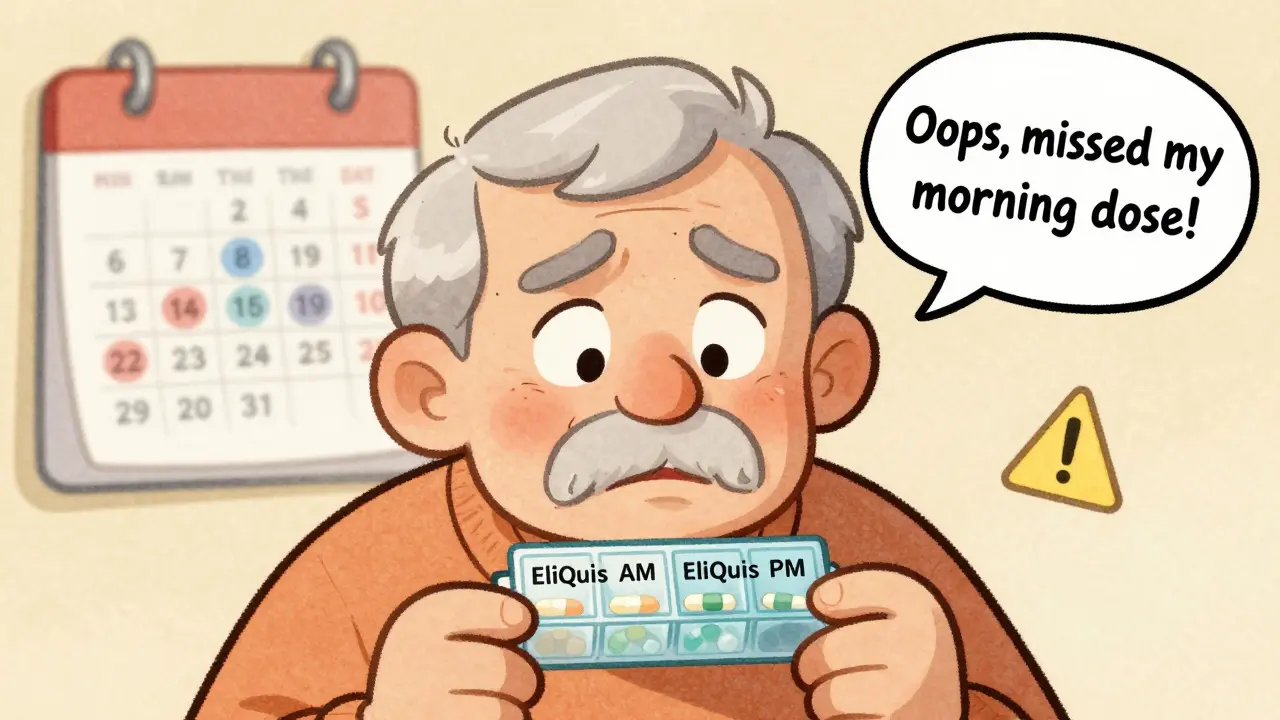
For example, if you usually take apixaban at 8 a.m. and 8 p.m., and you realize at 2 p.m. that you missed your morning dose, take it now. But if it’s 3 p.m. or later, skip it. Your next dose is at 8 p.m.-take that one as usual. Taking two doses too close together raises your bleeding risk without adding extra protection.
When to Call Your Doctor or Go to the ER
Most of the time, missing one dose and following the steps above is enough. But some symptoms mean you need help right away.
Call your doctor or go to the emergency room if you have:
- Red or brown urine-this could mean bleeding in your kidneys or bladder.
- Black, tarry, or bloody stools-signs of internal bleeding in your stomach or intestines.
- Unexplained bruising, especially large or spreading bruises without injury.
- Sudden dizziness, weakness, or confusion-could signal bleeding in the brain.
- Severe headache, vision changes, or trouble speaking-possible stroke symptoms.
- Shortness of breath or chest pain-could mean a pulmonary embolism.
- You’ve fallen or hit your head-even if you feel fine. Blood thinners make bleeding inside the skull more likely.
If you accidentally take too much-say, you took two pills thinking you missed one-call your doctor or go to the ER immediately. Bring your medication bottle and your anticoagulant record book with you. That helps them know exactly what you took and when.
Why You Should Never Double Up
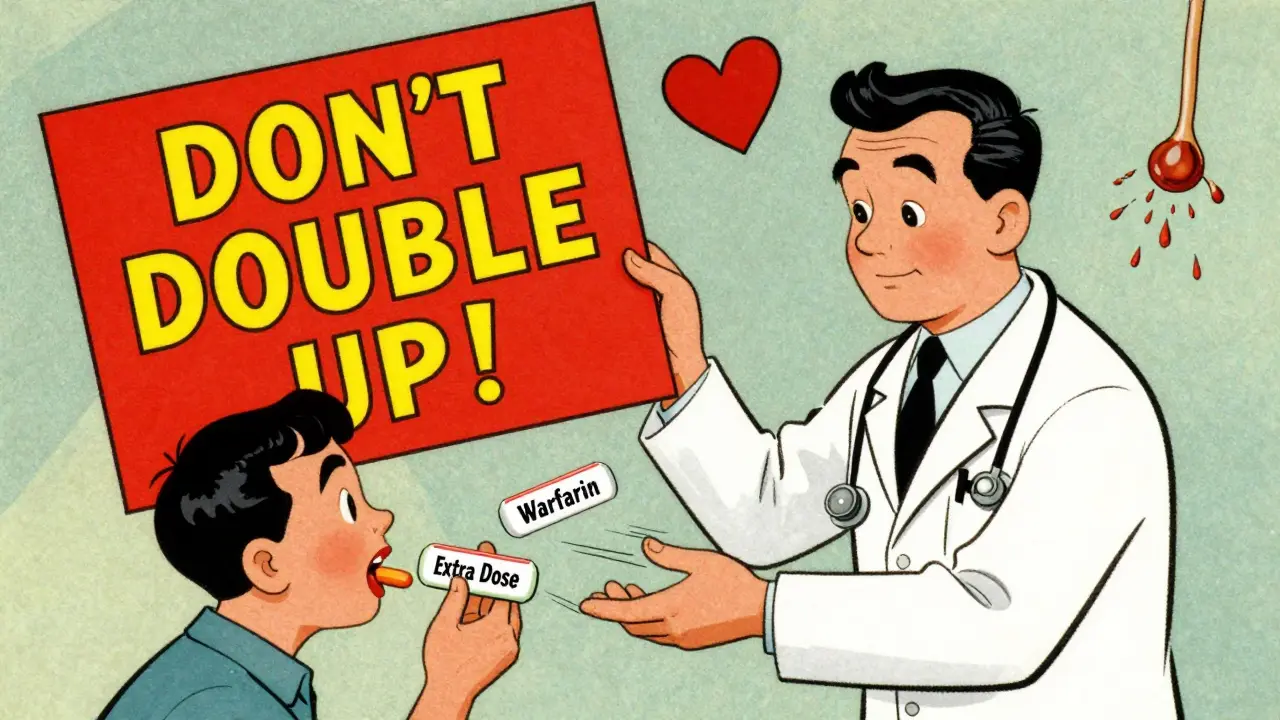
It’s tempting. You missed your dose. You’re worried. So you take two tomorrow. Don’t do it.
Doubling up doesn’t give you better protection. It just increases your bleeding risk. A single extra dose of warfarin can send your INR soaring. With DOACs, even one extra pill can push your blood’s clotting ability too low. The ROCKET-AF trial showed that annual major bleeding rates for patients on DOACs were already 1-3%. Doubling doses can push that number higher.
And here’s the truth: blood thinners are not like painkillers. You can’t just take more if you’re still in pain. They’re balancing acts. Too little, and you get a clot. Too much, and you bleed out. There’s no middle ground.
How to Avoid Missing Doses
The best way to handle a missed dose is to never miss one in the first place.
- Set phone alarms for each dose. Use two alarms-morning and night.
- Use a pill organizer with separate compartments for morning and evening.
- Refill your prescription before you run out. Don’t wait until the last day.
- Keep your yellow book or medication log updated. Write down every dose you take and every one you miss.
- Ask a family member or friend to check in with you once a day.
- If you travel, bring extra pills and keep them in your carry-on. Time zone changes can mess with your schedule.
People on warfarin should also avoid sudden changes in vitamin K intake-like eating a huge plate of kale one day and none the next. Vitamin K fights warfarin’s effect. Consistency matters.
What Happens If You Stop Taking It
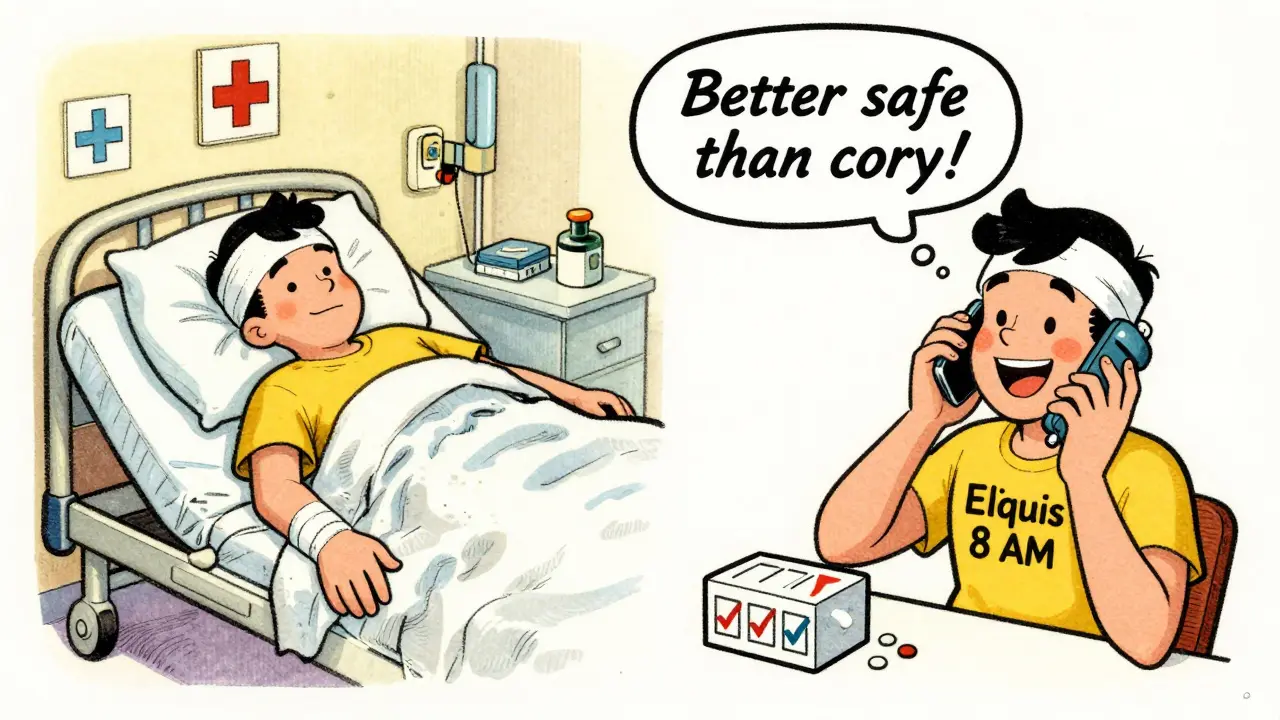
Some people stop taking their blood thinner because they feel fine, or they’re scared of bleeding, or they think they don’t need it anymore. That’s dangerous.
If you have atrial fibrillation, your risk of stroke without anticoagulation is 1.5% to 6.6% per year. That’s not a small number. For someone over 70, that’s a 1 in 10 to 1 in 20 chance of having a stroke each year. And once you have one, recovery is rarely complete.
Stopping without your doctor’s approval is not a choice-it’s a gamble. And the odds are stacked against you.
Final Reminder
Blood thinners save lives. But only if you take them exactly as prescribed. Missing a dose isn’t a failure-it’s a signal. A signal to check your routine, set better reminders, or talk to your doctor about why you’re struggling to stay on track.
If you’re unsure what to do after missing a dose, call your clinic. Don’t guess. Don’t rely on internet advice. Your provider knows your history, your risk factors, and your exact medication. They can tell you what’s safe for you.
One missed dose might not cause harm. But it’s a reminder: this isn’t optional. This is your safety.
What should I do if I miss a dose of Eliquis?
If you miss a dose of Eliquis and remember within 6 hours of your usual time, take it right away. If it’s been more than 6 hours, skip the missed dose. Do not take two doses at once. Take your next dose at your regular time the next day. Never double up to make up for a missed pill.
Can I take two warfarin pills the next day if I missed one?
No. Never take two warfarin pills in one day to make up for a missed dose. Doing so can raise your INR too high, increasing your risk of serious bleeding. If you miss a dose and remember within 12 hours, take it. If it’s been longer, skip it and resume your normal schedule the next day.
What are the warning signs of bleeding from blood thinners?
Watch for red or brown urine, black or tarry stools, unexplained bruising, vomiting blood, severe headaches, dizziness, confusion, or sudden weakness. These could mean internal bleeding. If you notice any of these, call your doctor or go to the emergency room right away.
Do DOACs like Eliquis need blood tests like warfarin?
No. DOACs such as Eliquis, Xarelto, and Pradaxa don’t require regular blood tests like warfarin does. But they need strict daily dosing because they leave your body faster. Missing doses can quickly reduce their protective effect, raising your risk of stroke.
What happens if I stop taking my blood thinner?
Stopping your blood thinner without medical advice increases your risk of stroke dramatically. For example, people with atrial fibrillation have a 1.5% to 6.6% chance of stroke each year without anticoagulation. Even if you feel fine, the clot risk is still there. Never stop these medications on your own.
Can I drink alcohol while on blood thinners?
Moderate alcohol use is usually okay, but heavy drinking can interfere with how your body processes warfarin and increase bleeding risk. With DOACs, alcohol doesn’t interact as strongly, but it can still raise your fall risk or cause stomach irritation. Talk to your doctor about what’s safe for you.
Should I tell my dentist I’m on blood thinners?
Yes. Always tell your dentist and any other healthcare provider you’re on blood thinners. Most dental procedures are safe without stopping the medication, but your dentist may need to take extra precautions to prevent bleeding. Never stop your blood thinner before dental work without your doctor’s approval.
Jessie Ann Lambrecht
January 7, 2026 AT 20:44Just wanted to say this post is a lifesaver. I’ve been on Eliquis for 3 years and used to forget constantly until I started using a pill organizer with alarms-now I haven’t missed one in over a year. It’s not glamorous, but consistency saves lives. Seriously, set two alarms. One for morning, one for night. Your future self will thank you.
Paul Mason
January 9, 2026 AT 12:55Man, I used to think missing a dose was no big deal till my buddy had a stroke because he skipped his Xarelto for two days ‘cause he was ‘feeling fine.’ Spoiler: he wasn’t fine. Now I nag my whole family about meds. If you’re on blood thinners, this isn’t optional-it’s your body’s emergency brake. Don’t gamble with it.
Aparna karwande
January 10, 2026 AT 19:30Let me be blunt: skipping your anticoagulant is not a ‘mistake’-it’s negligence dressed up as forgetfulness. You think you’re being busy? Millions of people juggle jobs, kids, and chronic illness and still take their pills on time. You’re not special. Your body doesn’t care about your ‘routine.’ Warfarin or DOACs-either way, your blood doesn’t negotiate. Miss a dose? You’re playing Russian roulette with your brain. And don’t even get me started on people who stop because they ‘feel fine.’ That’s not health literacy-that’s arrogance with a prescription.
steve rumsford
January 11, 2026 AT 06:45Just missed my evening Eliquis yesterday and panicked for like 10 minutes. Then I remembered the 6-hour rule-thank god for this post. Took it at 11pm, skipped the next morning dose, and now I’m back on track. I used to double up like an idiot till I read this. Big thanks to whoever wrote this. Seriously. Saved me from a hospital trip.
Sai Ganesh
January 11, 2026 AT 08:45In India, many elderly patients stop their blood thinners because they believe ‘natural remedies’ or ‘Ayurveda’ can replace them. I’ve seen it firsthand. One uncle stopped warfarin after a neighbor said turmeric ‘thins blood.’ He had a TIA two weeks later. This post is vital-not just for Western audiences, but globally. Consistency isn’t a Western concept. It’s a biological imperative. Please share this with families who still think medicine is optional.
Andrew N
January 11, 2026 AT 10:34Let’s be real-studies say missing one dose increases stroke risk by 57% for DOACs. But that’s an average. What’s the actual hazard curve? Is it linear? Exponential? And what about drug interactions? This post mentions alcohol but ignores NSAIDs, SSRIs, and grapefruit. You can’t just say ‘talk to your doctor’-that’s a cop-out. Where’s the data on polypharmacy risks? This feels like a marketing pamphlet, not medical guidance.
Elen Pihlap
January 13, 2026 AT 09:35OMG I’m so glad I found this. I’ve been so scared to take my pills because I’m terrified of bleeding. I had a nosebleed last week and thought I was gonna die. But now I get it-it’s not about being scared, it’s about being smart. I’m gonna set alarms and use a pill box. I feel better already. Thank you for not making me feel stupid.
Katrina Morris
January 14, 2026 AT 00:05My mom just started on Eliquis and she’s terrified. I printed this out for her and she cried. Said she never realized how dangerous missing one was. She’s now using a phone alarm and even made a little checklist. I’m so proud. This isn’t just info-it’s a lifeline. Thank you.