
Isotretinoin and Depression: What You Need to Know About Mental Health Monitoring
 Feb, 24 2026
Isotretinoin Mental Health Risk Assessment
How Your Risk Is Calculated
This assessment uses factors highlighted in the article to estimate your risk of mood changes during isotretinoin treatment. Based on research, your risk may be influenced by:
- History of mental health conditions
- Age and gender
- Current mental health status
- Isotretinoin dosage level
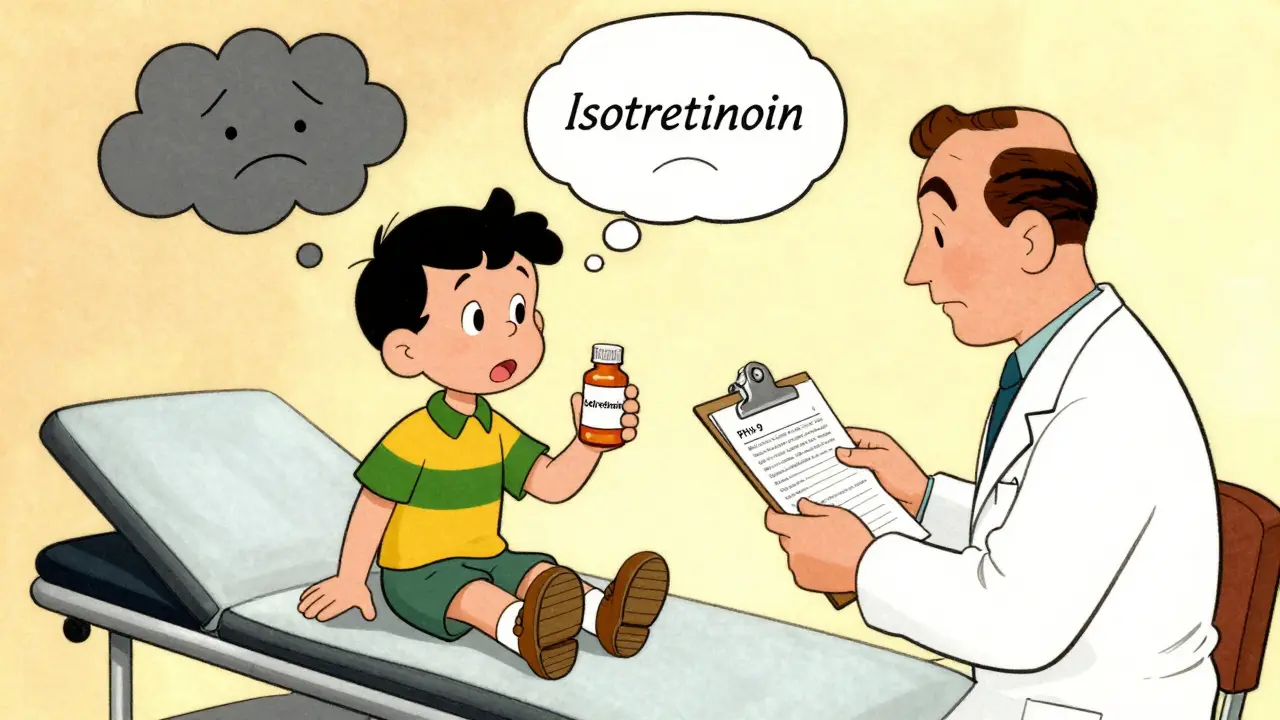
Isotretinoin is one of the most effective treatments for severe acne. For many, it’s life-changing-clear skin, fewer scars, improved confidence. But behind that success story is a quiet, persistent concern: isotretinoin and depression. Is the medication causing mood changes? Or is it just coincidence? The answer isn’t simple. And that’s why mental health monitoring isn’t optional-it’s essential.
How Isotretinoin Works (and Why It Might Affect Your Mood)
Isotretinoin, a synthetic form of vitamin A, shrinks oil glands and cuts sebum production by up to 90%. That’s why it clears stubborn acne where antibiotics and creams fail. About 85% of people who finish a full 15- to 20-week course never need to go back on it. But this drug doesn’t just target skin. It crosses the blood-brain barrier. And that’s where things get complicated.
Some studies suggest isotretinoin may lower serotonin levels or affect brain regions tied to emotion regulation. Others point to inflammation changes or vitamin B12 drops-since 18.7% of users develop a deficiency during treatment, which can mimic depression symptoms. But here’s the catch: no single mechanism explains every case. And that’s why blanket statements like "isotretinoin causes depression" are misleading.
The Evidence: Conflicting Studies, Clear Patterns
On one side, you’ve got the FDA’s Adverse Event Reporting System (FAERS). Between 2004 and 2024, over 19,000 psychiatric events were linked to isotretinoin. The most common? Depression (47.5%), suicidal thoughts (17.7%), and anxiety (15%). The odds of reporting these events were more than three times higher than in non-users. Suicidal ideation had the strongest signal-over 11 times more likely to be reported.
But then there’s the 2023 JAMA Dermatology meta-analysis of over 1.6 million people. It found no increased relative risk of depression or suicide compared to the general population. The 1-year suicide attempt rate? Just 0.14%. The depression rate? 3.83%. That’s almost identical to typical teen depression rates (3.3-5.72%).
So which is right? Both. The key is understanding the difference between relative risk and absolute risk. Yes, some people experience serious mood changes. But for most, the risk is low. What matters more is who’s at risk.
Who’s Most at Risk?
Not everyone. The data shows clear patterns:
- History of mental illness: People with prior depression, anxiety, or bipolar disorder have a significantly higher chance of worsening symptoms.
- Age and gender: Younger patients (under 25) report more mood changes. Men are more likely to experience completed suicide incidents-consistent with general suicide trends.
- Dose matters: Paradoxically, higher cumulative doses were linked to lower suicide risk in the JAMA study. This might mean those who tolerate higher doses better are more resilient overall.
- Timing: Symptoms most often show up around week 8. Half of all psychiatric events occur within the first two months.
That’s why monitoring isn’t a one-time checkbox. It’s a rhythm.
What Mental Health Monitoring Actually Looks Like Today
Regulators and clinics aren’t ignoring this. Here’s what’s happening now:
- Baseline screening: Before starting, your dermatologist should ask about past or current depression, anxiety, therapy, medications, and family history. A simple PHQ-9 questionnaire (9 questions about mood, sleep, energy) is standard.
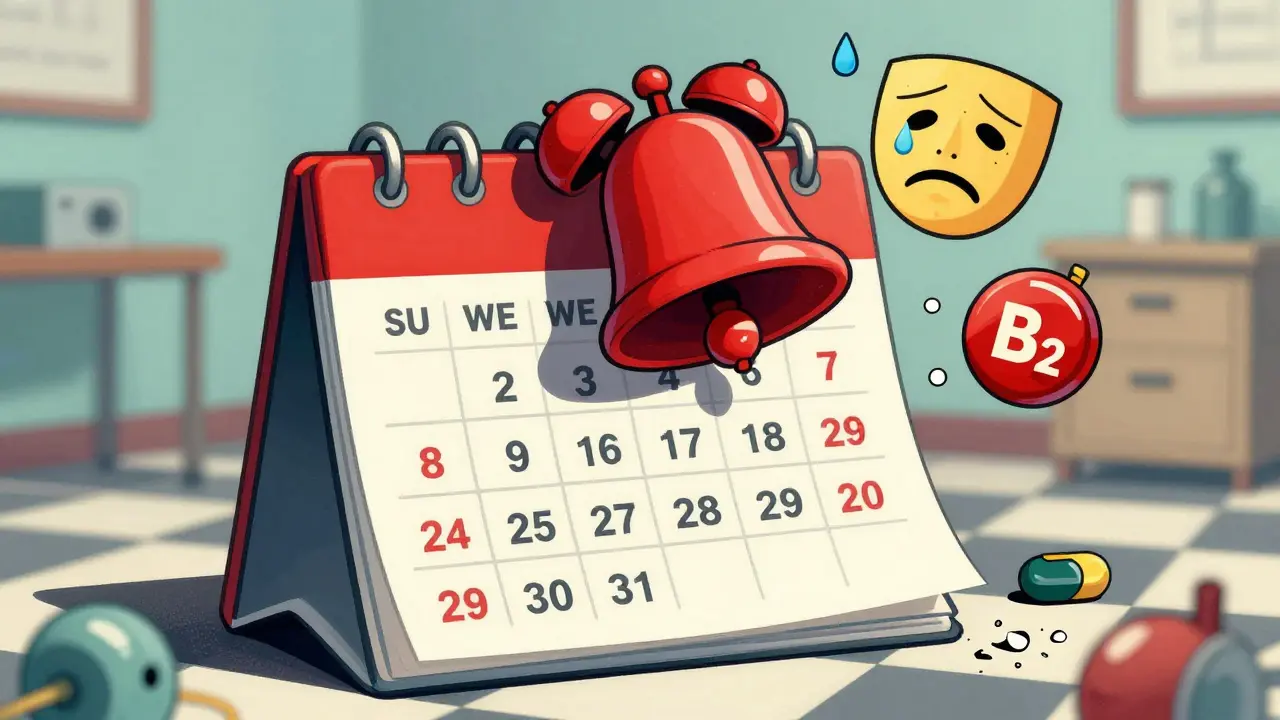
- Weekly check-ins for the first 8 weeks: This is critical. That’s when most problems start. Some clinics, like UCSF, now require an in-person "mental health pause" at week 8 before continuing.
- Monthly follow-ups: After week 8, check-ins continue monthly. The iPLEDGE program in the U.S. now requires PHQ-9 scores every month. If your score hits 10 or higher, you’re referred to a mental health professional.
- Digital tools: Starting in 2025, the FDA is piloting automated PHQ-9 check-ins through the iPLEDGE app. Patients answer weekly via phone or tablet. If red flags pop up, their provider gets an alert.
And it’s not just about depression. Irritability, emotional numbness, panic attacks, or sudden crying spells? Those count too. One Reddit user wrote: "Week 8 hit. I felt nothing. No joy, no anger. Just empty." That’s emotional blunting-a real, documented effect.
What to Do If You Feel Off
Don’t wait. Don’t assume it’s "just stress." If you notice any of these, tell your doctor immediately:
- Thoughts of self-harm or suicide (even if you don’t plan to act on them)
- Unexplained crying or emotional shutdown
- Severe anxiety that doesn’t improve
- Loss of interest in things you used to love
- Extreme irritability or aggression
Stopping isotretinoin doesn’t mean failure. Many people report mood symptoms resolving within 2-3 weeks after quitting. One user on Drugs.com said: "Stopped at week 9. Crying every day. Stopped the drug. Within 21 days, I felt like myself again."
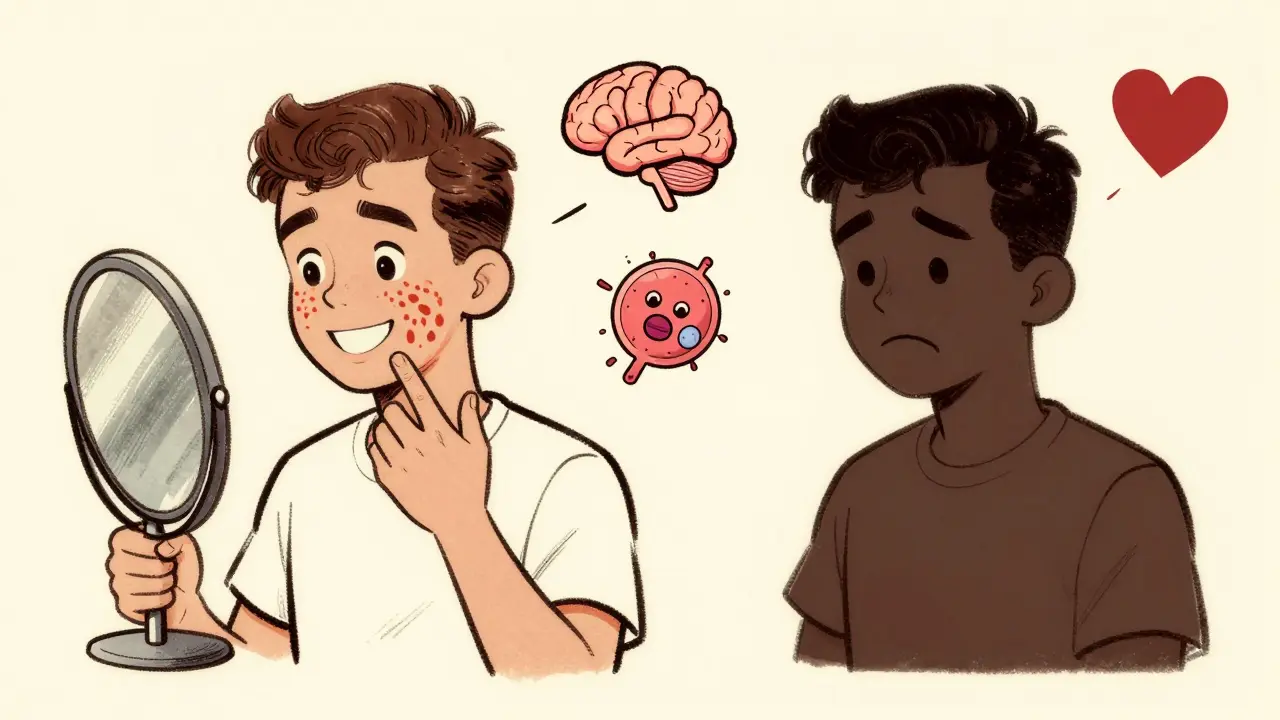
But here’s the flip side: some people feel better. "My depression lifted dramatically," wrote another user. "My acne was crushing me. When my skin cleared, so did my mood."
That’s why it’s not about the drug alone. It’s about the whole picture: skin, brain, life stress, self-esteem.
What About Other Acne Treatments?
Is isotretinoin uniquely risky? Not exactly. Minocycline, a common acne antibiotic, has been linked to depression in 1.7% of users. That’s low-but still real. Topical retinoids? Minimal psychiatric risk. But they don’t work for severe cases.
Isotretinoin’s risk profile is higher than most, but it’s also more effective. For someone with scarring, social anxiety, or job loss because of acne, the benefits can outweigh the risks-if monitored properly.
What’s New in 2025?
Research is moving fast:
- Genetic testing: A 2024 study found a gene variant (BDNF Val66Met) predicts depression risk with 68% accuracy. It’s not routine yet-but in the next few years, it might be.
- Vitamin B12 checks: Since deficiency mimics depression, some clinics now test B12 at baseline and mid-treatment.
- Personalized guidelines: The American Psychiatric Association’s 2025 guidelines will recommend tailoring monitoring based on history, not just blanket rules.
The message is clear: one-size-fits-all doesn’t work. A 17-year-old with no mental health history? Lower risk. A 22-year-old with a history of depression and no support system? Higher risk. Your treatment plan should reflect that.
Final Thoughts: It’s Not About Fear. It’s About Awareness.
Isotretinoin doesn’t turn people into depressed or suicidal. But it can unmask or worsen underlying vulnerabilities. That’s why monitoring isn’t bureaucracy-it’s care.
If you’re considering isotretinoin, ask your doctor:
- "Have you screened me for depression or anxiety?"
- "What’s your protocol for checking in during treatment?"
- "What signs should I watch for?"
- "What happens if I report mood changes?"
And if you’re already on it? Keep talking. Even if you think it’s "just a bad week." Your mental health matters as much as your skin.
Can isotretinoin cause depression even if I’ve never had it before?
Yes, it can. While most people don’t develop depression on isotretinoin, some with no prior history report mood changes. The exact reason isn’t fully understood, but it may involve brain chemistry changes, vitamin B12 drops, or inflammation. The key is early detection-symptoms often appear around week 6-8. If you notice persistent sadness, loss of interest, or emotional numbness, talk to your doctor right away.
How long do mood side effects last after stopping isotretinoin?
For most people, mood symptoms improve within 2 to 6 weeks after stopping the medication. In clinical reports, patients who stopped due to depression saw rapid improvement-often within 3 weeks. But if symptoms persist beyond 6 weeks, they may be unrelated to isotretinoin and need separate evaluation. Never assume the problem will go away on its own-follow up with a mental health professional if symptoms continue.
Is it safe to take antidepressants while on isotretinoin?
Yes, in most cases. There’s no known dangerous interaction between isotretinoin and common antidepressants like SSRIs (e.g., sertraline, fluoxetine). In fact, some dermatologists proactively prescribe them to patients with a history of depression before starting isotretinoin. Always inform both your dermatologist and psychiatrist about all medications you’re taking to ensure coordinated care.
Do I need to see a psychiatrist before starting isotretinoin?
Not always, but it’s strongly recommended if you have a history of depression, anxiety, bipolar disorder, or suicidal thoughts. Even if you don’t, a baseline mental health screening using tools like the PHQ-9 is now standard practice. Many clinics require this before prescribing. If your score is high, you’ll be referred to a mental health provider-not to stop treatment, but to support you through it.
Are there alternatives to isotretinoin for severe acne?
Yes, but none are as effective for severe nodular acne. Options include long-term antibiotics (doxycycline, minocycline), hormonal therapies (like spironolactone for women), or laser/light treatments. However, these often require ongoing use and don’t offer the same chance of permanent clearance. Isotretinoin remains the gold standard for treatment-resistant cases-especially when acne affects mental health. The decision should be based on risk vs. benefit, not fear alone.
Why do some people say isotretinoin helped their depression?
Because for them, the acne was the root cause. Severe acne can lead to social isolation, low self-worth, and chronic stress-all of which trigger depression. When the skin clears, the psychological burden lifts. This isn’t the drug fixing depression-it’s removing a major stressor. That’s why mental health screening before treatment is so important: to tell the difference between drug-induced symptoms and acne-related distress.
Christopher Brown
February 25, 2026 AT 10:51Isotretinoin is just another Big Pharma scam to keep people dependent. They don't care if you're depressed-they just want you to keep buying pills. The real cause of mood swings? The government's fluoride in the water. Everyone knows that.
Sanjaykumar Rabari
February 26, 2026 AT 23:23This drug is dangerous. My cousin took it and now he doesn't talk to anyone. They hide the truth. Watch out.
Kenzie Goode
February 28, 2026 AT 16:46I was on isotretinoin for five months. I didn't get depressed, but I did feel like a ghost for a while-like I was watching my life through glass. It wasn't the acne that broke me, it was the loneliness that came with it. When my skin cleared, I cried for three days. Not from joy. From relief. I didn't realize how much I'd been holding in.
Dominic Punch
March 1, 2026 AT 12:42Let’s cut through the noise. Yes, isotretinoin can affect mood-but that doesn’t mean it’s evil. It means we need better screening, not fear. The JAMA study is solid: absolute risk is low. What matters is who you are. If you’ve struggled with mental health before, this isn’t the time to wing it. Get a therapist on speed dial. Get your B12 checked. Track your mood daily. This isn’t overkill-it’s basic care. And if you’re scared to talk to your doc? You’re not alone. But silence kills. Speak up. Even if it’s just to say, ‘I’m not okay.’ That’s the bravest thing you can do.
Valerie Letourneau
March 2, 2026 AT 19:20As someone who lives in Canada, I find it remarkable how much more structured our approach to mental health monitoring is compared to other countries. Our dermatologists here are required to provide written mental health resources before prescribing isotretinoin, and follow-ups are built into the billing system. It's not perfect, but it's a step toward treating mental health as part of physical health-not an afterthought. We still have work to do, but the direction is clear.
Khaya Street
March 3, 2026 AT 21:05Look, I get it. The science is messy. But if you're gonna take a drug that can mess with your brain, you better be ready to pay attention. I've seen too many people just shrug and say 'I'm fine' while they're falling apart. Don't be that guy. Check in with yourself. Write it down. Talk to someone. It's not weak. It's smart.
David McKie
March 5, 2026 AT 08:25Of course isotretinoin causes depression. It's a vitamin A derivative. Vitamin A is a neurotoxin in high doses. The FDA knows this. They just don't care because the pharmaceutical lobby owns them. And don't even get me started on iPLEDGE-it's a surveillance tool disguised as safety. You think they care about your mental health? They care about liability. They want you to sign forms so they can say, 'We warned you.' Wake up.
Southern Indiana Paleontology Institute
March 6, 2026 AT 12:01my cousin took isotretinoin and he got real depressed. then he stopped and he was fine. so it was the drug. nothin else. people say 'oh it's just stress' but nah. it was the pill. they lie to you. i dont trust doctors. they just wanna sell stuff. my skin was fine anyway. i shoulda never listened.
lela izzani
March 8, 2026 AT 11:04Thank you for writing this with such care. I’ve been a dermatology nurse for 12 years, and I’ve seen patients who were on the verge of quitting college because of acne-and then, after isotretinoin, they started smiling again. But I’ve also seen those who slipped into silence. The difference? Support. Monitoring. Someone asking, 'How are you *really*?' That’s the real treatment-not the pill. If you’re reading this and you’re scared: you’re not alone. And you’re not weak for needing help. Your skin is not your worth. But your mind? That’s everything.