
Hypoparathyroidism: How to Manage Low Calcium and Vitamin D Effectively
 Dec, 5 2025
What is hypoparathyroidism?
Hypoparathyroidism is a rare endocrine disorder where the parathyroid glands don’t make enough parathyroid hormone (PTH). Without enough PTH, your body can’t keep calcium levels stable. This leads to low calcium in the blood-called hypocalcemia-and high phosphate levels. You might feel tingling in your fingers, muscle cramps, or even seizures if it’s severe. Most cases happen after thyroid or neck surgery, but it can also come from autoimmune disease, genetics, or radiation treatment.
Why calcium and vitamin D matter
PTH normally tells your bones to release calcium, your kidneys to hold onto calcium, and your gut to absorb more from food. When PTH is missing, all those systems slow down. That’s why you need to replace calcium and vitamin D artificially. But here’s the catch: you don’t just need any vitamin D. Regular vitamin D3 (cholecalciferol) won’t work well because your kidneys can’t activate it without PTH. Instead, you need calcitriol or alfacalcidol-active forms that skip the step your body can’t do anymore.
Standard treatment: Calcium and active vitamin D
The go-to treatment is simple in theory but tricky in practice. You take calcium supplements and active vitamin D every day, for life. Most doctors start with 1,000 to 2,000 mg of calcium daily, split into two or three doses. The best form is calcium carbonate because it’s cheap and has 40% elemental calcium. That means you need less of it than calcium citrate, which only gives you 21%. Take it with meals-it helps absorb calcium and also binds to phosphate in food, helping lower your phosphate levels.
For vitamin D, most start with 0.25 to 0.5 mcg of calcitriol per day. Some people need more. The goal isn’t to get calcium into the normal range. It’s to keep it in the lower half-around 2.00 to 2.25 mmol/L (8.0 to 8.5 mg/dL). Going higher than that increases your risk of kidney stones and calcium deposits in your brain or blood vessels. One study found that patients with calcium levels above 2.35 mmol/L had nearly three times the risk of brain calcification after 15 years.

What to monitor-and why
It’s not enough to just check your blood calcium. You need to watch four key things:
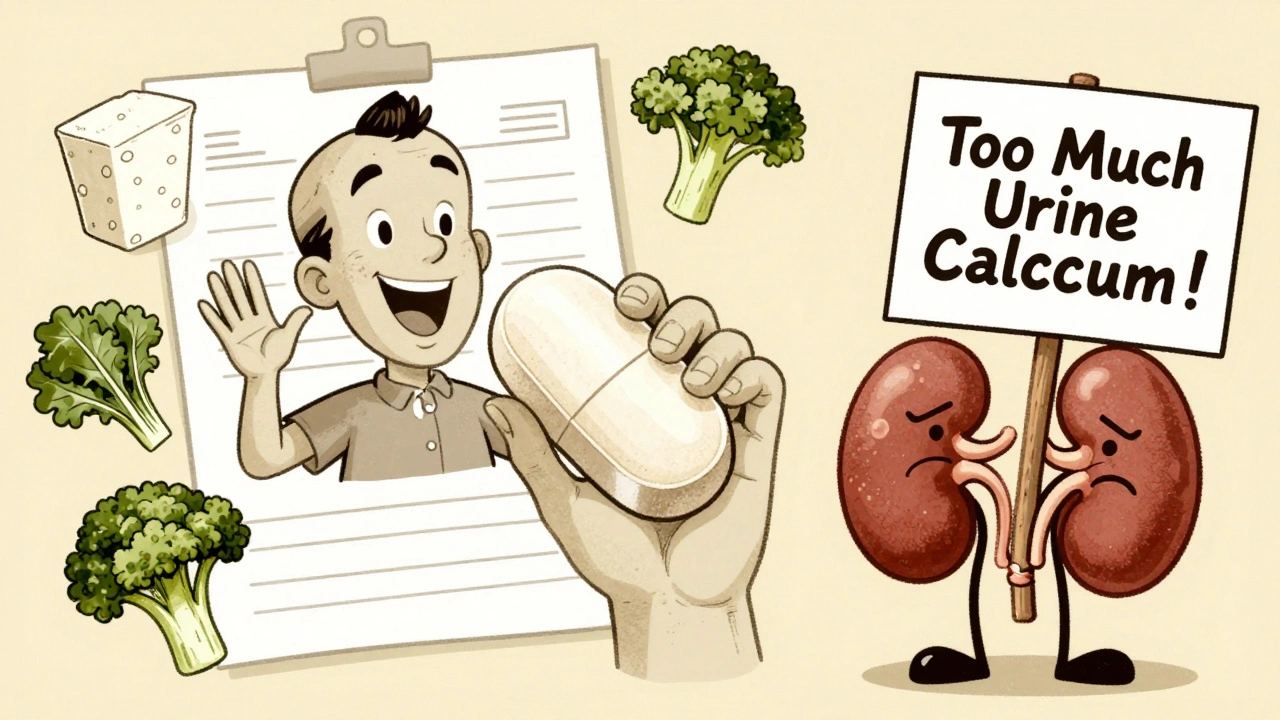
- 24-hour urinary calcium: You want less than 250 mg per day. Too much means you’re at risk for kidney stones. About 35-40% of people on standard treatment develop this.
- Serum phosphate: Keep it between 2.5 and 4.5 mg/dL. High phosphate worsens symptoms and speeds up calcification.
- Magnesium: If your magnesium drops below 1.7 mg/dL, your body can’t respond to PTH-even if you take supplements. Many people need 400-800 mg of magnesium oxide daily.
- 25-hydroxyvitamin D: Even though you’re on active vitamin D, you still need some D3 to keep levels between 20 and 30 ng/mL. Take 400-800 IU daily.
Check these every 1-3 months when you’re starting treatment. Once stable, you can cut back to every 6-12 months. But don’t skip the urine test. It’s the best early warning sign for kidney damage.
When standard treatment isn’t enough
About 25-30% of people struggle with conventional therapy. You might be in this group if:
- You need more than 2,000 mg of calcium daily
- You need more than 2 mcg of calcitriol per day
- Your urine calcium stays high despite diet changes
- You’re tired of taking 6-10 pills a day and still getting symptoms
For these cases, doctors may consider recombinant human PTH(1-84) (Natpara) or teriparatide (Forteo). These are daily injections that replace the missing hormone. Natpara was pulled from the U.S. market in 2019 due to manufacturing issues but came back in 2020 with strict safety rules. It costs about $15,000 a month-way more than the $100-$200 for pills. But for some, it cuts calcium and vitamin D needs by 30-40%, reduces kidney risks, and improves quality of life.
Dietary tweaks that make a difference
What you eat matters as much as what you take. You need calcium-rich foods: dairy (300 mg per serving), kale (100 mg per cup), broccoli (43 mg per cup). But you also need to cut back on phosphate. Avoid soda-just one liter has 500 mg of phosphoric acid. Skip processed meats and hard cheeses-they’re loaded with phosphate. Aim for under 1,000 mg of phosphate daily.
Also, keep sodium low-under 2,000 mg per day. High salt makes your kidneys dump more calcium into your urine. Thiazide diuretics like hydrochlorothiazide can help, but only if your doctor prescribes them.
Real-life struggles and smart fixes
A 2021 survey of 412 patients found that 68% couldn’t keep their calcium stable. Many described a "calcium rollercoaster"-tingling one day, exhausted the next. Constipation from high-dose calcium affected 45%. Some people found relief by splitting their calcium into four or five smaller doses instead of two or three. Others improved by optimizing magnesium and taking vitamin D3 at bedtime.
Access to PTH therapy is another hurdle. Getting Natpara approved can take 30-45 days. Many patients rely on specialty pharmacies and face delays. Support groups like the Hypopara Alliance and Reddit communities (r/Hypoparathyroidism) help people share tips, find resources, and push for faster access.
What’s coming next
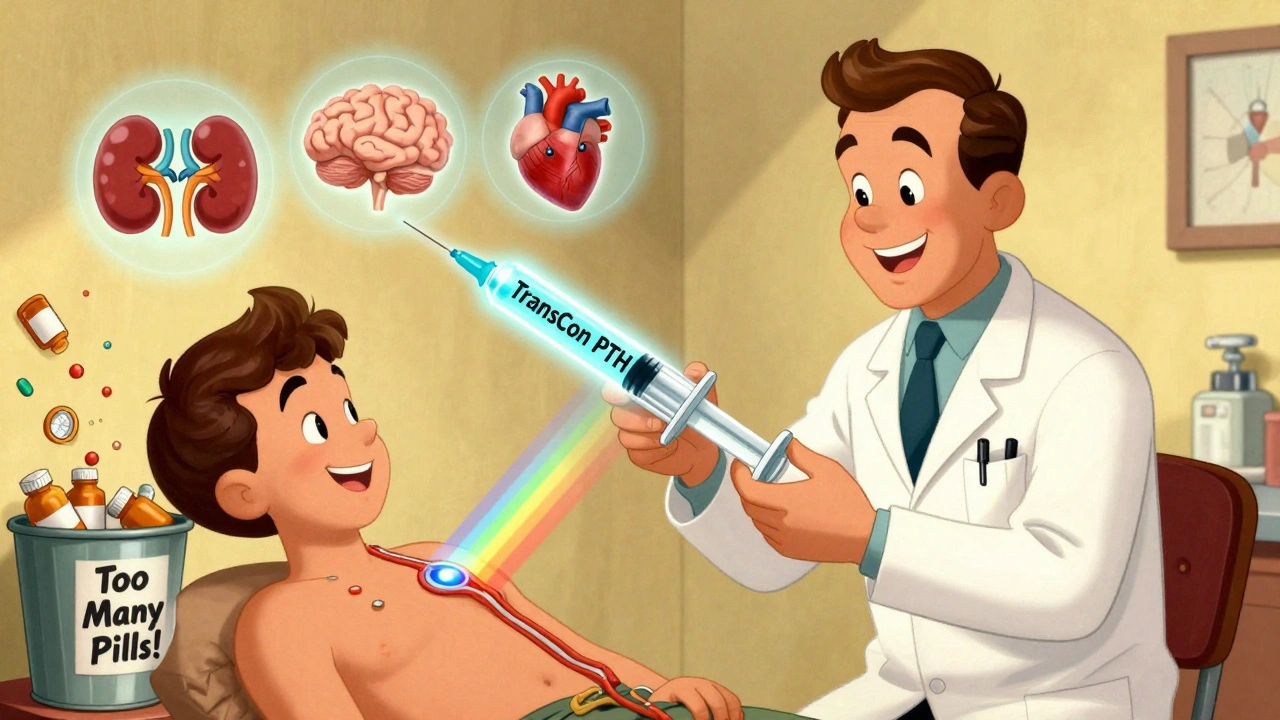
Research is moving fast. A new drug called TransCon PTH showed in a 2022 trial that it could normalize calcium in 89% of patients with just one daily injection. It’s not approved yet, but it could be a game-changer-less frequent dosing, fewer side effects, and better control.
Doctors are also starting to look at long-term kidney damage. About 15-20% of people on conventional therapy develop stage 3+ chronic kidney disease after 10 years. That’s why the European Society of Endocrinology is updating its guidelines. The goal isn’t just to stop symptoms. It’s to protect your kidneys, heart, and brain for decades.
What you can do today
- Take calcium with meals-never on an empty stomach.
- Use calcium carbonate unless you have absorption issues.
- Ask for a 24-hour urine test at least once a year.
- Check your magnesium levels regularly.
- Track your symptoms: tingling, cramps, fatigue, brain fog.
- Don’t skip doses-even one missed pill can trigger symptoms.
- Have an emergency plan: chew 2-3 calcium tablets if you feel a flare-up coming.
Managing hypoparathyroidism isn’t about perfection. It’s about consistency. Small, steady changes add up. Work with your endocrinologist, keep your doctor informed, and don’t hesitate to ask for help. You’re not alone-and better treatments are on the way.
Can I take regular vitamin D3 instead of calcitriol?
No. Regular vitamin D3 (cholecalciferol) needs to be activated by your kidneys using PTH. If you have hypoparathyroidism, your kidneys can’t do that step. You need active forms like calcitriol or alfacalcidol, which bypass the need for PTH. Studies show calcitriol works 2.3 times faster than D3 at raising calcium levels.
Why is my calcium still low even though I’m taking supplements?
Low magnesium is a common culprit. If your magnesium is below 1.7 mg/dL, your body can’t use PTH properly-even if you’re taking calcium and vitamin D. Check your magnesium levels. Many people need 400-800 mg of magnesium oxide daily. Also, make sure you’re taking calcium with meals and not skipping doses.
Is it safe to take more than 2,000 mg of calcium a day?
It’s risky. Taking more than 2,000 mg of elemental calcium daily increases your risk of heart problems and kidney stones. The goal is to use the lowest dose that controls your symptoms. If you need more, talk to your doctor about switching to PTH therapy or using thiazide diuretics to reduce urinary calcium loss.
Can hypoparathyroidism be cured?
In most cases, no. It’s a lifelong condition. But it can be well-managed. Some people recover after surgery if the parathyroid glands were only temporarily damaged. For others, PTH replacement therapy or emerging treatments like TransCon PTH may offer better control in the future-but not a cure yet.
What should I do if I miss a dose?
If you miss one calcium dose, take it as soon as you remember-but don’t double up. If you miss vitamin D, just take your next dose on time. If you start feeling tingling, cramping, or numbness, chew 2-3 calcium tablets (500-1,000 mg total) right away. Always have a backup plan. Keep extra calcium tablets in your bag, car, or desk.
How often should I see my doctor?
When you start treatment, expect 3-4 visits in the first 3 months to adjust doses. Once stable, 3-4 visits a year are usually enough. But if you’re on PTH therapy or having trouble controlling calcium, you may need more frequent check-ins. Don’t wait for symptoms to get worse before scheduling an appointment.
Inna Borovik
December 7, 2025 AT 10:09Let’s cut through the noise: most people don’t realize that calcium supplementation without active vitamin D is like buying a Ferrari and never turning the key. You’re not just wasting money-you’re risking nerve damage, seizures, and kidney calcification. The 2.00–2.25 mmol/L target isn’t arbitrary-it’s the sweet spot between survival and slow poisoning. And yes, magnesium is the silent hero here. I’ve seen patients crash because their doc ignored Mg levels. Stop treating symptoms. Treat the system.
Dan Cole
December 8, 2025 AT 05:07So let me get this straight-you’re telling me we’ve been treating a hormonal deficiency with two over-the-counter pills for 70 years while the real solution-PTH replacement-was sitting in a lab since the 90s? And now it costs $15k/month because Big Pharma decided to weaponize biological necessity? This isn’t medicine. It’s economic torture wrapped in clinical guidelines. We’re managing a chronic condition like it’s a plumbing leak while the entire water system is rusted through. TransCon PTH isn’t the future-it’s the overdue correction. And yet, insurance still denies it because ‘it’s not cost-effective’-as if human brains calcifying is a budget line item.
Rashmi Gupta
December 8, 2025 AT 23:20Everyone here is acting like this is some groundbreaking science. In India, we’ve been managing this with traditional calcium-rich foods-sesame seeds, ragi, moringa-and minimal supplements for generations. No calcitriol. No Natpara. Just food, sunlight, and patience. The real problem isn’t the disease-it’s the Western obsession with pharmaceutical fixes for everything. You don’t need a $200 pill when a bowl of curd and spinach costs 20 cents. Your body isn’t a machine that needs replacement parts-it’s an ecosystem. Stop treating it like a car.
Andrew Frazier
December 10, 2025 AT 21:24bro i just take 3 tums before bed and call it a day. why are people making this so hard? its just low calcium. i dont need no fancy injections or urine tests. i got a job and a family. i dont got time for all this. also vitamin d3 works fine for me. stop gatekeeping your meds.
Mayur Panchamia
December 11, 2025 AT 16:37Listen here, you over-medicated Americans-you think this is about pills? No. It’s about discipline. You want to live? Then you eat your calcium with meals-no excuses. You want to survive? Then you track your phosphate like your life depends on it-because it does. You skip a dose? You feel the tingling? You chew tablets like your life is a ticking bomb-because it is. And if you’re whining about cost? Get a job. Get a plan. Stop blaming Big Pharma and start taking responsibility. This isn’t a Netflix doc-it’s your body. Treat it like it matters.
Karen Mitchell
December 11, 2025 AT 22:35It is, without question, a profoundly concerning development that the medical community continues to endorse the administration of calcium carbonate as a primary therapeutic modality, particularly in light of the documented correlation between elevated serum calcium levels and intracranial calcification. The prevailing paradigm, which prioritizes symptom suppression over long-term systemic integrity, constitutes, in my estimation, a failure of clinical foresight. Furthermore, the normalization of self-administered calcium supplementation without concurrent renal monitoring is not merely negligent-it is ethically indefensible.
Geraldine Trainer-Cooper
December 12, 2025 AT 13:26brenda olvera
December 13, 2025 AT 03:51