
How to Store and Label Breast Milk When Taking Temporary Medications
 Feb, 7 2026
When you're breastfeeding and need to take a temporary medication-whether it's an antibiotic, pain reliever, or something for a short-term illness-it’s natural to worry: Is my milk still safe? Should I stop nursing? Do I need to dump everything? The truth is, for most medications, you don’t have to stop. But you do need to store and label your milk correctly to keep your baby safe and avoid wasting precious supply.
Let’s cut through the confusion. You’re not alone if you’ve stared at a bag of milk wondering if it’s safe to feed after taking a pill. Many moms panic and throw away perfectly good milk because they don’t know the rules. The good news? Fewer than 2% of medications require you to stop breastfeeding at all. The rest? You can keep nursing-with smart storage and clear labeling.
Why Labeling Matters More Than Ever
When you’re not on medication, labeling breast milk with the date and time is important. When you are? It becomes critical. A single mislabeled bag could mean your baby gets milk with a higher concentration of medication than intended-or worse, you discard milk that was perfectly safe to use.
Here’s what every container needs:
- Date and time of collection (always)
- Your baby’s name (if you’re storing it for someone else to feed)
- Medication name (e.g., “Amoxicillin 500mg”)
- Time you took the medication (e.g., “Taken at 8:00 AM”)
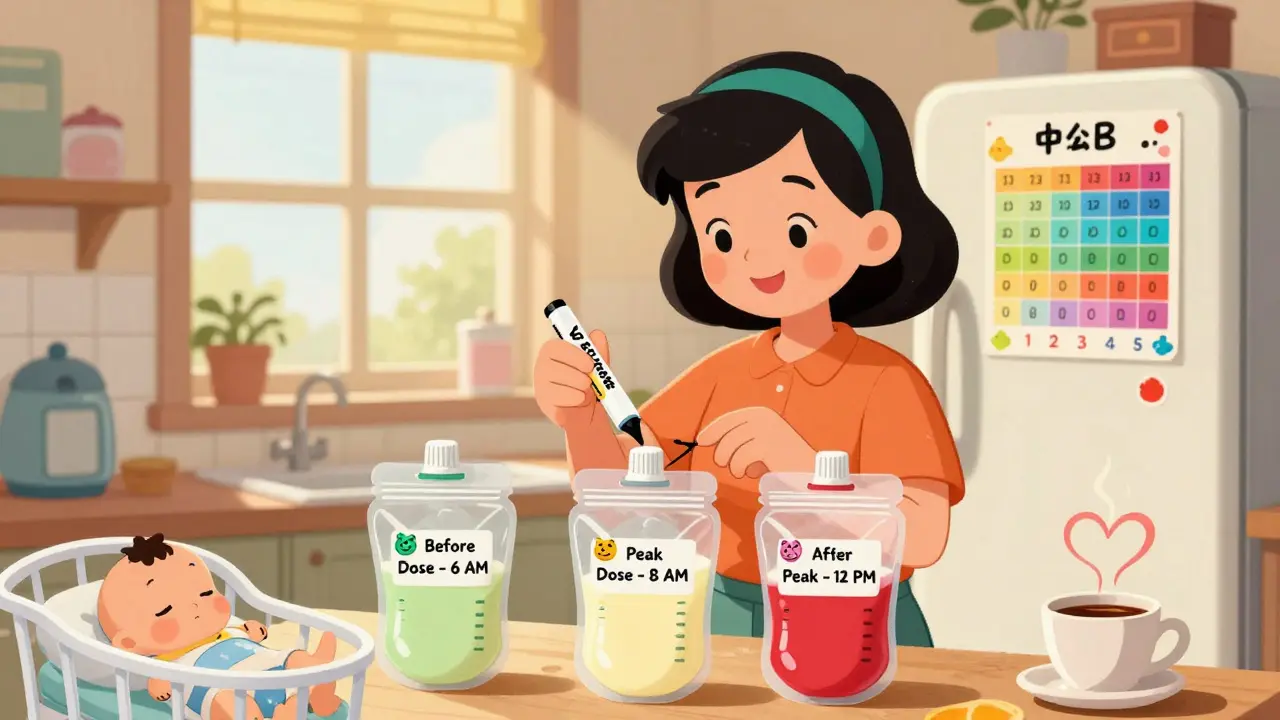
Use waterproof labels and permanent ink. A sticky note that smudges or a pen that fades won’t cut it. Some moms use color-coded stickers-green for milk before the dose, yellow for 2-4 hours after, red for after the peak. That’s not just helpful; it’s a game-changer.
One mom on BabyCenter shared how she used red, yellow, and green stickers during a 10-day antibiotic course. She fed her baby 90% of her stored milk without a single issue. Without labeling, she would’ve thrown away half of it.
Storage Rules: The Standard + The Medication Twist
Standard breast milk storage times are simple:
- Room temperature (up to 77°F): 4 hours
- Refrigerator (39°F or colder): 4 days
- Freezer (0°F or colder): 6-12 months
But when you’re on medication, these rules need a tweak. The key is timing your pumping around your medication dose.
Most medications peak in your breast milk 1-2 hours after you take them. That’s when levels are highest. So here’s the strategy:
- Feed your baby right before your dose. This gives you the most time to pump and store milk before the medication peaks.
- Pump and store milk 1-2 hours after your dose. Label this batch clearly: “Peak dose: 8:00 AM.”
- Pump again 3-4 hours after your dose. This milk will have much lower levels. Label it: “Post-peak: 12:00 PM.”
- Store these batches separately.
You might end up with 2-4 labeled batches per day, depending on how often you take the medication. Don’t mix them. Even if they’re all from the same day, mixing could accidentally give your baby a higher dose than expected.
Pro tip: Freeze milk in 2-4 ounce portions. That way, if you need to thaw just one batch for a feeding, you won’t waste the rest. And remember-breast milk expands when it freezes. Leave at least an inch of space at the top of the container.
When Do You Actually Need to “Pump and Dump”?
The phrase “pump and dump” scares a lot of moms. But it’s rarely necessary. In fact, most medications don’t require you to discard any milk at all.
Here’s what doctors and lactation consultants actually recommend:
- Low-risk (L1-L2): No dumping needed. Examples: ibuprofen, acetaminophen, most antibiotics (amoxicillin, cephalexin), fluconazole.
- Medium-risk (L3): Usually safe. Monitor baby for side effects. Examples: some antidepressants, allergy meds. Label carefully.
- High-risk (L4-L5): Rare. May require temporary pumping and dumping. Examples: chemotherapy drugs, radioactive iodine, some anti-seizure meds. Always check with your provider.
Dr. Thomas Hale’s Medications and Mothers’ Milk is the gold standard reference. It rates drugs on a five-level safety scale. If your doctor doesn’t mention it, ask them to check it. Many pharmacies now have access to this data too.
And here’s the kicker: “Pump and dump” doesn’t remove medication from your system faster. Your body clears drugs over time-usually through your liver and kidneys. Pumping doesn’t speed that up. It just removes milk that’s already there. So if you’re dumping out of fear, you’re probably wasting milk for no reason.
What About Traveling or Working?
Managing milk storage on the go gets harder when you’re on medication. But it’s doable.
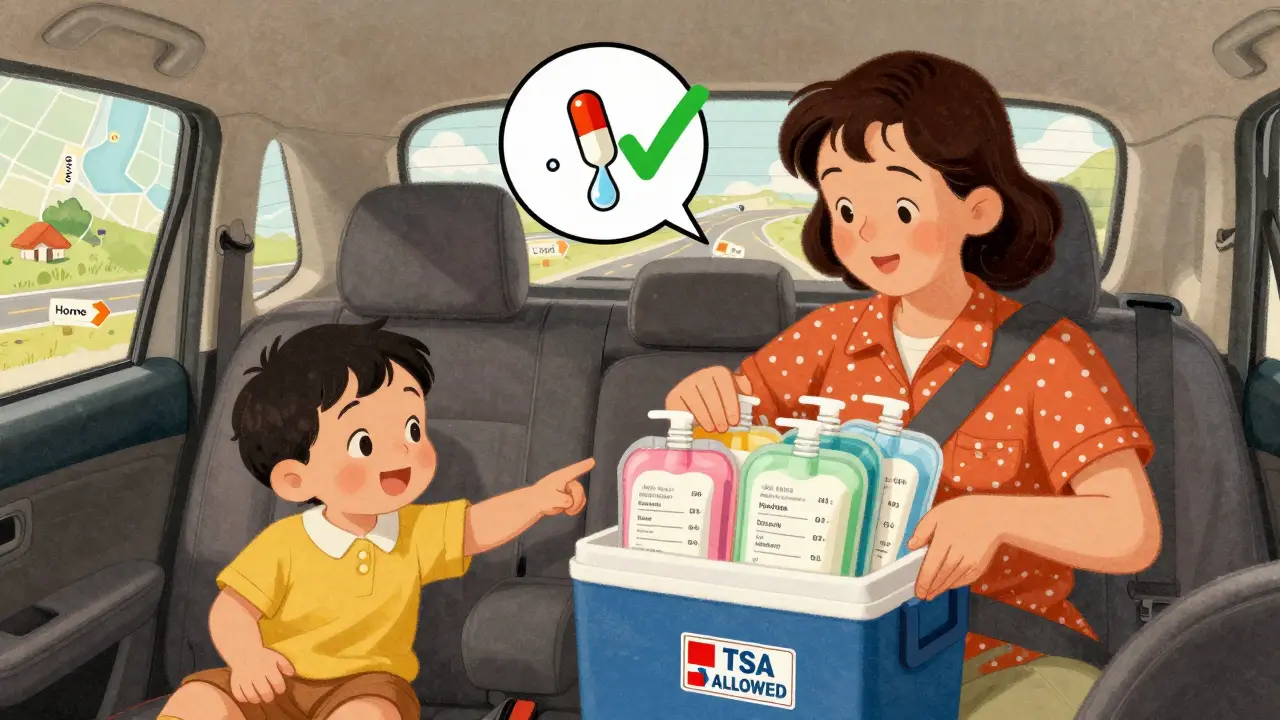
Use an insulated cooler bag with frozen ice packs. The CDC says this keeps milk safe for up to 24 hours. If you’re away from home for longer, freeze your milk before you leave. Thaw it in the fridge overnight before your trip.
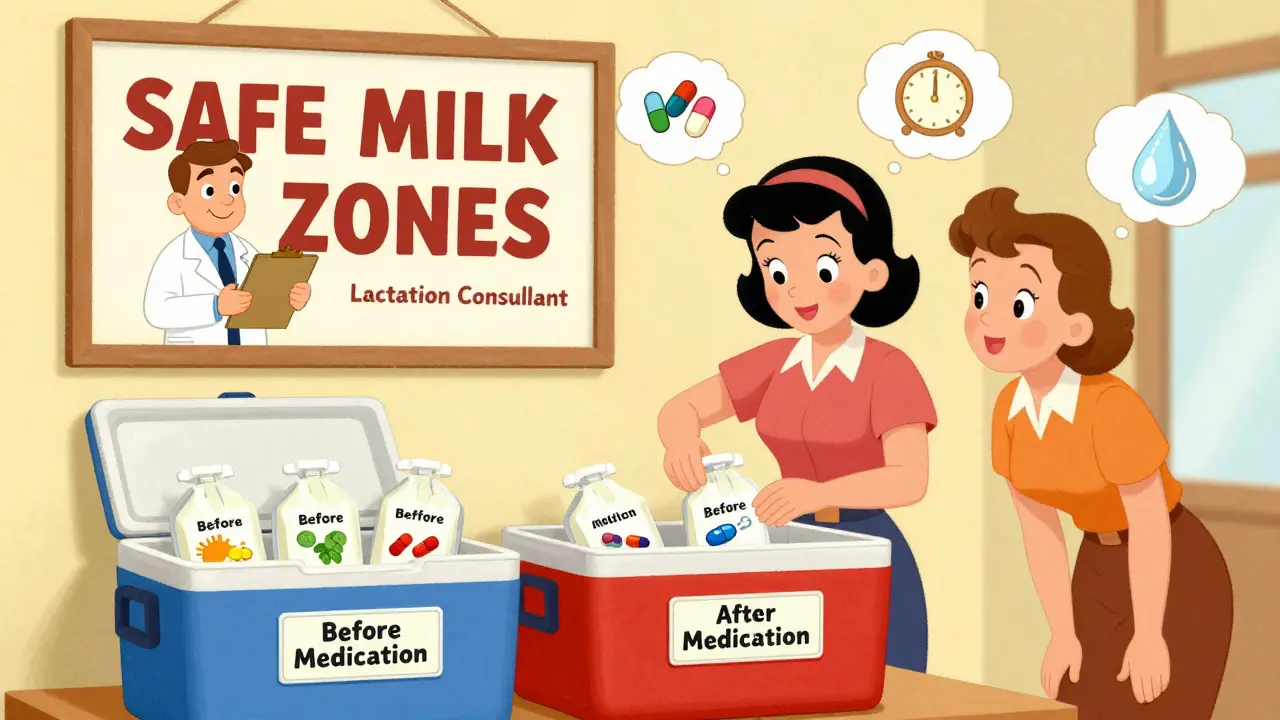
At work? Keep a labeled, separate cooler just for your medication-affected milk. Use different colored bins or containers. One mom I spoke with used a blue container for “before dose” milk and a red one for “after dose.” Her coworkers even started asking for tips.
And if you’re traveling by plane? Pack your milk in your carry-on. TSA allows breast milk in quantities over 3.4 ounces-you don’t need to throw it away. Just tell the officer it’s breast milk. Bring a note from your doctor if you’re carrying multiple bags.
What Happens If You Mix Them?
Accidentally mixing a “peak dose” batch with a “before dose” batch? It’s not a disaster. But it’s not ideal.
If you’ve already mixed them, don’t panic. You can still feed it-just avoid giving it to your baby right before your next dose. Wait until after you’ve taken the next pill, then feed it. That way, the medication levels even out.
But if you’re unsure? Play it safe. Store the mixed milk in the fridge and use it within 24 hours. Don’t freeze it. And next time? Double-check your labels before pouring.
Common Mistakes (And How to Avoid Them)
Based on surveys of over 1,000 breastfeeding moms taking medications:
- 68% didn’t label the medication name or time. → Always write it down. Use a permanent marker.
- 52% stored affected milk with clean milk. → Keep separate containers. Color-code if needed.
- 73% thought they had to dump milk for the whole course. → Most meds only need 1-2 hours of separation.
- 41% threw away milk they didn’t need to. → Ask your lactation consultant or pharmacist before tossing.
The biggest mistake? Assuming you have to stop. You don’t. You just need to be smart about it.
When to Call a Lactation Consultant
If you’re unsure about your medication, reach out. An IBCLC (International Board Certified Lactation Consultant) can help you:
- Check if your drug is safe
- Map out your dosing schedule
- Create a labeling system that works for you
- Prevent unnecessary milk loss
A 2022 study found that moms who got personalized advice from an IBCLC wasted 37% less milk than those who relied on internet searches. That’s not just about saving money-it’s about preserving your supply and your peace of mind.
Many hospitals offer free consultations. Apps like MotherToBaby (updated 2024) now generate custom storage labels based on your medication and schedule. Download it. It’s free. It’s reliable. It’s made by experts.
What’s Changing in 2026?
The rules are getting clearer. In 2025, the FDA plans to require all prescription labels to include breastfeeding storage instructions. That’s huge. Until then, you’re the expert on your own body.
Pharmacies are starting to stock special milk storage bags with built-in medication label spaces. They’re not expensive-about $10 for 50 bags. If you’re on a med for more than a few days, they’re worth it.
And here’s the bottom line: You can do this. You’ve done hard things before. This is just another step in motherhood-not a setback.
Do I need to pump and dump after every dose?
No, not unless your medication is in the high-risk (L4-L5) category. For most drugs, you can continue breastfeeding. The key is timing: feed your baby right before you take the dose, then pump and store milk 1-2 hours after. Label it clearly. You rarely need to discard milk.
Can I mix milk from different times of the day if I’m on medication?
It’s best not to. Milk expressed right after a dose has higher medication levels than milk taken before or long after. Mixing them could unintentionally give your baby a larger dose. Store them separately and use the earliest batch first.
How long should I wait to breastfeed after taking a pill?
You don’t need to wait at all for most medications. In fact, feeding right before your dose is ideal-it means your baby gets milk with the lowest possible medication level. For drugs that peak in milk 1-2 hours after ingestion, waiting 2-4 hours before the next feed is usually enough. Always check with your provider for your specific drug.
Is it safe to freeze milk that was expressed while on medication?
Yes. Freezing doesn’t change the medication level-it just stops further changes. As long as you’ve labeled the batch correctly, frozen milk from after a dose is safe to use later. Just thaw it slowly in the fridge and use it within 24 hours once thawed.
What if I accidentally feed my baby milk from the wrong batch?
If your baby gets milk with a higher medication level than intended, watch for unusual sleepiness, fussiness, or changes in feeding. Most medications are in such small amounts that they won’t cause harm. But if you’re concerned, call your pediatrician. In most cases, it’s a non-issue-especially if it only happened once.
Can I use the same storage bags for all my milk, or do I need different ones?
You can use the same bags, but you must label each one clearly with the medication timing. Many moms find it easier to use different colored bags or stickers to avoid mix-ups. Specialized storage bags with pre-printed medication fields are now available and reduce errors.
If you’re taking medication and breastfeeding, you’re doing something powerful. You’re balancing health, care, and science-all while keeping your baby fed. You don’t need to be perfect. You just need to be informed. And now, you are.
Ariel Edmisten
February 8, 2026 AT 22:19Sarah B
February 10, 2026 AT 00:57Heather Burrows
February 11, 2026 AT 04:25Savannah Edwards
February 11, 2026 AT 17:31Gouris Patnaik
February 12, 2026 AT 08:58Lakisha Sarbah
February 12, 2026 AT 09:07Amit Jain
February 12, 2026 AT 18:38Eric Knobelspiesse
February 14, 2026 AT 16:54Mayank Dobhal
February 16, 2026 AT 09:49Jesse Lord
February 17, 2026 AT 21:03