
How to Speak Up About Medication Side Effects During Treatment
 Jan, 12 2026
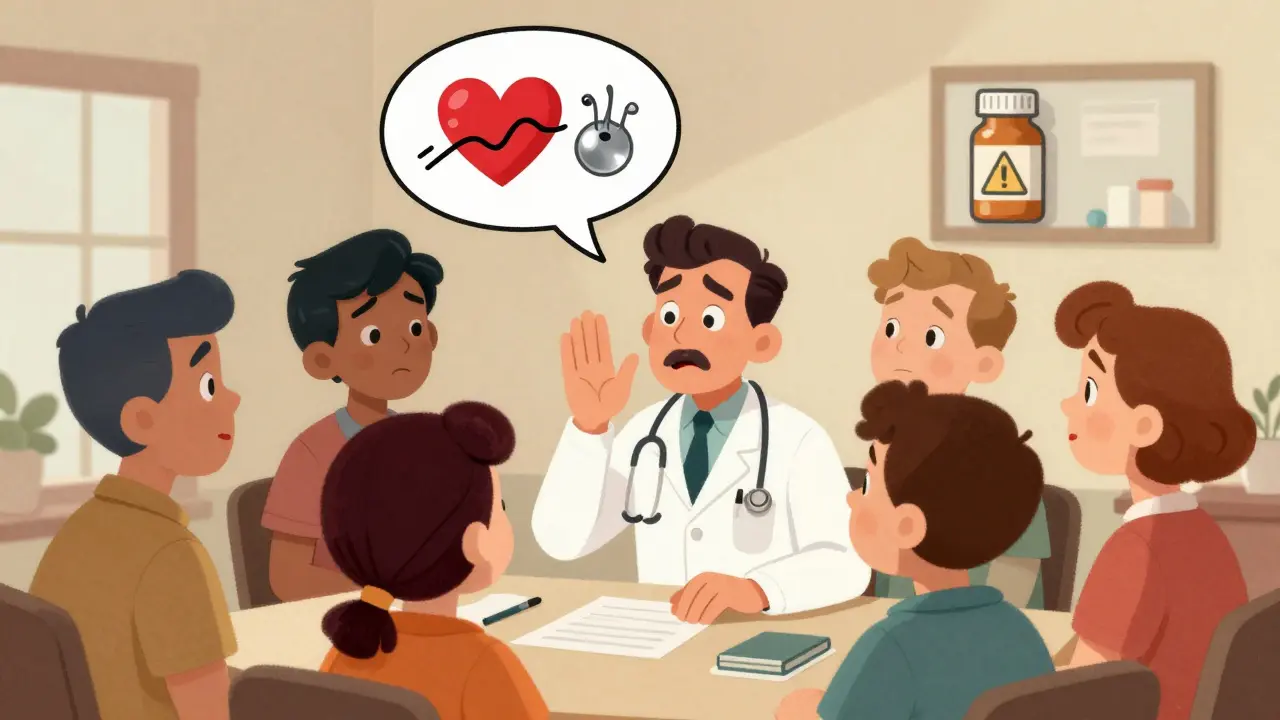
When you start a new medication, you’re told what to expect: nausea, dizziness, fatigue. But what if the side effect is worse than the label says? Or worse - what if it’s something not listed at all? Many people stay silent. They think it’s just part of the deal. Or they assume their doctor already knows. But here’s the truth: if you don’t speak up, no one else will. And that silence can delay life-saving changes to how drugs are used - or even lead to a drug being pulled from the market.
Why Your Voice Matters More Than You Think
Clinical trials test drugs on thousands of people. But real life? Millions take the same pill. And in that real world, rare side effects show up - ones that never showed up in the lab. In 2022 alone, the FDA received over 2.2 million reports of adverse reactions. That’s a 37% jump from just four years earlier. Most of those reports came from patients and doctors speaking up after noticing something unusual. Take Paxlovid, for example. When it was first approved for COVID-19, the label didn’t mention a strange metallic taste in the mouth. But patients started reporting it - over and over. Within months, the FDA updated the label to include “dysgeusia” as a known side effect. That change happened because people talked. The same thing happened with the Johnson & Johnson COVID vaccine. A nurse noticed a pattern of rare blood clots in young women. She filed a report with VAERS. Within 15 days, the CDC and FDA paused use of the vaccine to investigate. That report saved lives. Your experience isn’t just noise. It’s data. And that data helps regulators, doctors, and even other patients make smarter choices.What Counts as a Side Effect Worth Reporting?
You don’t need to be a doctor to know when something’s off. The FDA defines a serious adverse event as any reaction that:- Causes death
- Is life-threatening
- Requires hospitalization
- Leads to permanent disability
- Causes birth defects
- Needs medical intervention to prevent permanent harm
- Severe insomnia after starting a new antidepressant
- Unexplained bruising while on blood thinners
- Chronic dry mouth from a blood pressure pill
- Memory lapses after starting a cholesterol drug
How to Report Side Effects - Step by Step
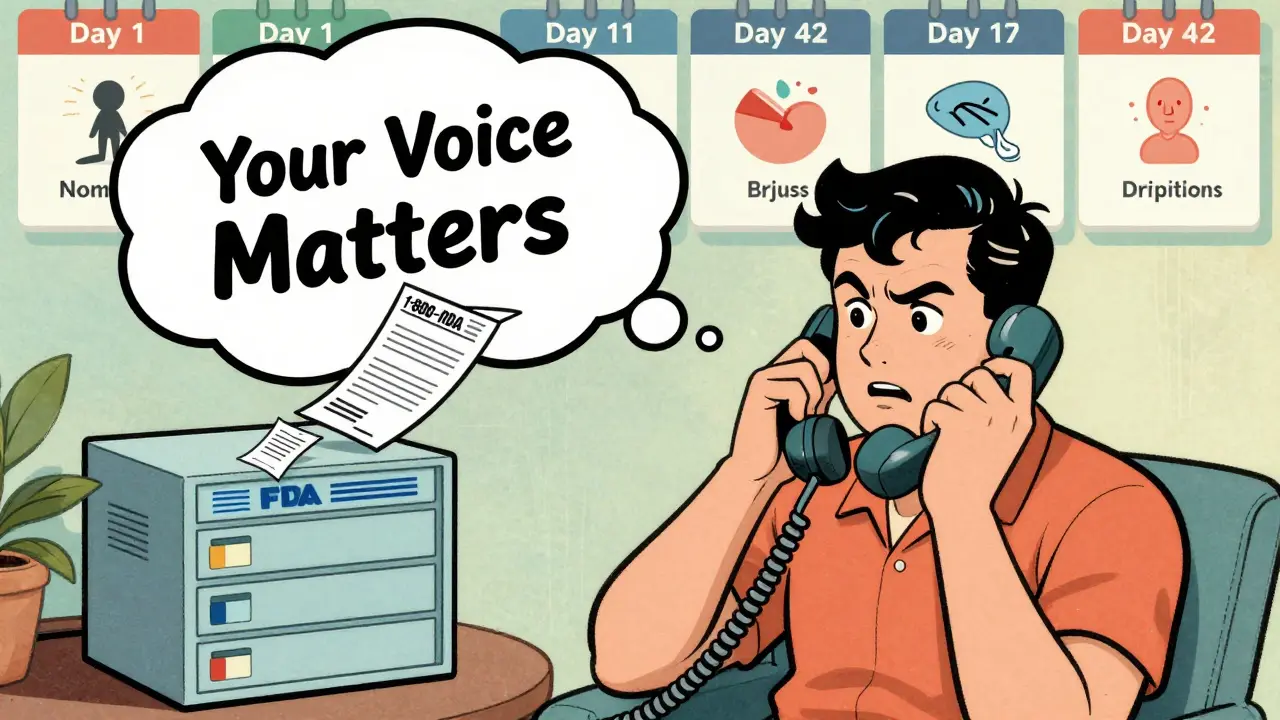
Reporting isn’t complicated. You don’t need to fill out a 10-page form. Here’s how to do it in under 15 minutes. Step 1: Talk to your doctor first. Always. They need to know what’s happening for your care. But don’t assume they’ll report it. Only about 1 in 10 serious side effects get reported by healthcare providers. Step 2: Choose your reporting path. You have three easy options:- Call 1-800-FDA-1088 - This number is now required on every prescription label since January 2022. A live person answers. You can report in English or Spanish.
- Fill out the online form - Go to www.fda.gov/medwatch and click “Patient/Consumer.” It’s free, secure, and takes about 10 minutes.
- Ask your pharmacist - Many pharmacies have printed forms or can help you submit a report online.
- Drug name (including dosage - e.g., “Lisinopril 10mg daily”)
- When you started taking it
- When the side effect started
- What happened (be specific: “I felt like my heart was pounding for 3 hours after taking the pill”)
- What you did about it (did you stop the drug? Go to the ER?)
- Your age and gender (optional but helpful)
Why Most People Don’t Report - And How to Overcome It
A 2022 survey found 68% of patients didn’t know they could report side effects directly to the FDA. Another 42% thought their doctor would do it for them. And 58% feared being dismissed. Here’s how to push past those barriers:- “It’s normal” isn’t true. Fatigue from a new medication? Maybe. Fatigue that lasts six weeks and makes you miss work? Not normal. Trust your body.
- Your doctor won’t always report it. A 2021 study found community pharmacists reported side effects at just 3.2% of cases. Doctors are busy. They’re not trained to file paperwork. You have to be the advocate.
- Reporting doesn’t mean you’re “complaining.” It means you’re helping others. One report can prevent another person from ending up in the ER.
What Happens After You Report?
Once you file a report, it goes into the FDA’s database. It doesn’t trigger an immediate investigation. But when dozens - or hundreds - of people report the same issue with the same drug, the FDA’s system picks up a pattern. That’s called a “signal.” That signal can lead to:- Updated drug labels with new warnings
- Warnings to doctors about high-risk patients
- Changes in dosing recommendations
- Even drug withdrawals - like the painkiller Vioxx, pulled after reports linked it to heart attacks

What’s Changing - And What’s Coming
The system is slowly getting better. Since 2022, the FDA has required the toll-free number on all prescription labels. Direct consumer reports have gone up 18%. Hospitals like Mayo Clinic boosted reporting by 47% after adding automated alerts into their electronic records. In 2023, the FDA started testing AI tools to scan patient records for hidden side effects - catching 27% more issues than traditional reporting. And by 2024, the Sentinel Initiative 2.0 will analyze data from 300 million patient records to spot trends automatically. But here’s the catch: technology can’t replace human voices. AI can’t feel the exhaustion, the confusion, the fear. Only you can describe what it’s like to wake up every morning with your heart racing after taking your pill. That’s why your report still matters more than ever.Final Thought: You’re Not Just a Patient. You’re a Watchdog.
Medications save lives. But they also carry risks - some known, many hidden. The system that keeps us safe doesn’t work unless people speak up. You don’t need to be a scientist. You don’t need to be loud. You just need to be honest. Next time you notice something off - a strange taste, a sudden mood shift, an unexplained rash - don’t shrug it off. Don’t wait for your doctor to notice. Pick up the phone. Open the form. Say: “This isn’t right.” Someone else might be experiencing the same thing. And your report could be the one that helps them - or saves them.Can I report side effects even if I’m not sure the medication caused them?
Yes. The FDA explicitly says you don’t need to prove causation. If you suspect a drug might be involved - even if you’re unsure - report it. Many serious safety signals start with just one unclear report. The FDA’s job is to look for patterns, not to assign blame.
Do I need to give my real name when reporting?
You can report anonymously, but providing your contact information helps the FDA follow up if they need more details. Your personal info is protected under federal privacy laws and won’t be shared publicly. If you’re uncomfortable, you can still report without your name - but your report will be less useful without a way to clarify details later.
What if my doctor says the side effect isn’t serious?
Your experience matters more than their opinion. Doctors can miss things - especially if they’re seeing dozens of patients a day. If you feel the side effect is affecting your quality of life, it’s worth reporting. You can say, “I understand you think it’s common, but I’d like to report it to the FDA because I’m concerned.” Most doctors will respect that.
Can I report side effects for someone else, like an elderly parent?
Absolutely. Family members, caregivers, and even pharmacists can file reports on behalf of patients. Just include the patient’s name (if permitted), the medication, and your relationship to them. The FDA accepts reports from anyone who has firsthand knowledge of the event.
How long does it take for a reported side effect to lead to a drug warning?
There’s no fixed timeline. Some warnings come within weeks if the pattern is strong and consistent - like the blood clot cases with the J&J vaccine. Others take years, especially for rare effects. The FDA reviews reports continuously, but action depends on volume, severity, and whether similar reports are coming in from other sources. Your report adds to the pile - and every pile matters.
Are there side effects that shouldn’t be reported?
If a side effect is clearly listed in the drug’s official labeling and is mild - like occasional headache from aspirin - you don’t need to report it. But if it’s worse than described, lasts longer than expected, or you’re unsure, report it anyway. Better to over-report than under-report. The FDA prefers to see too many reports than miss one that could save a life.
Adam Rivera
January 13, 2026 AT 11:21Just wanted to say thanks for this. My mom took that new blood pressure med and started getting dizzy every afternoon. She thought it was just aging, but after reading this, she reported it. Turns out, three other people in her clinic had the same thing. They switched her meds last week and she’s back to gardening like normal. Small thing, big difference.
Acacia Hendrix
January 13, 2026 AT 20:08The epistemological rupture between clinical trial paradigms and real-world pharmacovigilance is profoundly underappreciated. The FDA’s passive surveillance infrastructure remains fundamentally reactive, predicated on the assumption that patients possess both the epistemic authority and the institutional literacy to encode their phenomenological experiences into structured adverse event reports. This is a neoliberal fantasy disguised as patient empowerment.
Moreover, the normalization of ‘mild’ side effects as mere ‘noise’ in the signal-to-noise ratio reflects a deeper ontological dismissal of patient subjectivity. Dysgeusia isn’t just a symptom-it’s an existential disruption of embodied cognition. Yet we’re told to ‘just endure it’ while corporate pharmacoeconomics remain unchallenged.
The algorithmic surveillance systems like Sentinel 2.0 are merely technocratic band-aids. They don’t address the root pathology: the commodification of health data and the erosion of clinician-patient epistemic parity. Until we reconceptualize patients as co-producers of pharmacological knowledge-not mere data points-we’re just rearranging deck chairs on the Titanic.
lucy cooke
January 14, 2026 AT 08:34I cried reading this. Not because I’m dramatic (okay, maybe a little) but because I spent six months being told my ‘anxiety’ was just stress-until I realized it was the antidepressant making me feel like my soul was being vacuum-sealed. I reported it. No one called me back. No one thanked me. But I know I did the right thing. And now? I’m off it. And my therapist says I’ve ‘reclaimed my emotional bandwidth.’ That’s not just healing. That’s rebellion.
Also, if you think your doctor knows everything? Honey. They’re juggling 30 patients, a broken printer, and a Medicaid audit. You’re the only one who lives in your body. Speak up. Even if your voice shakes. Especially then.
John Pope
January 15, 2026 AT 18:52Look, I get it. People don’t wanna be that guy. But here’s the thing: if you don’t report, you’re basically letting Big Pharma get away with murder. Literally. I had a cousin who got liver failure from a statin. The label said ‘rare.’ Turns out, 17 other people had the same thing and nobody said anything. He’s dead now. His wife didn’t even know she could report. So now I tell everyone I know. I don’t care if they think I’m obsessive. I’d rather be the annoying guy who saved a life than the quiet one who let someone die because they were ‘too polite.’
And yeah, doctors are busy. But that’s not your problem. Your problem is staying alive. So pick up the phone. Write the thing. Send it. Don’t wait for permission. You don’t need a degree. You just need a heartbeat and a brain that knows something’s wrong.
Milla Masliy
January 16, 2026 AT 19:53This is so important. I’ve been reporting every weird side effect since my dad got sick last year. We reported the brain fog from his chemo med, the dry mouth from his antihypertensive, even the weird metallic taste after his antibiotic. Turns out, the dry mouth was a known issue but not on the label yet. They updated it last month. I feel like we helped. Not because we’re heroes-just because we didn’t stay silent.
Also, if you’re scared your doctor will judge you? Just say, ‘I want to help others.’ They usually soften right away. And if they don’t? Then you’ve already won by reporting anyway.
Kimberly Mitchell
January 18, 2026 AT 02:02Why are we even doing this? The FDA doesn’t act on most reports. It’s performative activism. You think your ‘unexplained bruising’ is going to change anything? The system is broken. The drug companies own the regulators. Your report gets buried in a database with 2 million others. You’re not a watchdog. You’re a data point in a corporate PR campaign.
Save your time. Focus on your own health. Stop trying to fix a machine designed to ignore you.
Randall Little
January 18, 2026 AT 12:01Let’s be real: the fact that you need a 15-minute guide to report a side effect is a national disgrace. We have AI that can predict stock trends in milliseconds, but a patient has to manually fill out a form because the system was designed in 1998? And the only reason this post exists is because someone finally had the energy to explain it in plain English.
Also, ‘dysgeusia’? Really? You couldn’t just say ‘metallic taste’? The medical establishment’s obsession with Latinizing everything is the real side effect here.
John Tran
January 18, 2026 AT 19:09Okay so like I took this new anxiety med and I swear I started hearing my own heartbeat in my ears like a drum machine? I thought I was losing it. I told my doc and he was like ‘it’s just stress’ so I didn’t say anything for two weeks. Then I saw this post and I was like… wait, what if I’m not crazy? So I called 1-800-FDA-1088 and this lady was like ‘oh yeah we’ve had 14 other reports of this with this exact med’ and I was like… holy shit. I didn’t even know I was part of a pattern. Now they’re changing the label. I didn’t think I mattered. Turns out I did. So yeah. Report stuff. Even if you think you’re being dramatic. You’re not. You’re just awake.
mike swinchoski
January 19, 2026 AT 07:31Why do we even care? The drugs are gonna kill us anyway. Just take your pills and shut up.
Lethabo Phalafala
January 19, 2026 AT 13:19I’m from South Africa and I’ve seen what happens when people don’t speak up. My sister took a cheap blood pressure pill imported from a country with no oversight. She started having seizures. We didn’t know where to report. No one helped. She almost died. So now? I tell every person I meet. If you’re on medication and something feels off? Don’t wait. Don’t apologize. Call them. Send the email. Write the letter. Your voice is the only thing between someone’s life and a footnote in a medical journal. Don’t let silence be your legacy.
Avneet Singh
January 19, 2026 AT 13:20The entire premise of this article is a neoliberal myth. Patient-reported outcomes are not ‘data’-they’re anecdotal noise amplified by performative wellness culture. The FDA’s system is designed for signal detection, not narrative validation. You are not a ‘watchdog.’ You are a consumer participating in a manufactured discourse of empowerment that absolves systemic failures of responsibility.
Real pharmacovigilance requires standardized, validated instruments-not emotional testimonials written on a phone at 2 a.m. The romanticization of patient reporting is a distraction from the real issue: underfunded regulatory bodies and industry capture.
Alan Lin
January 19, 2026 AT 22:49As a physician who’s spent 22 years in clinical practice, I can confirm: 95% of adverse events go unreported by providers-not because we’re negligent, but because the system is broken. Reporting forms take 20 minutes. Insurance doesn’t pay for it. EMRs don’t integrate with MedWatch. So we rely on patients to do the work we can’t.
That’s why I hand out printed MedWatch forms at every visit. I tell my patients: ‘If you feel something’s wrong, you’re not being dramatic. You’re being accurate.’ And I mean it. I’ve seen three drug recalls come from patient reports I helped submit. You are not a burden. You are a partner in safety.
And if you’re afraid your doctor won’t listen? Say this: ‘I’d like to file a report. Can you help me with the details?’ If they say no, find another doctor. Your life is worth more than their convenience.
Lance Nickie
January 20, 2026 AT 11:15lol who even cares