
How to Safely Dispose of Expired Pediatric Medications
 Jan, 8 2026
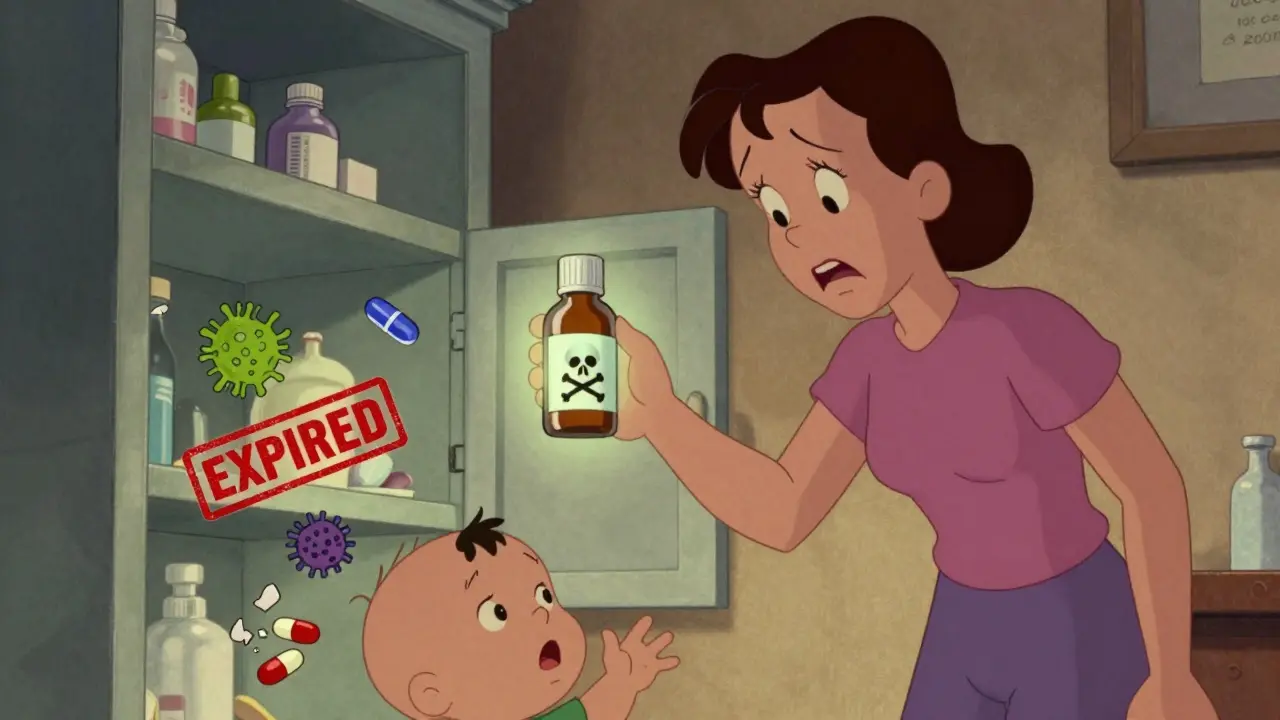
Every year, thousands of children end up in emergency rooms because they got into a medicine they weren’t supposed to. Many of those cases involve expired pediatric medications-drugs that parents thought were still safe because they "looked fine" or "weren’t that old." But expired kids’ meds aren’t just weaker. They can be dangerous.
Why Expired Pediatric Medications Are Riskier Than Adult Ones
Children aren’t small adults. Their bodies process medicine differently. A drug that’s just a little less effective in an adult might become toxic in a child. The FDA warns that expired pediatric medications can break down into harmful substances. Liquid antibiotics, for example, lose potency fast-up to 87% within 14 days of expiration, according to University of Michigan research. Worse, they can grow bacteria. A 2021 Johns Hopkins study found that one-third of opened liquid antibiotics developed contamination after just two weeks. Insulin, epinephrine auto-injectors, and nitroglycerin are especially risky. Insulin degrades by 1.5% per month after expiration. Epinephrine drops to 65% effectiveness just six months past its date. That’s not a small margin-it could mean the difference between saving a child’s life and not acting fast enough during an allergic reaction. Even common OTC meds like children’s Tylenol or antihistamines aren’t safe past their expiration date. Expired antihistamines can cause hyperactivity instead of drowsiness, leading to dangerous behavior. And expired benzocaine teething gels have caused over 120 cases of methemoglobinemia-a rare but life-threatening blood disorder-in children between 2018 and 2022.What Happens When Medications Expire?
Expiration dates aren’t arbitrary. They’re based on strict stability testing. After that date, manufacturers can’t guarantee the medicine will work as intended. But for kids, the risks go beyond reduced effectiveness. - Liquid suspensions can become breeding grounds for bacteria if stored improperly or past their use-by date. - Tablets and capsules can break down chemically, forming new compounds that may be toxic. - Topical creams can separate, leading to uneven dosing. - Temperature matters. Acetaminophen suspensions lose 22% of their potency if stored above 86°F for 30 days. And here’s the scary part: 78% of parents don’t check expiration dates until they’re about to give the medicine to their child. That means they’ve been keeping expired drugs in the medicine cabinet for months-or years.How to Store Pediatric Medications Safely (Before They Expire)
Prevention starts with smart storage. The American Academy of Pediatrics says all medications-prescription, OTC, vitamins, even topical creams-should be kept:- Out of reach and out of sight-above 5 feet high
- In a locked cabinet (only 22% of homes do this)
- In their original containers (only 58% of parents comply)
- With child-resistant caps securely closed (33% of parents fail to do this)
How to Dispose of Expired Pediatric Medications Safely
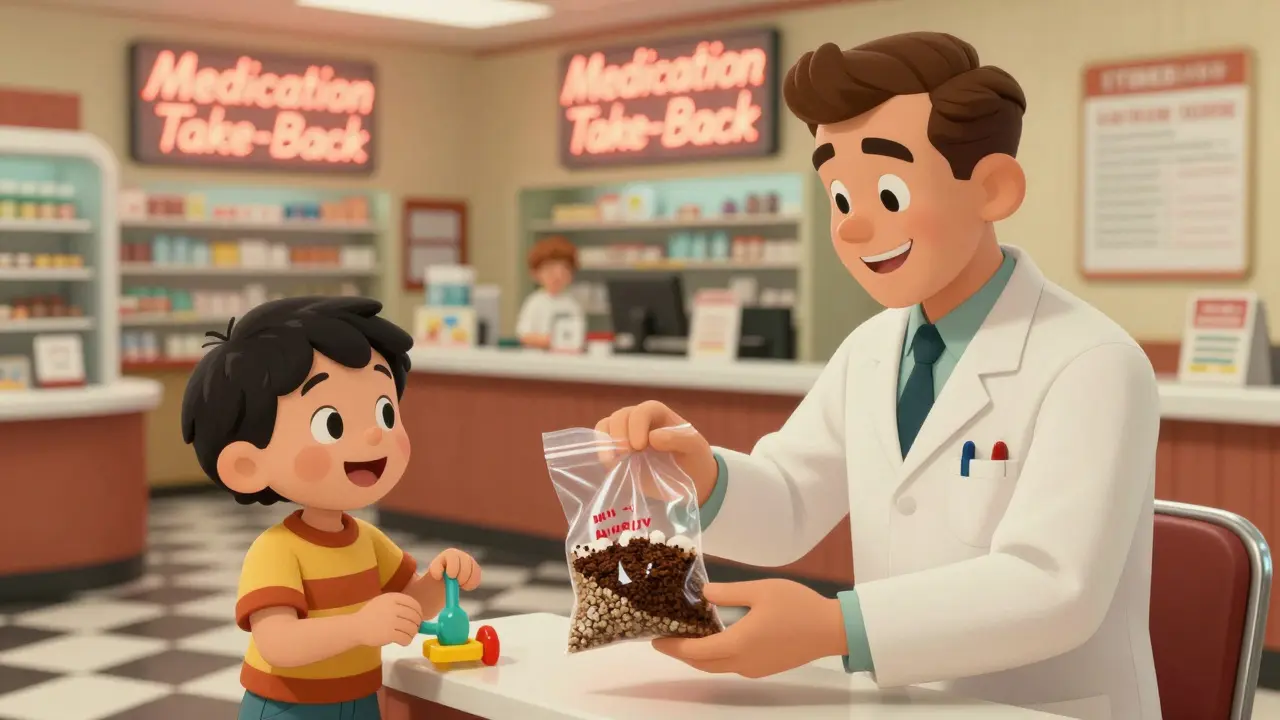
Never flush meds unless they’re on the FDA’s flush list. That list has only 15 drugs-mostly powerful painkillers-and most pediatric meds aren’t on it. Flushing the wrong thing contaminates waterways. The EPA and FDA now recommend take-back programs as the gold standard. Here’s what to do:- Find a take-back location. The DEA runs over 16,700 permanent drop-off sites at pharmacies and hospitals. Walgreens and CVS now have disposal kiosks in more than 12,400 locations nationwide.
- Remove the medication from its original container. Scratch out your name and prescription number with a permanent marker-97% of parents skip this step.
- Mix the pills or liquid with something unpalatable: used coffee grounds, cat litter, or dirt. Use a 2:1 ratio (two parts grounds, one part meds).
- Seal it in a plastic bag or container. Put it in the trash.
What Parents Get Wrong About Expired Medicines
A 2023 survey found that only 20% of parents knew expired pediatric meds were unsafe. The rest believed:- They’re just less effective (44% of parents think this)
- It’s okay to use them within 1 month of expiration (20%)
- Three months past the date is still fine (14%)
- Even a year past is acceptable (15%)
What’s Being Done to Fix This Problem
The system is slowly improving. The CDC’s MedEd program has trained over 18,500 healthcare providers to talk to parents about safe disposal. Those who get the message are 38% more likely to dispose of meds properly. The American Academy of Pediatrics now recommends doctors discuss disposal at every well-child visit. But only 31% of pediatricians actually do it. That’s a missed opportunity. When providers give clear instructions, parents follow through. New tech is helping too. Some pharmacies now put QR codes on pediatric prescriptions that link to disposal videos. Smart cabinets that track expiration dates and send phone alerts are hitting the market-projected to be a $4.7 billion industry by 2026. And there’s momentum for policy change. H.R. 2883, a bill introduced in 2023, aims to create a national standard for medication disposal. Right now, only 38% of states have strong programs.
What You Can Do Today
You don’t need to wait for a law or a new gadget. Here’s your action plan:- Check every medicine in your house that’s meant for a child. Look at the expiration date. If it’s expired, set it aside.
- Call your local pharmacy. Ask if they have a take-back kiosk. Most do.
- If no drop-off is nearby, mix the meds with coffee grounds or cat litter, seal them, and throw them in the trash.
- Lock up all remaining meds. Use a high, locked cabinet-even vitamins and teething gels.
- Set a calendar reminder: check all kids’ meds every month for liquids, every quarter for pills.
Frequently Asked Questions
Can I give my child an expired fever reducer like Children’s Tylenol?
No. Even if it looks fine, expired acetaminophen can lose potency and may not reduce fever effectively. Worse, chemical breakdown can create harmful byproducts. Children’s bodies are more sensitive to these changes. Always use a new, unexpired bottle.
What if I can’t find a drug take-back location near me?
If no drop-off site is available, mix the expired medication with an unpalatable substance like used coffee grounds or cat litter (use two parts grounds to one part medicine). Seal it in a plastic bag or container, then throw it in the trash. Never flush unless it’s on the FDA’s flush list. Scratch out your personal info on the bottle first.
Are liquid antibiotics safe to use after 14 days, even if the expiration date is later?
No. The American Academy of Pediatrics and FDA both recommend discarding opened liquid antibiotics after 14 days, regardless of the printed expiration date. Bacterial growth can occur quickly in liquid suspensions, and potency drops significantly. Giving outdated antibiotics can lead to treatment failure and antibiotic resistance.
Why can’t I just keep expired meds for "just in case"?
Because "just in case" becomes a danger. Most pediatric poisonings happen at home, often from medications stored within reach. Studies show 78% of cases involve meds kept below 5 feet. Expired meds are unpredictable-they might not work, or they might harm. Keeping them increases risk with zero benefit. When in doubt, dispose of it.
What about expired children’s vitamins or supplements?
Even though they’re not drugs, expired vitamins and supplements should still be disposed of. They can degrade into compounds that aren’t safe for children. Plus, kids may mistake them for candy. Treat them the same way you’d handle expired medicine: mix with coffee grounds or cat litter, seal, and trash. Don’t flush.
How often should I check my child’s medicine cabinet?
Check liquid medications every month. Check pills, creams, and syrups every three months. Set a reminder on your phone. It takes less than five minutes, and it could prevent a trip to the ER. Remember: 82% of pediatric poisonings happen within 24 hours of giving the medicine-so knowing what’s expired saves lives.
Drew Pearlman
January 9, 2026 AT 08:10Man, I never realized how much of a ticking time bomb my kid’s medicine cabinet was. I’ve got like three bottles of expired Tylenol in there from last winter’s cold. I thought, ‘Eh, it’s just a month past’ - turns out I was basically keeping poison under the sink. Thanks for the wake-up call. I’m cleaning it out tonight after dinner. Also, just called CVS - they’ve got a drop box right by the pharmacy. Took me five minutes to drop off six bottles. Feels good to do the right thing, even if it’s late.
Catherine Scutt
January 10, 2026 AT 00:28Ugh. I’m so tired of parents who think ‘it’s still good’ just because it hasn’t turned color. I’ve seen kids hospitalized because someone gave them expired antibiotics ‘because they had the same bottle from last year.’ You’re not saving money - you’re gambling with your kid’s liver. Just throw it out. Stop being cheap with their lives.
Darren McGuff
January 11, 2026 AT 00:35As a pharmacist in Manchester, I’ve seen this too many times. Liquid amoxicillin? Once opened, it’s a bacterial buffet after day 14 - even if the bottle says 2026. I’ve had mothers cry because their child got sepsis from ‘just one dose’ of an old suspension. And the worst part? They always say, ‘But it looked fine!’ Look? It’s not a fruit. It’s a chemical compound that degrades into toxins. The FDA isn’t being dramatic - they’re being *precise*. Please, if you’re reading this: don’t wait for tragedy. Check your cabinet. Now. Then lock it.
And yes - coffee grounds + cat litter + sealed bag = your new best friends. I’ve even started handing out little ziplock bags with instructions at the counter. Small thing. Big difference.
Ashley Kronenwetter
January 12, 2026 AT 10:42This is an exceptionally well-researched and responsibly presented article. The data cited from the American Academy of Pediatrics, the FDA, and peer-reviewed studies are not only accurate but critically necessary for public health education. I commend the author for presenting actionable steps with clear, evidence-based guidance rather than alarmist rhetoric. The inclusion of specific statistics - such as the 87% potency loss in liquid antibiotics and the 62% of children opening child-resistant caps - underscores the urgency without sensationalism. This should be distributed to all pediatric clinics and school nurse offices.
Chris Kauwe
January 12, 2026 AT 18:31Let’s be real - this isn’t about medicine. It’s about cultural decay. We’ve turned parenting into a Netflix binge of half-efforts. You don’t ‘check’ expiration dates because you’re ‘busy.’ You do it because you’re responsible. The fact that 78% of parents wait until the moment they’re about to give the drug is a national disgrace. We’re raising a generation of kids whose parents think ‘maybe it’s still good’ is a valid medical decision. Meanwhile, in countries with real accountability, parents get fined for this. Maybe we need a law. Maybe we need consequences. Or maybe we just need to stop pretending ignorance is an excuse.
Meghan Hammack
January 13, 2026 AT 03:02Y’all, I just did this. I opened my kid’s cabinet and found THREE expired things - including that teething gel that gave me nightmares after reading the methemoglobinemia stats. I mixed everything with coffee grounds (my morning brew, ironically), sealed it in a bag, and tossed it. Then I locked the cabinet with a $12 latch from Target. I set a phone reminder: ‘Check meds’ every 1st of the month. It takes 3 minutes. That’s less time than it takes to scroll TikTok. Your kid deserves more than ‘I hope it’s still good.’ Do it. You got this. 💪❤️
RAJAT KD
January 14, 2026 AT 23:17Expired pediatric meds are a silent killer. The data is clear. The solution is simple. Action is overdue. Dispose properly. Lock storage. Educate others. No exceptions.
Matthew Maxwell
January 15, 2026 AT 14:28It’s not rocket science. If you’re not disposing of expired medications properly, you’re not fit to be a parent. The fact that this even needs to be explained in 2024 is a failure of basic human responsibility. You don’t get a pass because you’re ‘busy.’ You don’t get a medal for ‘thinking it’s fine.’ You get a warning - and if your child ends up in the ER because you kept a bottle of expired antihistamine, you have no one to blame but yourself. This isn’t opinion. It’s fact. And you’re failing.
Pooja Kumari
January 16, 2026 AT 21:03I just read this and I’m crying. Not because I didn’t know - I did. But because I kept that expired epinephrine for ‘just in case’ after my son’s first allergic reaction. I thought, ‘Maybe next time it’ll still work.’ And now I’m terrified I almost lost him because I was too scared to throw it out. I didn’t want to face the guilt of wasting money. But now I see - the real waste was time. I just drove to Walgreens and dropped off everything. I’m locking the cabinet tonight. I’m setting the reminder. And I’m telling every mom in my group chat. Because if I can save one kid from my mistake… it’s worth it. Thank you for writing this. I needed to hear it.
Jacob Paterson
January 17, 2026 AT 04:36Oh wow. Another ‘parenting guilt trip’ disguised as public health advice. Let me guess - next you’ll tell me I should brush my kid’s teeth with a toothbrush I bought in 2019? 😏 You know what’s *really* dangerous? Over-medicalizing everything. Kids used to survive on grandma’s remedies and hope. Now we’re treating them like lab rats. Expired meds? Maybe they’re just weaker. Big deal. Kids are tougher than you think. And if they get sick? They’ll get better. You don’t need a QR code, a kiosk, or a locked cabinet. You need less anxiety and more trust in nature. 🙄
Drew Pearlman
January 18, 2026 AT 20:40@Jacob Paterson - I get it. You think this is overkill. But here’s the thing: my cousin’s 3-year-old had a seizure from an expired teething gel. Not because she was ‘weak’ - because the benzocaine broke down into a blood poison. That’s not ‘nature.’ That’s chemistry. And that’s not ‘anxiety’ - that’s science. I used to think like you. Now I lock the cabinet. Every night. And I sleep better. So… thanks for the sarcasm. But I’m not taking the risk.