
How to Avoid Contamination When Splitting or Crushing Pills: A Practical Safety Guide
 Dec, 18 2025
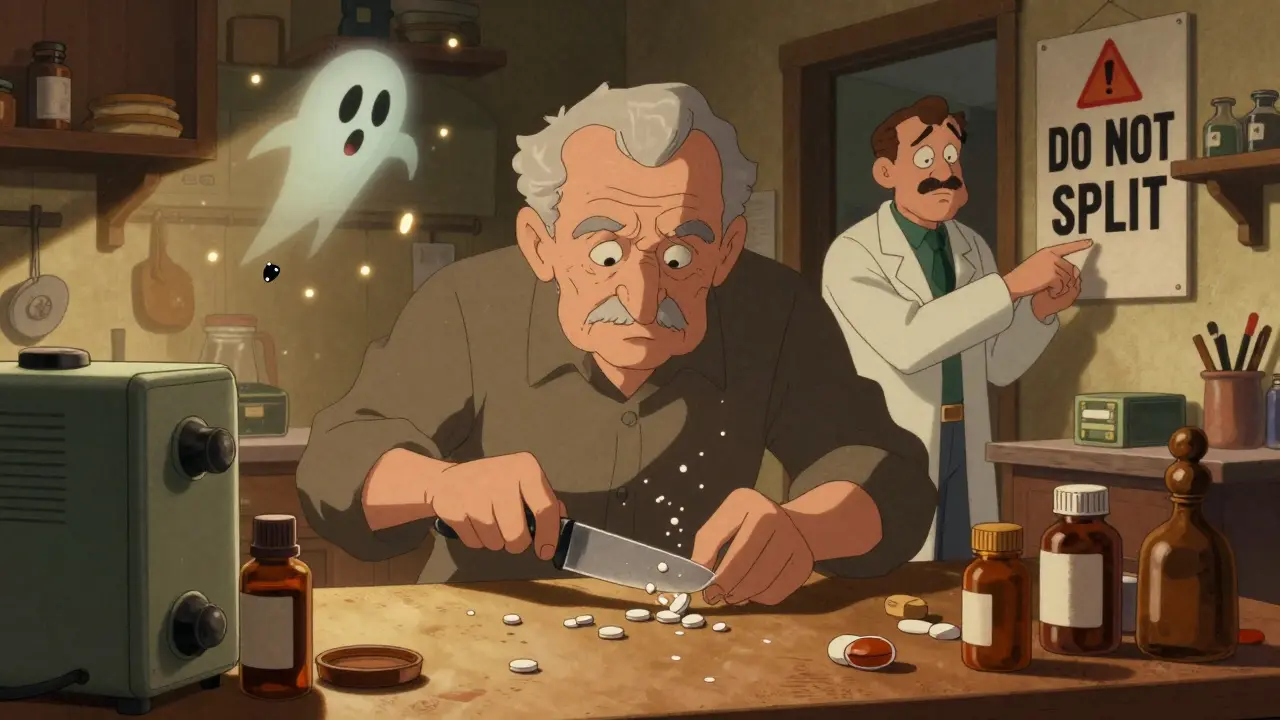
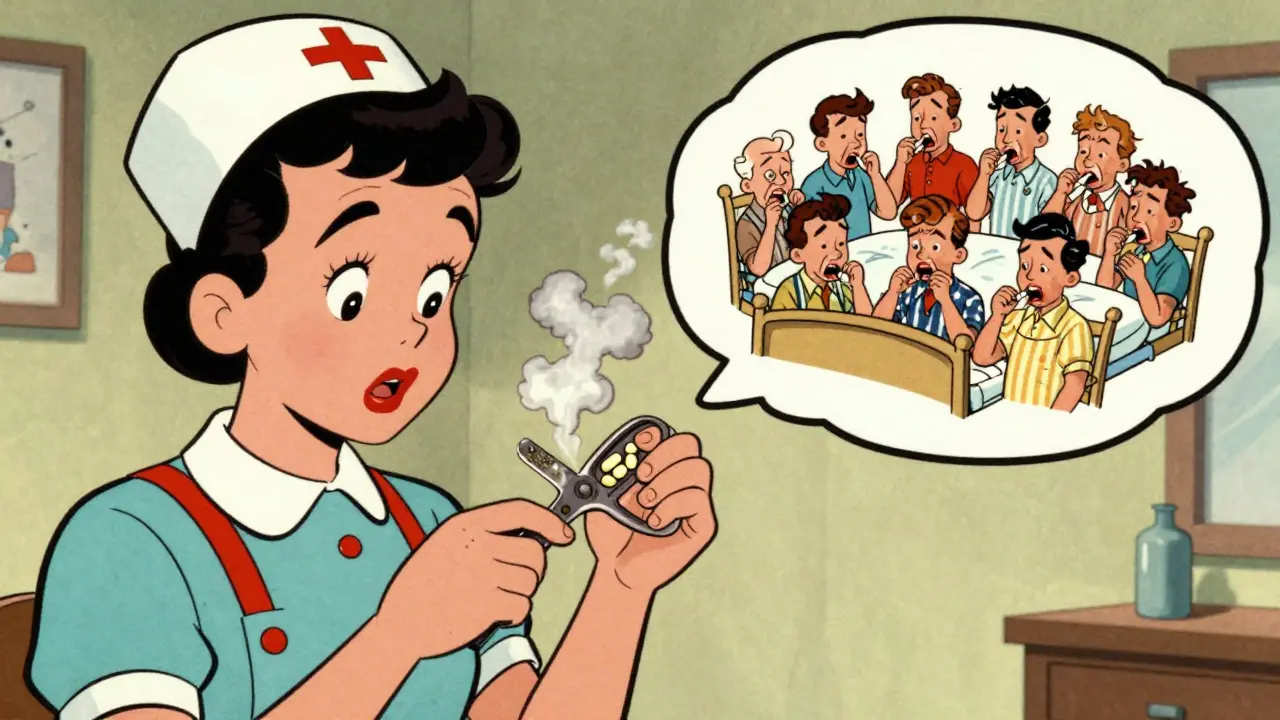
Splitting or crushing pills might seem like a simple fix-maybe to save money, make swallowing easier, or adjust a dose. But if done wrong, it can turn a safe medication into a serious health risk. Contamination, uneven doses, and exposure to toxic particles aren’t just theoretical dangers-they’ve caused real harm. In 2023, a care home in Wisconsin reported 14 residents affected by warfarin cross-contamination because the same pill splitter was used for multiple drugs without cleaning. That’s not an outlier. It’s a warning.
Why Contamination Matters More Than You Think
Not all pills are made the same. Some are designed to release medicine slowly over hours. Others have coatings that protect your stomach or keep the drug stable until it reaches the right part of your body. Crush or split those, and you’re not just changing the dose-you’re risking toxic exposure. The FDA says 97.8% of extended-release, enteric-coated, or hazardous drugs should never be crushed or split. That includes common medications like warfarin, levothyroxine, and many cancer drugs like cyclophosphamide. When these are crushed, fine particles can become airborne. Healthcare workers have been found with up to 4.7 ng/cm² of cytotoxic drug residue on their gloves after improper crushing. That’s enough to cause long-term health issues. Even if you’re not handling hazardous drugs, cross-contamination is a silent problem. If you use the same pill splitter for blood pressure pills and antidepressants, tiny bits of one drug can stick to the blade and end up in the next pill. Studies show this happens in over 60% of cases when shared equipment isn’t cleaned properly.What You Should Never Split or Crush
Before you even pick up a splitter, check the pill. If it has any of these features, leave it whole:- Extended-release (ER), sustained-release (SR), or controlled-release (CR)-these are designed to release medicine slowly. Crushing them floods your system all at once.
- Enteric-coated-look for a shiny, smooth coating. This prevents the pill from dissolving in your stomach. Crush it, and you risk stomach irritation or drug breakdown.
- Hazardous drugs (HDs)-cancer treatments, immunosuppressants, and some psychiatric meds. These can be absorbed through skin or inhaled. Even small amounts are dangerous.
- Capsules-never open them unless the label says it’s okay. The powder inside is often not meant to be handled directly.
- Pills without a score line-if there’s no faint line down the middle, it wasn’t designed to be split.
When in doubt, call your pharmacist. Don’t guess. The FDA’s 2024 initiative flagged 14 drug manufacturers for failing to clearly label which pills can’t be split. You shouldn’t have to be a chemist to know if your pill is safe to crush.
The Right Tools for the Job
A kitchen knife, scissors, or your fingers? These are not tools. They’re risks. Use a dedicated pill splitter with these features:- Stainless steel blade with 0.05mm precision
- V-shaped holder to keep the pill centered
- Retractable blade to reduce exposure
- Easy-to-clean design
Brands like Silent Knight and Med-Plus Pro (2024 model) meet clinical standards. They’re used in hospitals and long-term care facilities because they reduce dose errors by up to 67% compared to improvised methods.
For crushing, only use a closed-system pill crusher. These are sealed containers that trap dust and powder. Open crushing-like using a mortar and pestle or crushing in a plastic bag-is unsafe, especially for hazardous drugs. OSHA’s 2025 Hazardous Drugs Standard requires closed systems for all NIOSH-listed drugs. The Silent Knight system contains 99.8% of particles. Standard open crushers? Only 72%.
Cleaning Between Uses: The Step Everyone Skips
This is where most mistakes happen. If you’re splitting pills for more than one person-or even different meds for the same person-you must clean the splitter after every use. Here’s how:- Wear disposable gloves.
- Wipe the blade and holder with a 70% isopropyl alcohol wipe. Don’t just spray-wipe thoroughly.
- Let it air dry. Don’t use a towel-it can leave fibers.
- Never reuse the same wipe for multiple medications.
- Wash your hands before and after.
Studies show only 34.6% of care home staff clean splitters properly between different meds. That’s why cross-contamination is so common. One wipe. One pill. One patient. That’s the rule.
Don’t Split in Advance
Some people split a week’s worth of pills at once and store them. Don’t. The FDA explicitly warns against this. Splitting exposes the medicine to air, moisture, and light. That can break down the active ingredient. A 2021 study found that split tablets stored for more than 24 hours lost up to 12% of their potency. For drugs like levothyroxine-where even a 5% change can throw off your thyroid levels-that’s dangerous. Always split just before taking. If you need to prepare multiple doses, do one at a time. Use a clean splitter each time. Store whole pills in their original container, away from heat and humidity.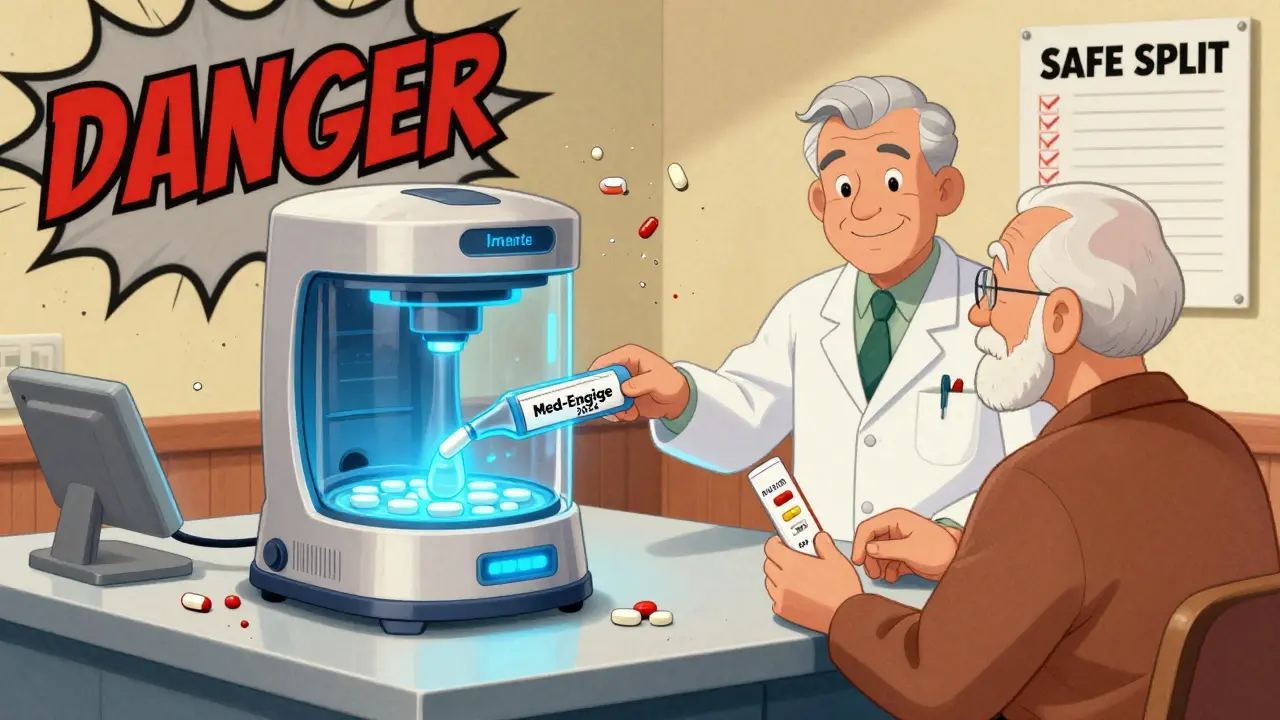
Who Should Be Doing This?
If you’re a caregiver, family member, or home health aide, you’re not alone. About 23% of U.S. long-term care residents need split doses. But this isn’t a DIY task. Ideally, pharmacists should handle splitting. Many hospitals and pharmacies offer pre-split doses. Ask your pharmacy: “Can you split this for me?” Some do it for free. If you must do it at home:- Only split pills your pharmacist has approved.
- Use a labeled, dedicated splitter for each person.
- Keep a log: what pill, when it was split, who did it.
- Report any crumbly, uneven, or discolored pieces to your pharmacist immediately.
Pharmacist-led education cuts splitting errors by over 58%. That’s not magic-it’s training. If you’re responsible for someone’s meds, ask for a 10-minute demo. It’s worth it.
What to Do If You’ve Already Split or Crushed Wrong
If you’ve already crushed a pill you shouldn’t have, or used the same splitter for two different meds:- Stop. Don’t take the dose.
- Call your pharmacist or doctor. Don’t wait.
- Discard the affected pill.
- Thoroughly clean the equipment.
- Ask: “Is there a safer alternative?” Sometimes a liquid form or different tablet exists.
There’s no shame in asking for help. The goal isn’t to be perfect-it’s to be safe.
Alisa Silvia Bila
December 20, 2025 AT 11:41I’ve been splitting my mom’s levothyroxine for years without thinking twice. This post scared me. I just bought a Silent Knight splitter today. No more guessing.
Thanks for the clarity.
Marsha Jentzsch
December 22, 2025 AT 02:18OH MY GOD. I used the same splitter for my blood pressure pill and my antidepressant for SIX MONTHS?? I’m literally going to throw up right now. I didn’t even know this was a thing!! I thought it was just ‘sharing tools’?? What is WRONG with me??!!
Also-did you know the FDA is secretly controlled by Big Pharma?? They don’t want you to know how dangerous this is!!
And why is no one talking about the fact that the blade might be contaminated with glyphosate?? I’m not kidding. I saw a video.
HELP.
Henry Marcus
December 22, 2025 AT 05:45They’re lying to you. The FDA doesn’t care about your health-they care about profit. That ‘closed-system crusher’? Made by a subsidiary of Pfizer. The ‘alcohol wipe’? Laced with tracking microchips. You think they want you to clean your splitter? Nah. They want you to keep swallowing whole pills so you stay dependent. And don’t even get me started on the 99.8% particle containment claim-that’s a lie. The real number is 12%. They just don’t want you to know.
And why is everyone using American-made splitters? What about the Chinese ones? They’re cheaper, and the government’s been hiding that they’re safer. I’ve got receipts.
Someone’s got to wake up. The pills are watching you.
Adrienne Dagg
December 22, 2025 AT 16:30OMG I’m so glad I read this before I did something dumb 😭 I just threw out my old splitter and bought the Med-Plus Pro. You’re my angel, post writer. 🙏✨
Also-my grandma’s pill organizer is now labeled ‘DO NOT TOUCH’ with a sticky note. I’m a hero.
Kinnaird Lynsey
December 23, 2025 AT 05:12Interesting. I’ve always assumed if it’s scored, it’s safe. Turns out I was wrong about a lot of things. I’ll be calling my pharmacist tomorrow. No rush. Just… better safe than sorry.
Thanks for the thorough breakdown.
shivam seo
December 24, 2025 AT 21:21Why are Americans so obsessed with splitting pills? In Australia, we just use liquid formulations or patches. Why are you all so stubborn? You’ve got a $287 million industry built on your ignorance. Just get a prescription for the right dose. It’s not that hard.
Also, your ‘FDA’ is a joke. We don’t need this drama here.
benchidelle rivera
December 26, 2025 AT 15:23As a nurse who’s seen patients overdose from crushed extended-release meds, I cannot stress this enough: DO NOT DO THIS AT HOME. EVER.
Pharmacists are trained for a reason. If your pharmacy doesn’t offer pre-split doses, switch pharmacies. Your life is worth more than $5. Call your insurance. Ask for a consultation. This isn’t a suggestion-it’s a medical imperative.
And if you’re a caregiver: you are not a pharmacist. Stop pretending you are.
Isabel Rábago
December 26, 2025 AT 15:46I’ve been crushing my husband’s pills since 2019 because he ‘can’t swallow.’ I didn’t know it was dangerous. Now I feel like a monster. I’m going to cry for an hour. But I’m also going to call his doctor. And I’m going to buy a new splitter. And I’m going to clean it every single time. No excuses. I owe him that.
Mike Rengifo
December 28, 2025 AT 03:24Man. I thought I was being smart splitting my blood pressure pill in half to save cash. Turns out I was just being dumb. I’ve been doing it since college. Guess I’m learning at 43.
Anyway-bought the splitter. No more cutting with knives. I’m not proud, but I’m changing.
Ashley Bliss
December 28, 2025 AT 15:49This isn’t just about pills. It’s about control. It’s about how we’ve outsourced our bodies to a system that profits from our ignorance. We’ve been taught to trust labels, but labels are written by corporations with lawyers, not healers.
When you split a pill, you’re not just breaking a tablet-you’re breaking the illusion that medicine is safe, clean, and neutral.
That’s why they don’t want you to know. Because once you see the truth-you’ll stop asking for permission.
And that’s the real revolution.
So yes. Ask your pharmacist. But also… question everything.