
Generic combination products: When multiple generics equal one brand
 Dec, 9 2025
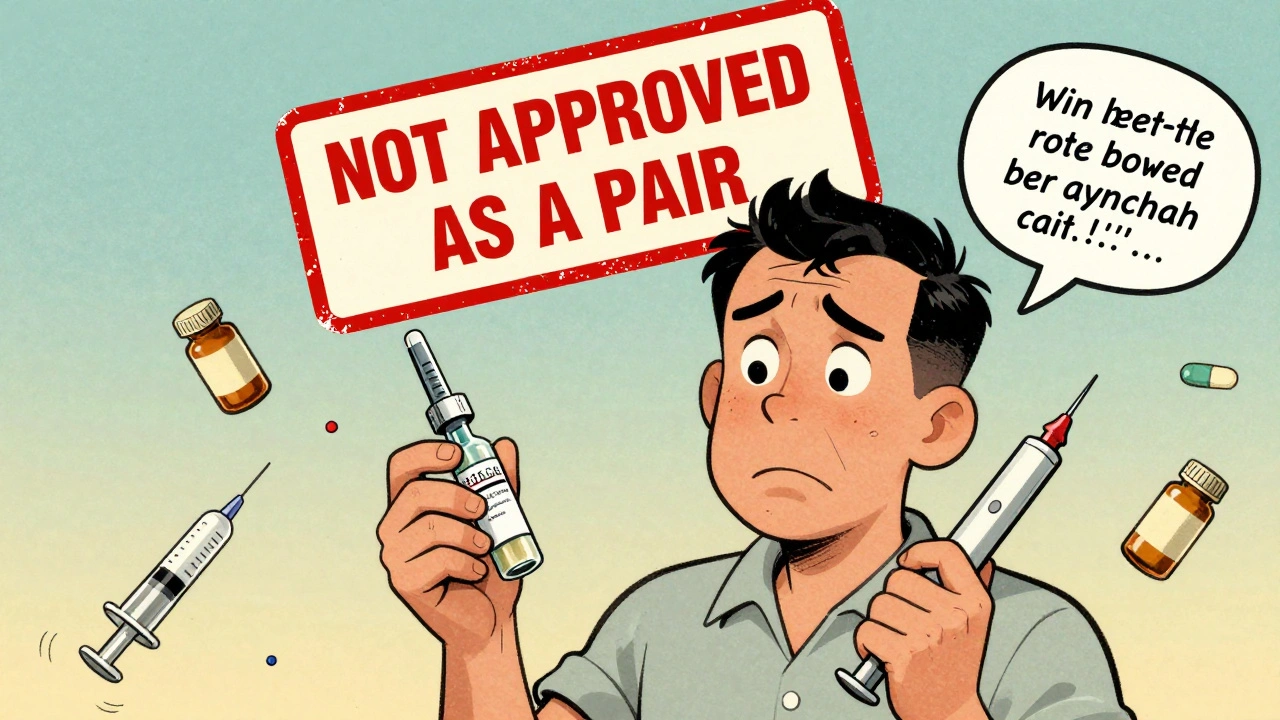
Imagine you need an EpiPen for a severe allergy. You get a generic version of the epinephrine - but the auto-injector device is still the branded one. Or worse - you get the generic device, but the drug inside isn’t approved to work with it. You’re stuck. Not because the medicine doesn’t work, but because generic combination products don’t play by the same rules as regular generics.
This isn’t a glitch. It’s the system. When a drug and a device are combined - like an inhaler, an auto-injector, or a prefilled syringe - the FDA treats them as one product. Not two. And that changes everything.
What exactly is a combination product?
A combination product isn’t just a drug in a box. It’s a drug + a device that work together as one unit. Think insulin pens, asthma inhalers with dose counters, or glucose monitors that link to apps. The FDA defines them as products where components are: physically combined, packaged together, or separately packaged but labeled for use together.
That’s key. If the device is essential to delivering the drug correctly - like an auto-injector that triggers at the right pressure - then the whole thing is one regulated unit. The FDA calls this the Primary Mode of Action (PMOA). If the drug does the main healing job, it’s reviewed by CDER (Center for Drug Evaluation and Research). If the device does the heavy lifting - like a pacemaker - it goes to CDRH (Center for Devices). This determines the whole approval path.
Why can’t you just swap parts?
Here’s where things get messy. With regular pills, if the brand name is expensive, you get a generic version - same active ingredient, same effect, cheaper. Simple.
But with combination products? You can’t just swap the drug and keep the device. Or swap the device and keep the drug. Why? Because the interaction matters. The needle depth of an auto-injector, the spray pattern of an inhaler, the button force needed to trigger delivery - these aren’t just design choices. They’re part of the therapy.
Take the EpiPen. The branded version has a specific spring tension, needle length, and trigger mechanism. A generic epinephrine solution might be chemically identical. But if it’s put into a different injector, the dose might not deliver correctly. Or worse - the patient might not even know how to use it. That’s why the FDA requires a full human factors study: they test real people using the generic version to make sure they can use it safely, without training.
That’s not something you need for a tablet. It’s expensive. It takes 18-24 months. And most generic manufacturers just don’t bother.
The numbers don’t lie
Over 90% of single-drug prescriptions in the U.S. are filled with generics. That’s a win for patients and the system.
But for combination products? Only 12% are generic. And only 38% of complex combination products even have more than one generic approved. Compare that to 72% for regular generics. That’s a huge gap.
Why? Because the approval process is brutal. The FDA rejected nearly half of all combination product applications between 2020 and 2023 because the manufacturer didn’t prove the device worked the same way as the original. That’s not a small oversight. It’s a fundamental misunderstanding of what makes a combination product work.
And the cost? Developing a generic combination product can add $2.1 million to $3.7 million to the price tag. That’s more than many small generic companies can afford. So only 17 companies control 83% of the market. Meanwhile, over 120 companies make regular generics.
What does this mean for patients?
Patients pay more. Much more.
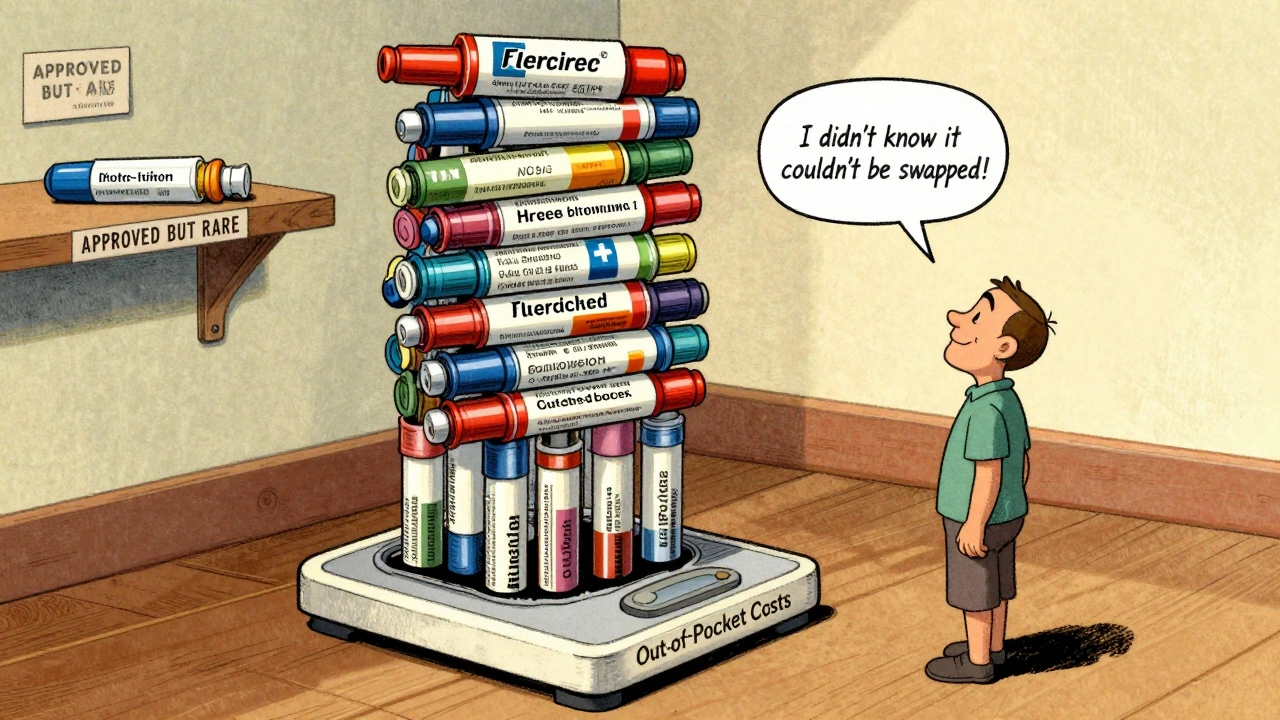
On average, patients pay 37% more out-of-pocket for complex combination products than for regular generics. Why? Because there’s little competition. If only one company makes the generic version of your insulin pen, they can set the price. And if no one else can get approval? You’re stuck with the brand.
Pharmacists are confused too. A 2024 survey found that 68% of community pharmacists have run into substitution issues with combination products. Over 40% get at least one patient complaint a month. One pharmacist on Reddit summed it up: “You can’t substitute the drug without the right device - and the right device often doesn’t exist yet.”
Doctors see delays. Nearly 60% report treatment delays because patients can’t get the right combo. That’s over three business days lost per incident. For someone with asthma or diabetes, that’s not just inconvenient - it’s dangerous.
Why aren’t state laws fixing this?
Most states have laws that let pharmacists substitute generics automatically. But those laws were written in the 1980s. They assume a pill is a pill. They don’t account for devices.
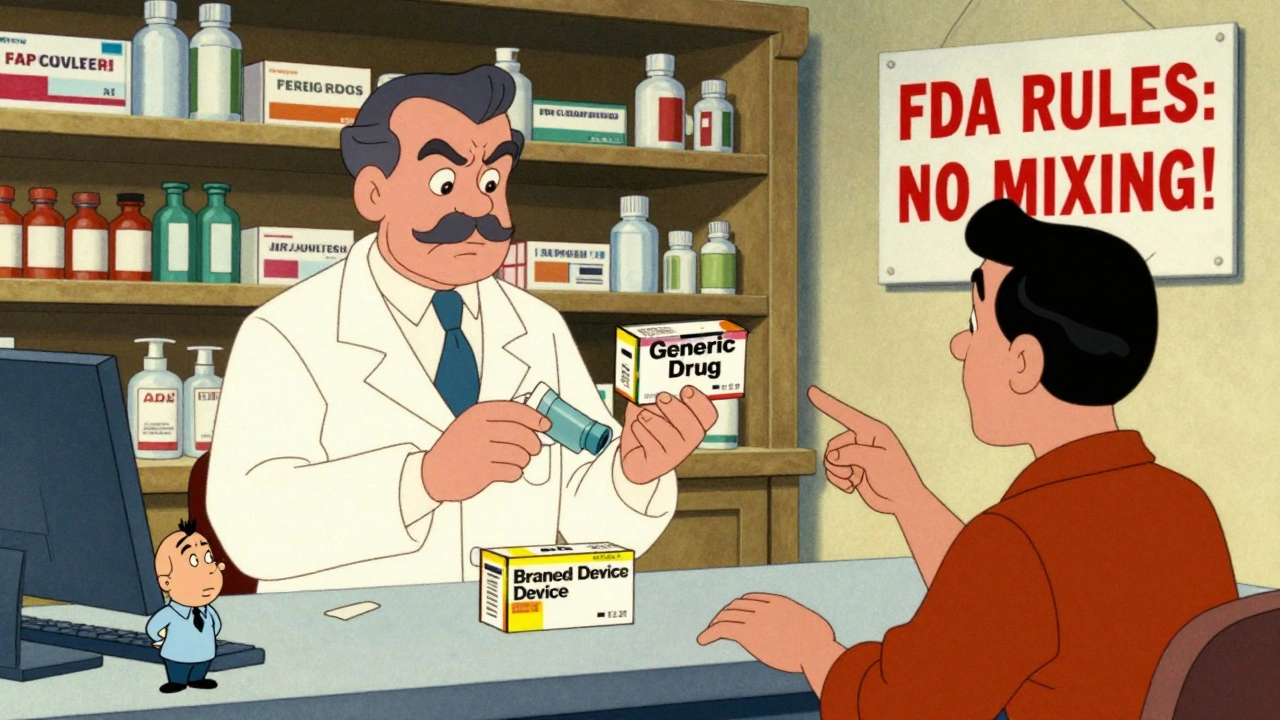
Some states are trying. California and Massachusetts passed new laws in 2024 to require pharmacists to verify both the drug and device components are approved as a matched pair. But most states haven’t updated their rules. So a pharmacist in Texas might legally swap a branded inhaler for a generic drug in a different device - and that’s a violation of FDA rules.
The FDA doesn’t have authority over pharmacy practice. That’s up to states. So you’ve got federal rules saying “don’t mix and match,” and state rules saying “substitute whenever possible.” It’s a mess.
What’s changing?
The FDA knows this is a problem. In 2024, they released new guidance on how to prove a generic combination product works like the brand. They’re hiring more reviewers - 45% more since 2022. And they launched “Complex Generic Initiative 2.0,” aiming to cut approval times by 30% by 2026.
Industry analysts believe generic penetration could rise from 12% to 35% by 2027. That’s a big jump. But it’s still far from the 90% we see with regular drugs.
Manufacturers are starting to catch on. A few new generic auto-injectors and inhalers have hit the market in 2024. But they’re still rare. And even when they exist, patients often don’t know they’re available - because pharmacists don’t know either.
What can you do?
If you’re on a combination product:
- Ask your pharmacist: “Is this the exact generic version approved to work with this device?” Don’t assume.
- Check the FDA’s Orange Book. It lists approved combination products and their generic equivalents - but only if they’re fully approved as a matched pair.
- If you’re switched to a different device, ask your doctor if it’s safe. Don’t just take it.
- If you’re paying too much, ask about patient assistance programs. Some manufacturers offer them for combination products.
If you’re a prescriber:
- Write “Do Not Substitute” if you know the device is critical - even if a generic drug exists.
- Know which combination products have true generic equivalents. Not all do.
- Stay updated. The FDA’s list of approved combination generics changes every month.
The bottom line
Generic combination products aren’t just harder to make. They’re harder to use, harder to approve, and harder to substitute. And until the system catches up, patients are the ones paying the price - in money, in time, and in risk.
The idea that “multiple generics equal one brand” sounds simple. But in practice, it’s not. The device isn’t just packaging. It’s part of the medicine. And until we treat it that way, we’re not giving patients real access - we’re just giving them confusion.
Can I substitute a generic drug with a branded device for a combination product?
No. The FDA requires the entire combination - drug and device - to be approved together as a matched pair. Even if the drug is generic and the device is branded, they must have been tested and approved as a unit. Mixing components from different products can change how the drug is delivered, which may lead to underdosing or overdosing. Always use the exact generic version approved by the FDA as a complete product.
Why are generic combination products so expensive?
Because they’re hard to develop. Unlike a pill, a combination product needs human factors testing - real people using the device to prove it works safely. This takes 18-24 months and costs $2-4 million. Few companies can afford it, so competition is low. With little competition, prices stay high. Only 17 companies control 83% of the market, compared to over 120 for regular generics.
Are all inhalers and auto-injectors eligible for generic substitution?
No. Only those with an FDA-approved generic version that matches the original device and drug exactly. For example, generic epinephrine auto-injectors like Adrenaclick and Auvi-Q have generic versions approved as full combinations. But many others - like specific insulin pens or nebulizers - still only have branded options. Always check the FDA’s Orange Book or ask your pharmacist for the approved generic name.
How do I know if my generic combination product is safe?
Look for the FDA’s approval designation. If the product is listed in the Orange Book as an approved generic combination product, it has passed all required testing - including device performance and human factors studies. If you’re unsure, ask your pharmacist to show you the FDA-approved labeling. Never use a generic drug with a branded device unless it’s explicitly approved as a combination.
What should I do if my pharmacy gives me the wrong combination?
Stop using it immediately. Contact your pharmacist and ask for the correct FDA-approved combination product. If they can’t provide it, ask your doctor to write a prescription specifying “Dispense as Written” or “Do Not Substitute.” You can also report the issue to the FDA’s MedWatch program. Using mismatched components can be dangerous - don’t assume it’s safe just because the drug is the same.
Steve Sullivan
December 9, 2025 AT 13:01George Taylor
December 10, 2025 AT 10:31ian septian
December 12, 2025 AT 02:40Chris Marel
December 12, 2025 AT 13:26Carina M
December 14, 2025 AT 09:42Iris Carmen
December 15, 2025 AT 22:41Andrea Petrov
December 16, 2025 AT 07:57Suzanne Johnston
December 18, 2025 AT 04:28Graham Abbas
December 18, 2025 AT 05:22Haley P Law
December 19, 2025 AT 14:10Tejas Bubane
December 20, 2025 AT 00:35