
Generic Approval Timelines: How Long FDA Reviews Take
 Dec, 10 2025
When you need a prescription medication, you probably don’t care if it’s made by the original brand or a generic version-as long as it works, costs less, and is available when you need it. But behind that simple exchange is a complex, tightly timed process run by the U.S. Food and Drug Administration (FDA). For generic drugs, the approval clock doesn’t start when you walk into the pharmacy. It starts when a manufacturer submits an Abbreviated New Drug Application (ANDA). And how long that process takes? It’s not as simple as a fixed number. It depends on the drug, the application, and whether the FDA has enough resources to review it without delays.
What’s the Standard Timeline for FDA Generic Approval?
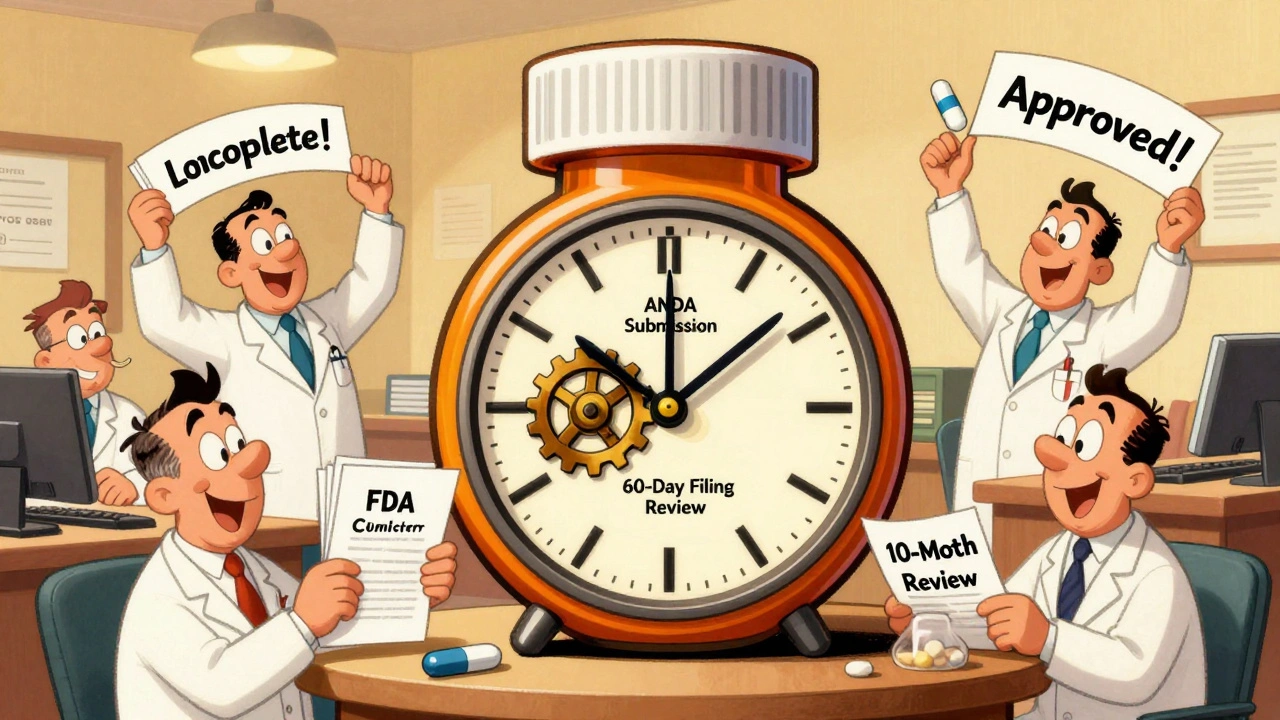
The FDA sets a goal of 10 months to review a complete generic drug application after it’s accepted. That’s the official target under the Generic Drug User Fee Amendments (GDUFA). But that’s not the whole story. The 10 months only begin after the FDA confirms your application is complete enough to start the review. Before that, there’s a 60-day filing review period. If your paperwork is missing key data-like chemistry details, manufacturing specs, or bioequivalence studies-the FDA will send you a refusal to file letter. You’ll have to fix it and resubmit. That adds months, sometimes over a year, to your timeline.
Once the clock starts, the FDA aims to approve 90% of standard applications by the 10-month mark. In 2025, the median approval time dropped to just 25 days for many straightforward generics-like tablets or capsules with no special delivery systems. But don’t confuse median with average. The average is pulled up by complex drugs that take much longer. So while some companies get approval in under three months, others wait over a year.
Why Do Some Generic Drugs Take Much Longer?
Not all generics are created equal. A simple oral tablet of ibuprofen? That’s a low-complexity product. The FDA has a streamlined process for these. But what about an inhaler, a topical cream with a unique base, or an injectable that needs special stability testing? Those are complex generics. They’re harder to copy because the drug’s behavior in the body depends on how it’s made-not just the active ingredient.
The FDA’s Complex Generic Drug Products initiative, launched in 2023, created dedicated review teams for these harder-to-copy drugs. Since then, approval times for complex generics have dropped by 22%. But even with that progress, some products still take 18 to 24 months. One Reddit user reported a nasal spray generic taking 1,087 days from submission to approval. Another got a standard tablet approved in 278 days. The difference? Complexity, not luck.
Also, if your drug is the first generic version of a brand-name product, the FDA gives it priority. First generic approvals are flagged for speed because they open the door to competition and lower prices. In 2025, first generic approvals were pacing ahead of 2024 numbers, with products like epinephrine injection, bosentan tablets, and doxycycline suspension hitting the market faster than ever.
What Happens When the FDA Says ‘No’?
Even if your application is complete, the FDA might still reject it. In Q2 2025, 42.3% of generic applications received a complete response letter-meaning the FDA found issues that need fixing. These aren’t minor typos. They’re serious gaps: unclear manufacturing processes, inconsistent bioequivalence data, or failed inspections.
Each time you get a complete response letter, you have to respond. That usually takes 3 to 6 months. Then the FDA restarts the clock. Some companies get approved on the first try. Others go through three or four rounds. The average manufacturer now faces 1.4 review cycles per application, up from 1.1 in 2023. That’s because the FDA is being stricter about quality, not just speed.
One big reason for delays? Pre-approval inspections. The FDA must inspect the manufacturing site before approving a generic. But inspections are limited by staffing and global travel. If your plant is overseas-especially in India or China-and the FDA hasn’t been able to schedule a visit, your application sits. Even if everything else is perfect.

How the FDA Is Speeding Things Up
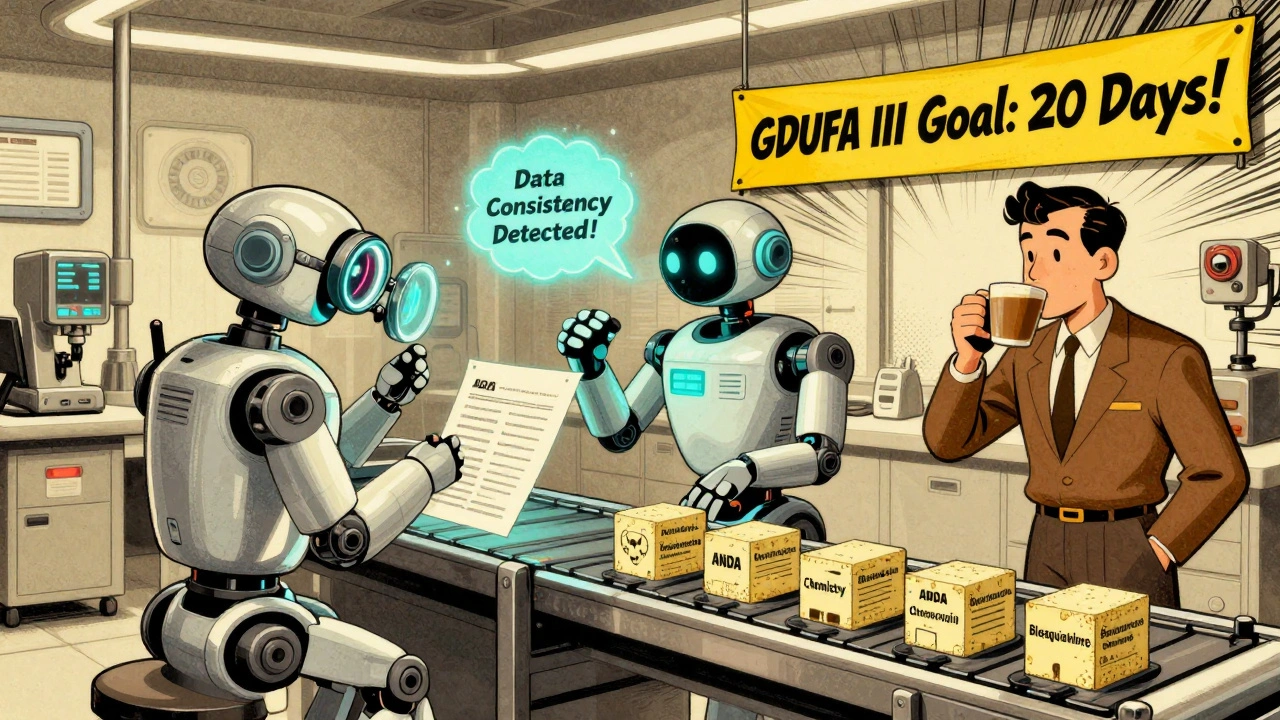
The FDA isn’t just waiting for applications to come in. They’re actively trying to cut review times. One major change? Artificial intelligence. In pilot programs during 2024, AI tools helped reviewers analyze chemistry data faster, reducing standard review times by 15.8%. Now, AI is being rolled out more widely to flag inconsistencies in data submissions before human reviewers even open the file.
Another game-changer is the new Commissioner’s National Priority Voucher (CNPV) program. Announced in late 2025, it lets manufacturers apply for a special fast-track review that cuts approval time from 10 months to just 1-2 months. This isn’t for everyone. It’s reserved for drugs that treat serious conditions, face shortages, or have no other generic options. Think cancer meds, insulin, or emergency epinephrine.
The FDA is also testing rolling reviews. Instead of waiting to submit the entire ANDA at once, companies can send in parts as they’re ready-chemistry data first, then manufacturing, then bioequivalence. The FDA reviews each piece as it arrives. This cuts down the waiting game. One company using this method shaved 4 months off their timeline.
Who’s Getting Approved Fastest?
It’s not random. The companies with the shortest approval times share a few habits:
- They submit high-quality applications with complete chemistry, manufacturing, and controls (CMC) data.
- They use pre-submission meetings with the FDA to get feedback before filing.
- They focus on high-demand drugs with no competition-where the FDA prioritizes them.
Teva, Viatris, and Sandoz lead the pack in generic approvals. Teva alone holds nearly 18% of the U.S. generic market. Their secret? They’ve built internal teams that specialize in FDA expectations. They don’t guess what the FDA wants-they know. They also invest in automation to ensure their data is clean and consistent from day one.
Small companies and first-time applicants can get approved too-but they need help. The FDA offers fee waivers for small businesses, and about 4.7% of ANDAs qualify. But even with a waiver, if your application is sloppy, you’ll still get stuck in the review loop.
Why Does This Matter to You?
Generic drugs make up 90% of all prescriptions in the U.S. but cost only 23% of what brand-name drugs do. That’s over $1.7 trillion saved in the last decade. Every time the FDA approves a generic faster, millions of patients get access to affordable medicine sooner.
But speed isn’t everything. If the FDA rushes approvals without proper quality checks, dangerous products could slip through. That’s why experts like Dr. Peter Lurie from the Center for Science in the Public Interest warn that faster doesn’t always mean safer. The FDA says it’s using a risk-based approach: high-risk drugs get more scrutiny, low-risk ones move faster. That’s the balance they’re trying to strike.
And it’s working. Between 2020 and 2024, median approval times dropped 18.7%. The FDA’s goal under GDUFA III (2023-2027) is to hit 20-day median approval times for standard generics and 10 days for priority ones. If they get there, the U.S. will have the fastest generic approval system in the world.
What’s Next for Generic Drug Approval?
Looking ahead, the FDA’s roadmap is clear: more AI, more rolling reviews, and more focus on complex drugs. By 2027, they aim to approve 90% of standard applications on time and 75% of priority ones. But there’s a catch. These improvements depend on funding. The GDUFA program is funded by user fees from drug companies-$138,400 per application in 2025. If Congress doesn’t renew or increase funding after 2027, the pace could slow.
For now, the trend is positive. More generics are getting approved faster. More patients are getting cheaper drugs. And the system is learning. The FDA isn’t perfect, but it’s adapting. And that’s what matters most.
Doris Lee
December 10, 2025 AT 23:34Thanks for breaking this down so clearly.
Michaux Hyatt
December 12, 2025 AT 04:48Raj Rsvpraj
December 13, 2025 AT 23:14Rebecca Dong
December 14, 2025 AT 11:17Nikki Smellie
December 16, 2025 AT 05:12Let me be clear: the same inspectors who approved the tainted metformin in 2020 are now using AI to ‘flag inconsistencies.’
AI doesn’t have ethics.
It doesn’t remember the 2018 valsartan recall.
It doesn’t care if a child dies because a tablet dissolved too slowly.
And yet, we trust it?
With all due respect... this is terrifying.
Neelam Kumari
December 17, 2025 AT 09:26Meanwhile, my uncle’s generic epinephrine auto-injector failed in 2023 because the batch had inconsistent dosage.
He survived. But the FDA didn’t recall it until *after* three more people collapsed.
Speed isn’t a virtue if it’s built on corpses.
Queenie Chan
December 18, 2025 AT 05:43Stephanie Maillet
December 18, 2025 AT 14:16What does it mean to wait 18 months for a generic asthma inhaler when your child is wheezing every night?
Is efficiency a moral imperative when lives hang in the balance?
Or is it just capitalism dressed up as public health?
I don’t know the answer.
But I know we’re still measuring progress in days and dollars, when we should be measuring it in breaths.
Ariel Nichole
December 18, 2025 AT 14:48