
Cost Barriers to Medication Adherence and How to Get Help
 Dec, 23 2025
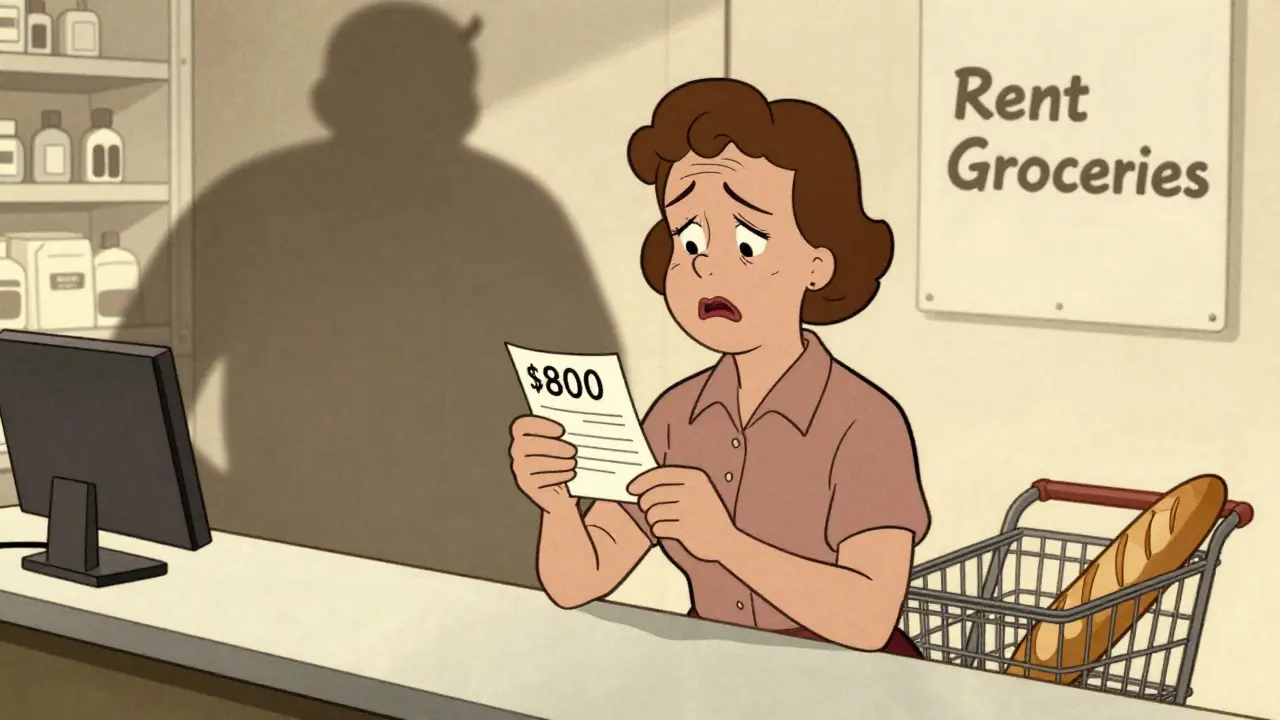
Every year, medication adherence saves lives. But for millions, taking pills as prescribed isn’t a choice-it’s a luxury they can’t afford. In the U.S., nearly 1 in 5 adults skip doses, split pills, or skip refills entirely because they can’t pay. It’s not laziness. It’s not ignorance. It’s hunger, rent, and a $500 insulin bill staring back from the pharmacy counter.
Why Cost Stops People From Taking Their Medicine
It’s simple math: if your monthly co-pay for blood pressure meds is $75 and your paycheck only covers groceries and utilities, you’ll pick the groceries. That’s what 8.2% of working-age adults did in 2021, according to the CDC. For older adults on Medicare, it’s even worse-14.4% admitted to cutting back on meds because of cost. The problem isn’t just high list prices. It’s how the system layers costs on top of each other: deductibles, coinsurance, tiered formularies, and surprise price hikes at the counter. A study in the American Journal of Managed Care found that when co-pays jumped above $50, adherence dropped by 15-20%. For insulin, some patients pay over $800 a month-even with insurance. That’s not a prescription. That’s a financial trap. Cardiovascular drugs are especially hard to afford. People with heart disease are more likely to skip doses than those with diabetes or cancer, even though skipping those pills can lead to heart attacks, strokes, or hospitalizations. One 62-year-old Medicare beneficiary told Kaiser Health News she pays $350 a month for her meds after coverage. She chooses between pills and groceries. That’s not a decision anyone should have to make.Who Gets Hit Hardest
Cost-related nonadherence doesn’t affect everyone equally. Low-income households, especially those earning under $25,000 a year, are 3.2 times more likely to skip meds than those earning over $75,000. Women, younger adults, and non-white patients are also disproportionately affected. Many say they’ve had to choose between medicine and heating their home, paying for childcare, or buying food. Even people with insurance aren’t safe. The U.S. spends more per person on prescription drugs than any other developed country. In 2021, out-of-pocket spending on retail drugs hit $63 billion. That’s not just a statistic-it’s a mother skipping her asthma inhaler so her child can have school lunches. It’s a veteran rationing his diabetes pills because his copay went up $30 last month.Real Stories, Real Consequences
Reddit threads are full of raw, unfiltered accounts. One user wrote: “I’ve been splitting my 20mg Lisinopril pills in half because $120 for a 30-day supply is too much. My BP is still high.” Another shared: “I took my insulin every other day for six months. I thought I was being smart. I ended up in the ER with diabetic ketoacidosis.” These aren’t rare cases. The American Heart Association estimates that 125,000 Americans die each year because they didn’t take their meds as directed. That’s more than traffic accidents or gun violence. And the financial toll? Between $100 billion and $300 billion in avoidable hospital visits, ER trips, and complications every year.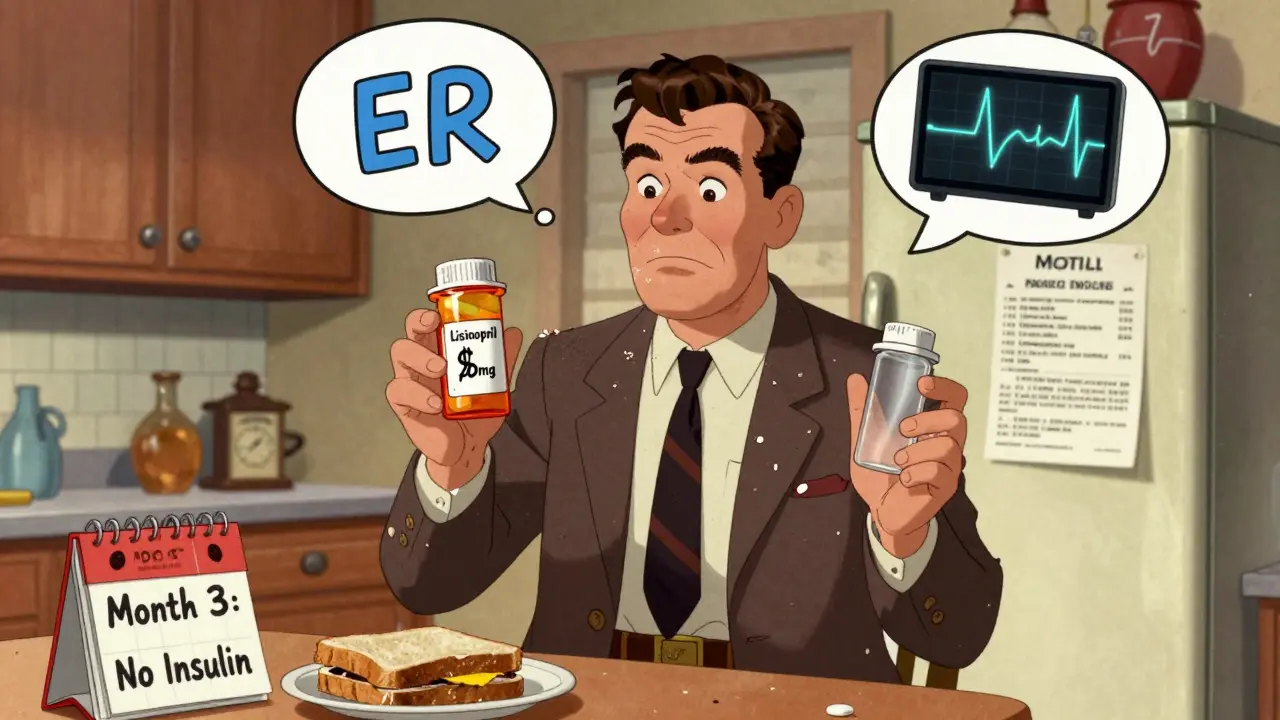
How to Get Help: Practical Steps You Can Take Today
You don’t have to suffer in silence. There are real, working solutions-but you have to ask for them.- Ask your doctor to check your formulary. Not all drugs are created equal in cost. Your doctor can switch you to a generic, a lower-tier drug, or one on your plan’s discount list. The American Medical Association says this is the single most effective step providers can take.
- Use GoodRx or SingleCare. These free apps compare prices at nearby pharmacies. You can save 50-80% on brand-name and generic drugs. In 2023, 35 million Americans used them monthly. A $400 insulin prescription can drop to $35.
- Ask for a 90-day supply. Many insurers charge less per pill when you get a 3-month supply through mail-order. You’ll save 20-30% and reduce how often you have to pay.
- Apply for patient assistance programs. Pharmaceutical companies run these programs for people with low income. Eligibility? Usually under 400% of the federal poverty level ($55,520 for one person in 2023). One type 2 diabetes patient went from paying $500/month for insulin to $25 after enrolling. Her adherence jumped from 60% to 95%.
- Check if you qualify for Medicare Extra Help. If you’re on Medicare and have limited income, this program can cover up to $5,000 in annual drug costs. Apply at SSA.gov or call 1-800-MEDICARE.
- Ask for samples. About 32% of patients who struggle with cost get free samples from their doctor. It’s not a long-term fix, but it can buy you time to apply for other help.
What’s Changing in 2025 and Beyond
The Inflation Reduction Act brought major changes starting in 2025. For Medicare beneficiaries, out-of-pocket drug costs are now capped at $2,000 per year. The infamous “donut hole” is gone. And for the first time, you can pay for high-cost medications in monthly installments instead of one big bill. The FDA approved over 1,100 generic drugs in 2022, bringing down prices for older medications. Real-time benefit tools (RTBTs) are now used by 78% of large health systems. These tools show your doctor the exact price of a drug before they write the prescription-so you’re not blindsided at the pharmacy. But these changes don’t fix everything. A 2022 study found that RTBTs still get prices wrong 37% of the time. And while insulin prices are finally being capped under Medicare, they’re still sky-high for people without Medicare.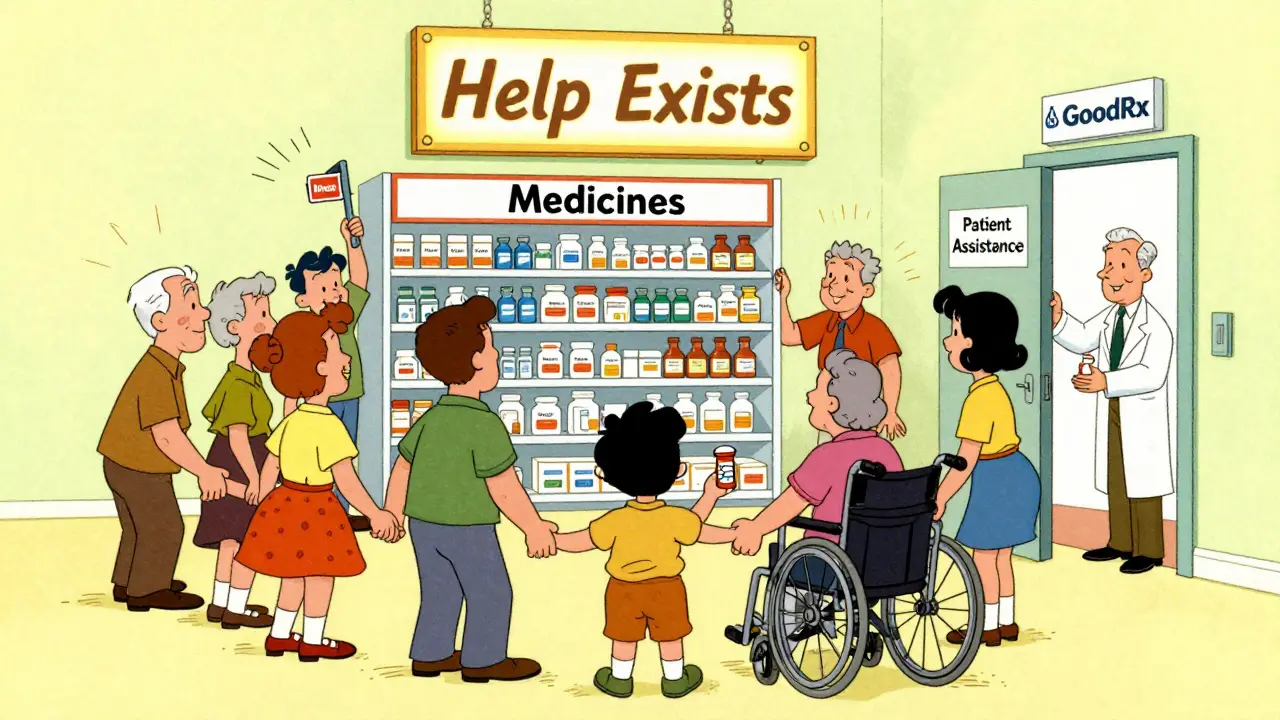
What You Can Do Right Now
If you’re skipping doses because of cost, you’re not alone. But you’re not powerless. Start by talking to your doctor. Say: “I can’t afford this. Can we find something cheaper?” Most doctors now ask about cost-65% do it routinely, up from 42% in 2019. They want to help. You just have to speak up. Download GoodRx. Call your pharmacy. Ask if they have a discount program. Check Patient Services Inc. or the Partnership for Prescription Assistance. These organizations connect people with free or low-cost meds. Don’t wait until you’re sick. Don’t wait until your blood pressure spikes or your blood sugar crashes. The system is broken-but help exists. You just have to reach for it.Frequently Asked Questions
What if I can’t afford my medication but don’t qualify for government help?
Many pharmaceutical companies offer patient assistance programs even if you earn slightly above the poverty line. Visit NeedyMeds.org or contact the drug manufacturer directly. Some programs accept applicants up to 500% of the federal poverty level. Also, check local community health centers-they often have free or sliding-scale clinics that can provide prescriptions at low cost.
Can I switch to a generic drug without losing effectiveness?
Yes. Generic drugs contain the same active ingredients as brand-name versions and are held to the same FDA safety and effectiveness standards. In most cases, they work identically. The only differences are in inactive ingredients, packaging, and price-often 80-85% lower. Always ask your doctor or pharmacist if a generic is available and appropriate for your condition.
Why do pharmacy prices vary so much for the same drug?
Pharmacies negotiate different prices with insurers and wholesalers. Some charge retail prices, others use discount programs. A drug might cost $120 at one pharmacy, $45 at another, and $25 with a GoodRx coupon. Always compare prices before paying. Use apps like GoodRx, SingleCare, or RxSaver to find the lowest local price.
Is it safe to split pills to save money?
It can be, but only if your doctor approves it. Not all pills are safe to split-especially extended-release, coated, or capsule forms. Splitting can change how the drug is absorbed. If you’re considering this, ask your pharmacist first. They can tell you if your medication can be safely split and recommend a pill splitter for accuracy.
What should I do if my insurance denies coverage for my medication?
Request a formulary exception from your insurer. Your doctor can submit a letter explaining why the medication is medically necessary. Many denials are overturned this way. You can also appeal the decision in writing. If you’re struggling, contact your state’s insurance commissioner’s office-they often have patient advocates who can help.
Isaac Bonillo Alcaina
December 23, 2025 AT 20:47Let’s be real-people who skip meds because they can’t afford them aren’t ‘lazy.’ They’re just trying to survive. But the fact that we’ve normalized this as ‘personal responsibility’ is disgusting. This isn’t a moral failing. It’s systemic violence dressed up as healthcare. If your life depends on a pill that costs more than your rent, the system is broken. Not you.
And don’t even get me started on ‘GoodRx.’ It’s a band-aid on a hemorrhage. You’re telling someone who’s choosing between insulin and their kid’s lunch to download an app? That’s not help. That’s exploitation with a UI.
Pharma CEOs made $1.2 billion in bonuses last year while seniors split pills. The math doesn’t lie. It’s criminal. And no, ‘patient assistance programs’ aren’t a solution-they’re PR stunts with a 12-month waiting period and 37 forms you need to notarize while you’re dying.
I’ve seen people die from this. Not ‘eventually.’ Not ‘in a few years.’ Right now. Today. In this country. And we’re still arguing about whether they should’ve ‘managed better.’
Stop praising the system. Start burning it down.
Sidra Khan
December 24, 2025 AT 04:36Wow. So now we’re supposed to feel bad for people who can’t afford meds? What about the people who spend $200 a month on weed and energy drinks? Or the ones who buy a new iPhone every year? I’m not saying they don’t deserve help-but why should I pay for someone else’s bad choices?
Also, insulin isn’t $800. That’s a myth. It’s $30 at Walmart. If you don’t know that, you’re not informed-you’re just angry.
And yes, I used 🤦♀️. You’re welcome.
Andrea Di Candia
December 25, 2025 AT 22:55I’ve been on blood pressure meds for 8 years. Last year, my copay jumped from $15 to $85. I didn’t skip doses-I just ate less. A lot less. I lost 20 pounds. My doctor didn’t notice until my BP spiked. When I told her I couldn’t afford it, she immediately switched me to a generic. It worked. Same results. Same side effects. Same life.
But here’s the thing: she didn’t ask. I had to say it. Out loud. In front of her. And I was terrified she’d think I was lazy or dramatic. I’m not. I’m just broke. And I’m not alone.
So if you’re reading this and you’re scared to say ‘I can’t afford this’ to your doctor? Say it. They’ve heard it a hundred times today. And they’ll still respect you. Probably more.
Also-GoodRx saved me. Not because it’s perfect. But because it’s free. And sometimes, free is enough to keep you alive.
claire davies
December 27, 2025 AT 15:48Over here in the UK, we don’t have this problem-because we don’t treat medicine like a luxury good. We don’t have to choose between insulin and heating. We don’t have to split pills because our insurance ‘tiered formulary’ decided your condition isn’t ‘priority enough.’
But I’ve seen this same pain in India, where my cousin’s aunt rationed her diabetes meds because the monthly cost was more than her daily wage. And I’ve seen it in the Philippines, where a friend’s father died from untreated hypertension because the clinic ran out of stock-and the private pharmacy charged $150 for a 30-day supply.
This isn’t an American problem. It’s a capitalist problem. Where profit is prioritized over personhood. And while the Inflation Reduction Act is a step, it’s still just a step. We need a whole new path.
Also, I’ve used GoodRx. It’s magic. But it shouldn’t be necessary. That’s the real tragedy.
Katie Taylor
December 28, 2025 AT 09:05Enough with the ‘poor people’ narrative. This isn’t about poverty. It’s about entitlement. People think medicine should be free because they ‘deserve’ it. But guess what? Nothing is free. Someone pays. And that someone is you. The guy working two jobs to afford his own meds. The single mom who skips lunch so her kid can have insulin.
Stop begging for handouts. Start demanding accountability-from pharma, from politicians, from the system. But don’t act like you’re a victim because you didn’t plan ahead. You don’t get to cry about the cost when you spent your paycheck on Netflix and TikTok.
And if you’re splitting pills? Stop. You’re not being clever. You’re being dangerous.
Bhargav Patel
December 29, 2025 AT 14:24It is a matter of profound regret that in a nation possessing the highest per capita healthcare expenditure globally, the fundamental right to therapeutic access remains contingent upon socioeconomic status. The phenomenon of cost-related nonadherence is not merely a clinical issue, but a sociopolitical indictment of the market-driven paradigm that governs pharmaceutical distribution.
Empirical data from the CDC, WHO, and NEJM collectively affirm that financial toxicity is the primary determinant of medication discontinuation, particularly among marginalized populations. The existence of discount platforms such as GoodRx, while commendable, functions as a palliative intervention rather than a structural remedy.
It is imperative that policy reform be enacted with the urgency of a public health emergency. The current model, wherein pharmaceutical patents are extended through evergreening and rebate systems incentivize high list prices, is ethically indefensible. We must transition toward a publicly regulated pricing framework, modeled upon the Canadian and German systems, wherein therapeutic necessity supersedes shareholder value.
Until then, the moral burden of survival is placed upon the shoulders of the vulnerable. This is not healthcare. This is exploitation.
siddharth tiwari
December 30, 2025 AT 04:47you think this is about money? nah. its about the gov and big pharma putting tracking chips in the pills so they can monitor your emotions and control your thoughts. i know a guy who got his insulin and then his wifi stopped working for 3 days. coincidence? i think not.
also goodrx is a scam. they get paid by pharma to push certain drugs. your data is sold to the cia. they know when you take your meds. they know when you skip. they know when you cry.
just stop taking pills. go to the forest. eat mushrooms. your body knows what to do. the system is lying to you.
suhani mathur
December 30, 2025 AT 09:41Oh sweet summer child. You really think the solution is ‘ask your doctor’? Let me guess-you’ve never had to sit in a 45-minute wait for a 7-minute appointment where the doctor scrolls through their phone while you try to explain why you haven’t taken your meds in three weeks because your rent increased $300.
Here’s the truth: 80% of doctors don’t ask about cost. The other 20% just say ‘try GoodRx’ and move on. And those patient assistance programs? They require 17 documents, a notary, and a blood oath. Good luck getting that done while working two jobs and caring for your grandma.
So yes, split your pills if you have to. Use GoodRx. Call your pharmacy at 7am. Do whatever it takes. Because no one’s coming to save you. Not the system. Not your doctor. Just you.
And if you’re lucky? You’ll survive long enough to see the system collapse. Which, honestly? It’s coming.
Diana Alime
December 31, 2025 AT 09:30imagine being so broke you have to split pills 😭
my dog gets better meds than me and he’s a chihuahua named benny. i cried in the pharmacy today. my bp med was $140. i walked out with nothing. now i’m just hoping i dont have a stroke before i turn 30.
also i tried goodrx. it said $35. then at the counter it was $98. so now i hate tech too.
someone pls send help. or at least a sandwich. i’m hungry and my heart is screaming.
Bartholomew Henry Allen
January 1, 2026 AT 08:04Medicare cap at $2000 is a start. But the real issue is foreign drug manufacturers undercutting American production. China and India are flooding the market with cheap generics. This is a national security threat. We need to bring pharmaceutical manufacturing back to America. Protect our workers. Secure our supply. Stop outsourcing our medicine to communist regimes.
Also stop whining. If you can’t afford your pills, you shouldn’t be alive. Survival of the fittest. That’s how evolution works.
USA. USA. USA.